Read this article in ʻŌlelo Hawaiʻi
Na Noah Gomes, Ethnographer, SHPD
In late 2025, a long-hidden lava tube was accidentally discovered in the South Kona district of Hawaiʻi Island. It offered a rare and valuable glimpse into Hawaiʻi’s deep past. Sealed by a pāhoehoe flow 9,000-10,000 years ago, this lava tube had apparently never been touched by human hands. No evidence of any kind of human use could be found, there were no kiʻi (petroglyphs), no tools, no fireplaces, no burials, nothing.
What was found were seven sets of sub-fossil animal skeletons – all believed to be ancient birds native to Hawaiʻi. Sub-fossils are very, very old bones that have started to mineralize into fossils, but have not completely become fossils yet. Among these was a peculiarly large set of bird bones that stood out among the others. Archaeologists who responded to the scene contacted the Hawaiʻi Department of Land and Natual Resources (DLNR) State Historic Preservation Division (SHPD).
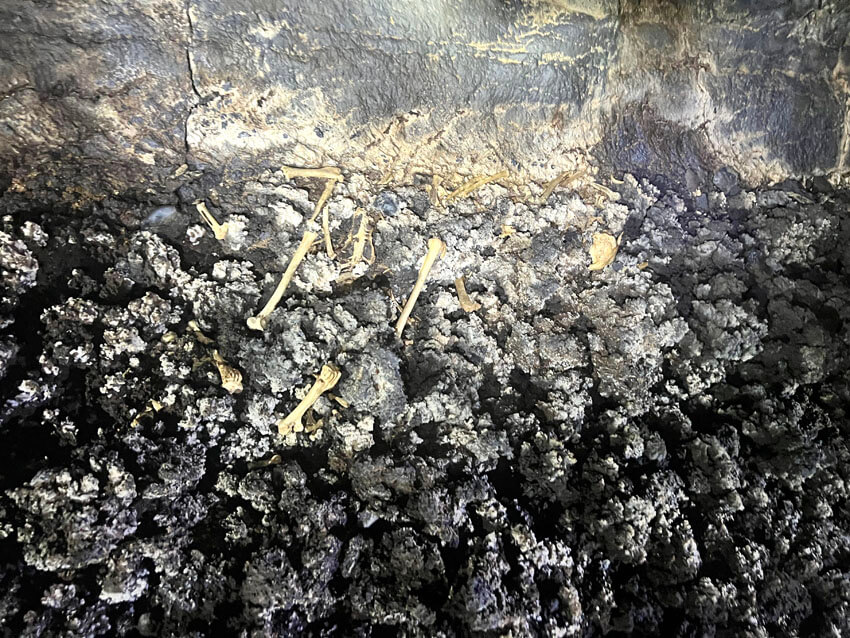
SHPD’s response team sent a photograph of this unusual bird to Dr. Helen James, Chair of Vertebrate Zoology at the Smithsonian National Museum of Natural History. Dr. James immediately identified the bird as a “beautiful specimen of the extinct flightless goose Branta rhuax,” a bird that only ever lived on Hawaiʻi Island and whose bones have been found in a handful of other caves in Kaʻū, Kona, and Kohala.
Branta rhuax was large – 4.3 times heavier than its living relative, the nēnē, and had massive legs and tiny wings. This goose died out soon after the ancestors of Native Hawaiians arrived to this island and has never been recorded by scientists in life.
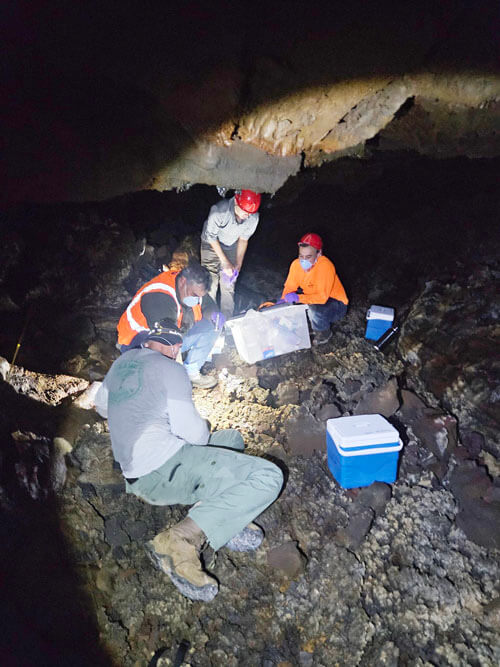
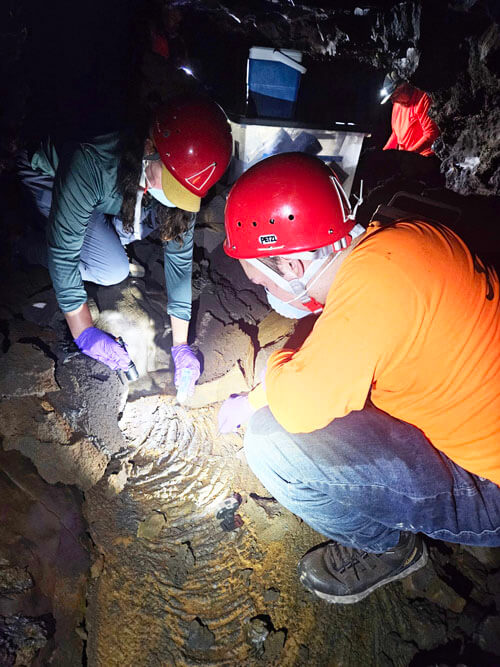
Realizing that this was a rare discovery and that important information about the past might come from these sub-fossil birds, a coordinated effort between the U.S. Forest Service (USFS), archaeology firm ASM Affiliates, the DLNR’s Division of Forestry and Wildlife (DOFAW), and SHPD was convened to recover the birds from the cave.
The recovery efforts were led by Dr. Kealoha Kinney of the USFS, who had experience working with Dr. James under similar circumstances in the past. The team was also led by Matt Clark of ASM Affiliates, who did an initial survey of the cave to confirm the nature of its contents. Other participants included ASM’s Steel DʻAlonzo Jaques, DOFAW’s Steven Bergfeld, and SHPD’s response team: Nicole Mello, Traven Apiki, Sean Naleimaile, and myself. The state employees assisted in the recovery mission, which took several hours to complete under unusually humid, hot, and oxygen-poor conditions.
The lava tube itself was fairly large. In most places the ceiling was tall enough for a man to walk through, though some tighter spots required crawling. Previous rock-falls from the ceiling littered the ground in certain areas. Near the Branta rhuax skeleton a former entrance to the cave could be seen, sealed by lava thousands of years ago. Remarkably, the bones of this large, flightless goose were mostly articulate; its legs, chest, wings and neck were all still in the same position as they would have been when it passed away. Only the beak seemed to be missing.
Because Branta rhuax disappeared so long ago, we don’t know today what our ancestors might have called it. There is also no modern Hawaiian name that has been given to it. Much about this bird is still a mystery. The other birds found in the cave have yet to be identified by scientists.
Time to study this unique time-capsule may be short, and the future of the cave itself is uncertain. In the meantime, Dr. Kinney continues to study the area, and has made several new, additional discoveries of invertebrate remains, ancient wood, and soil deposits that will likely yield new incredible insights to life in Hawaiʻi 10,000 years ago.