“Voyaging takes us into a place that only our ancestors have been,” Lucy Lee reflected. “On the deck of the canoe, especially on longer voyages, you’re transcended back into how they felt and the way that they lived.”

Lee is the volunteer coordinator for the Polynesian Voyaging Society (PVS) and a crew member who has already completed six voyages. Part of “Gen Z,” she is also an emerging leader in the organization. “I just turned 25, so I’m half the age of the [first] voyage and the canoe,” she quipped.
When Hōkūleʻa arrived in Papeʻete, Tahiti, 50 years ago no one could have fully predicted the impact that this achievement would have – not only on Hawaiʻi, but on all of the peoples of Moananuiākea.
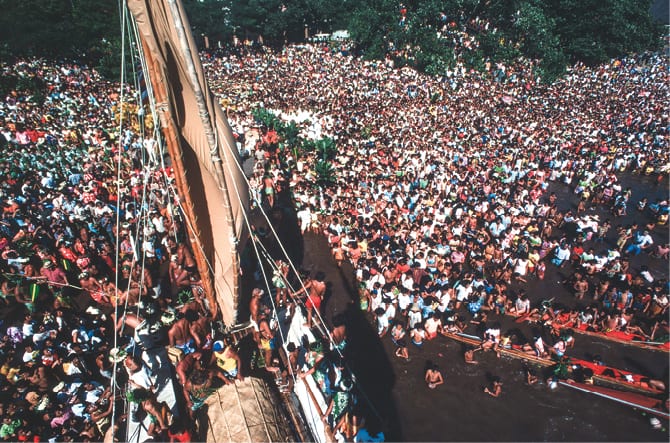
On June 4, 1976, more than 17,000 people gathered on the beach at Papeʻete Harbor – some paddling outrigger canoes or swimming out to greet the first voyaging canoe from another Pacific archipelago to arrive on the island in more than 600 years. It was a homecoming unlike anything before or since.
In the 50 years since her maiden voyage, Hōkūleʻa has sparked cultural pride and rediscovery across Oceania, inspiring generations and birthing the Pacific-wide revival of wayfinding and open-ocean voyaging.
Matahiarii Tutavae, a Tahitian journalist from the island of Moʻorea and a PVS crew member, was born several years after Hōkūleʻa made her historic landing in Papeʻete but heard about the event growing up.
“The first voyage was really impactful [because it proved] that it could be done,” Tutavae said, referencing the debunked early 20th century theory of “accidental drift.”
Over the years, as Hōkūleʻa continued voyaging to Tahiti, he observed a renewed relationship forming – and a new perspective of not just being Tahitians, but being a people of the ocean.
Tutavae points out that Hōkūleʻa and voyaging also affirmed that our ancestors were scientists. “That’s something we didn’t hear about. It was always myths and legends, and the scientific world was from elsewhere,” he said. “Now I see that. And it’s important. Our people were here for thousands of years so they have scientific knowledge based on observation, on empirical evidence.”
In 1985, Hōkūleʻa sailed to the Cook Islands for the first time on her Voyage of Rediscovery. Her visit inspired former Cook Islands Prime Minister Sir Tom Davis to found the Cook Islands Voyaging Society in 1992. He designed and built the Society’s first replica canoe, Te Au o Tonga, in 1994.
“Fortunately for us in Tahiti, in 2007 a German by the name of Dieter Paulmann saw Te Au o Tonga sail into Sāmoa,” Tutavae recounted. Excited by the crew’s use of traditional knowledge to navigate, Paulmann, a sailor himself and CEO of the Okeanos Foundation for the Sea, reached out to the Cook Islands Voyaging Society. Their collaboration resulted in the Okeanos Foundation financing the building of seven traditional waʻa in 2009 to support Pacific voyaging.
One of those canoes, Faʻafaite, was gifted to Tahiti. That same year, Tutavae helped to establish the Faʻafaite-Tahitian Voyaging Society and over the years, he has sailed on Faʻafaite throughout the South Pacific and to Hawaiʻi and back. He has also sailed on Hōkūleʻa, including during the Mālama Honua Worldwide Voyage (2013-2017).
From the beginning, PVS has focused on advancing the art and science of traditional voyaging through experiential educational programs designed to inspire current and future generations to care for themselves, each other, and the earth. Through voyaging, the organization aspires to educate all of humanity about the critical ecological importance of our oceans, Indigenous knowledge, community, and sustainability.
Under the guidance of venerated leaders like Pwo Navigators Nainoa Thompson, Bruce Blankenfeld and others, Hōkūleʻa has sailed more than 275,000 nautical miles relying on traditional navigation techniques, cementing her place in history and elevating awareness of and respect for the sophistication and depth of Indigenous knowledge.
Looking ahead, the next chapter of Hōkūleʻa’s story has yet to be written.
Lee believes that it will be critical for future generations of voyagers to approach the next 50 or 100 years with the same mindset as their mentors: keeping safety, reverence for the ocean, and aloha for our homes and culture at the center of decision-making.
As natural and existential threats to our oceans accelerate – from climate change, sea level rise and acidification of the oceans to microplastics in the marine food chain; from extractive commercial fishing to destructive deep sea mining – tomorrow’s voyagers will face different challenges than those who came before them.
“These things weren’t around 50 years ago. We will have to rise to the occasion and show the importance and relevance of voyaging to our youth. That is what’s in front of us,” Lee said.
“It’s about finding ways to remain relevant as the world around us continues to evolve and change.”
Despite the challenges facing future voyagers, there is also optimism. The international impact of Hōkūleʻa has been undeniably transformative – especially for the peoples of Moananuiākea.
PVS has a roster of more than 400 crew members from around the world. And there are now 25 voyaging canoes, 21 voyaging organizations, and more than a thousand active voyagers throughout 11 Pacific Island nations. As it did centuries ago, voyaging has once again reconnected Oceania.
“We used to say that ʻwe are island people.’ People from little islands,” Tutavae said. “Now it’s become ʻwe are people of this ocean.’ And as such, we are responsible for its wellbeing.”
Tutavae hopes that one day people on the continents – especially America, China and Europe – will come to understand Pacific people’s aloha for and relationship to the ocean.
“Although we are a big ocean, we are people who are connected to each other and to our ocean. We love our ocean. And we see it differently than the people who see it as a way to make money,” he added.
“Hōkūleʻa is no longer just a Hawaiian canoe. Borders are man-made and [designed] to control. But Hōkūleʻa and voyaging – in a very smart way – broke those borders. Is still breaking borders. And it’s not just borders between Melanesia and Micronesia and Polynesia. It’s also the borders we have in our minds,” Tutavae reflected. “Voyaging allows us to go beyond our genetics, beyond our looks or our names. This is something that is learned from Hōkūleʻa.”
“I think one of the most important parts about voyaging is that it’s communally shared. That’s a testimony to the people of the Pacific,” Lee said. “We only have this knowledge today because people from different places worked to ensure that this type of seafaring continued.”
When Lee thinks about the artificial divisions that have been placed between people groups – both self-inflicted and externally imposed – it reinforces her belief that we need to be more curious.
“Nainoa says there are two questions: Where are you, and where are you going? Another question is, where did you come from? You can’t emphasize enough how important of a role that Papa Mau [Piailug] had for the revitalization of voyaging – specifically in Hawaiʻi and then throughout the wider Pacific,” Lee asserted.
“Everything PVS has accomplished, and the story of Hōkūleʻa, it all leads back to the teacher.”
That aspect of Hōkūleʻa’s origin story is itself a lesson. The revival of Polynesian voyaging and wayfinding was made possible because a Micronesian navigator from Satawal was open to sharing his knowledge with Polynesians in Hawaiʻi – a testament to the way our connection as people of Oceania supersedes the political and anthropological divisions imposed on us over the past century.
“Throughout Moananuiākea there is a collective pride and joy that comes from being the people of this ocean and knowing that our ancestors held the same respect and affinity for one another,” said Lee.
“I’m sure that’s part of what kept voyaging alive for so many centuries. It’s inspiring that so many of our stories have ties to one another and it really does emphasize the point that the culture of Moananuiākea, and the culture of the people of the Pacific, is a shared one.”
“That idea that we’re all part of the same waʻa – which is earth – is becoming more real and making sense to a lot more people now,” added Tutavae. “I think we have something to share with the whole world.”