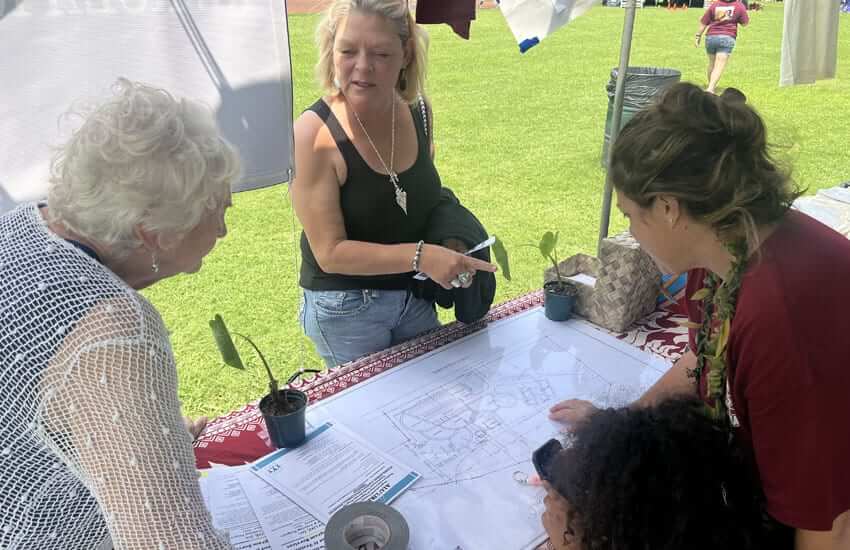
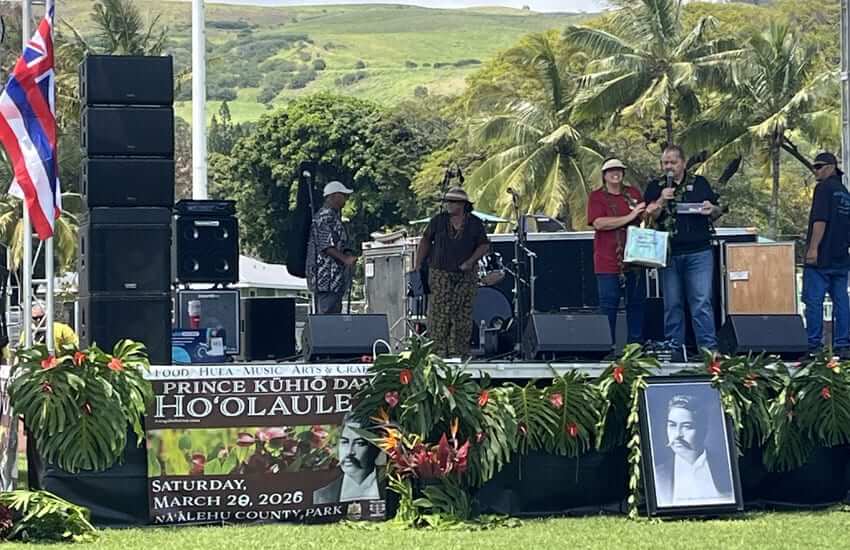
Plans for the Kaʻū Hawaiian Cultural Center are regaining significant momentum after being on hold for more than three decades.
“Back in the day the first time we started, the whole idea was for keep our people here,” says Kaʻū native Dane Shibuya, “We had kūpuna, so their grandbabies, they no like them move away. Us, we had small kids growing up, we no like them move away. So, we gotta come together as one.”
It was 1994 and the Kaʻū Sugar Plantation had announced its impending closure after more than a century of operation. Shibuya and other Native Hawaiians from across Kaʻū founded the nonprofit Hana Laulima Lāhui O Kaʻū.
“The whole point was that we had one guy from each town,” says Shibuya, a third-generation pig farmer and retired county police officer from Nāʻālehu.
Hana Laulima’s mission was to build a sustainable, community-driven economy while preserving the cultural integrity and environmental resources of Kaʻū. The Kaʻū community saw a need for development and jobs that work in harmony with the people, for the people, and by the people. The group gathered community input and the Kaʻū Hawaiian Cultural Center was born.
By 1997, Hana Laulima secured partial funding and drawn up plans for the project as a community-centered facility designed to revitalize the economy and preserve Native Hawaiian culture. Due to circumstances beyond the group’s control, the work on KHCC halted in the late 90s.
That didn’t stop Shibuya and his wife, Terry-Lee, from continuing to provide cultural workdays for keiki and ‘ohana at their family business, Masazo’s Pig Farm, in Nāʻālehu.
“We get our program with the kids here; our own local kids do the imu. They tell me, ‘Oh Uncle, first time I see one imu.’ Right there, hurt me because 90% [of these kids] never see one imu!?” Shibuya says “The cultural preservation is a must because we’re losing the culture.”
Native Hawaiians living in Kaʻū today are descendants of some of the most resilient, and fiercely independent people on Hawaiʻi Island. The rugged landscape and bountiful shores have provided generations with a lifestyle closely tied to the land and sea.
Today, Kaʻū remains one of Hawaiʻi’s most underserved communities with a little more than 9,400 residents spread out across 922 square miles. More than 34% of residents live in poverty, with limited access to education and health resources, and a complete absence of Hawaiian language or culture-based schools. As a designated food desert and rural community, Kaʻū also lacks infrastructure to support small business development and workforce training, particularly in culturally aligned and environmentally sustainable sectors.
The Kaʻū Hawaiian Cultural Center may be the answer.
Hana Laulima is currently seeking legislative support for Phase 1 of the Kaʻū Hawaiian Cultural Center. This first phase would include the construction of a Community Learning Center equipped with technology and learning labs, a Certified Teaching and Production Kitchen to support food entrepreneurs, and a Cultural Art Gallery and Community Store for local artisans and microenterprises.
The group is working closely with state Sen. Dru Kanuha and state Rep. Jeanne Kapela on the $7.5 million state Grant-In-Aid request for Phase 1.
“They are onboard and they are trying to help us build this Kaʻū Cultural Center at the Waiʻōhinu area,” says Terry-Lee.
Hana Laulima is also in lease negotiations with the state Department of Hawaiian Home Lands for 10.4 acres in Waiʻōhinu, Kaʻū.
“[In May], we find out about locking the lease. We’re hoping long-term for the people of Kaʻū,” says Terry-Lee.
Kapela called the project a “truly transformational opportunity for Kaʻū.”
“Kaʻū is one of the most remote regions in the state, and our residents are incredibly resilient,” says Kapela, “Beyond the cultural center itself, there is exciting potential to expand its impact through the development of a certified kitchen and a value-added facility. These efforts could create a lasting legacy, positioning our rural community as an economic and entrepreneurial hub for farmers, ranchers, and small business owners across Hawaiʻi Island.”
Shibuya says, “We wanna do that value-added one they have in Waipahu. We want to bring that model down here right next to our cultural center. They can package their products, label it, and sustain their families.”
Terry-Lee says the best part is that the cultural center can sustain itself economically by leveraging Waiʻōhinu’s proximity to the Hawaiʻi Volcanoes National Park.
“Get the malihini, the tourism. A million something people pass through Kaʻū on their way to go to Volcano. Even if they spend one dollar, that’s one million dollars,” says Shibuya.
For Shibuya, the project is about more than just infrastructure and tourism; it is a promise kept to the kūpuna of 1994. By building a place where the culture is lived rather than just remembered, Hana Laulima is ensuring that youth of Kaʻū no longer have to leave their roots to find their future.