
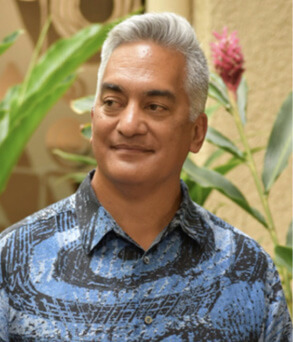
By Herman Piʻikea Clark
We are not waves. A wave is moved by forces outside itself, carried wherever the water pushes, spending itself on a shore it did not choose. Kānaka have never been that. We are the people who looked at the largest ocean on earth and chose to cross it – who read the stars and the swells and set out on purpose, carrying everything we were in the hull of a canoe. Hawaiʻi sits at the northern apex of Polynesia because our ancestors voyaged to reach it.
Movement is not something that happens to us. It is something we do, and have always done, and it is written into who we are.
I am one of the Hawaiians who left. I have spent much of my adult life away from the Islands – in Aotearoa and now in Canada – teaching, building programs, and mentoring young Indigenous scholars.
I know that for some at home, a Hawaiian who lives abroad can invite a quiet question: are they still truly one of us? I want to answer that question – not for myself alone, but for all of us who have gone out. The answer is older, and prouder, than the question.
Consider Henry ʻŌpūkahaʻia. Born in Kaʻū around 1792 and orphaned young, he boarded a ship as a teenager and sailed all the way to Connecticut. There, far from any face that knew him, he hungered for learning and began the work of setting his own language down on paper. He longed to bring that learning home.
He never made it; typhus took him in 1818, at age 26. But his last words, spoken in a New England winter, were “Aloha ʻoe” – my love be with you. His body lay in Cornwall for 175 years, until his people brought him home to Kona in 1993. One of the first of us to venture out carried Hawaiʻi within him to his final breath – and in the end, Hawaiʻi brought him home.
He was not the last. Through the 19th century, Kānaka shipped out aboard whaling and trading vessels and earned a reputation for being among the finest seamen afloat. Many settled along the Northwest Coast of the American continent, married into the Native nations there, and became beloved of them. They were called Kanaka – and they wore the name gladly. It stuck.
You can still find it written across the map, up and down the coast of British Columbia and inland: the homeland, planted wherever our people came to rest. Generations later, their descendants still turned their faces toward Hawaiʻi. A people do not leave their name across a coastline because they have forgotten themselves. They do it because they carry home so completely that they leave a piece of it everywhere they land.
And we did not only sail outward on others’ ships. We sent ourselves, deliberately, as a matter of national purpose.
Between 1880 and 1892, King Kalākaua and the Hawaiian Kingdom dispatched 18 young Hawaiians to study in six countries – Italy, Scotland, England, China, Japan, and the United States – in the program known as Hawaiian Youths Abroad.
They studied engineering, medicine, art, music, and military science, chosen to become the leaders of an independent nation. The going out was not exile; it was a commission from the crown. They were sent to gather the knowledge the lāhui needed – and to show the world that here was a nation of character, intellect, and talent, fit to stand among the nations of the earth. They were our representatives. We have never stopped sending them.
My own family is woven into this same current. My father, Herman Piʻikea Clark – whose name I carry – and his older brother, my uncle James Kalaeone Clark, both went from Punahou to Oregon State and into the National Football League.
My father, an all-pro guard for the Chicago Bears in 1955 and 1956, was later named to the NFL’s Half- Century team. Decades after his passing he was inducted into the Polynesian Football Hall of Fame by a committee that knew him only by reputation. My uncle, a guard for the Washington Redskins, came home to serve his people in the Hawaiʻi Legislature.
My great-uncles Duke and Sam Kahanamoku stood on Olympic podiums, Duke with three gold medals among the five he won across three Games, the brothers sharing the stand together at Paris in 1924. They competed against the whole world and beat it. Duke lived many years on the West Coast and carried Hawaiʻi with him wherever he went, becoming the man who gave surfing to the world. Not one of them became a drop less Hawaiian for having gone.
Even our treasures have made this journey and kept their meaning. In Chicago, Kulamanu McWayne Nash – a woman of aliʻi descent, connected by blood to Queen Liliʻuokalani herself – kept the kāhili, the feathered royal standards of our chiefs, through a lifetime far from home.
She carried her lineage and her mana with her, held these treasures in trust across the years away, and in 1949 gave them onward, knowingly, as Hawaiian things. The mana traveled. It was held, honored, and passed on. That is not the story of a people losing themselves at a distance. It is the story of a people keeping faith across one.
I left for the same reason my ancestors did: because the work I was called to do required knowledge that, at the time, I could not pursue at home. Years ago, I made the first attempt to begin a Native Hawaiian art and design course at the University of Hawaiʻi – the first taught from an Indigenous Hawaiian perspective – and it took root, carried forward by others after me.
But the deeper questions I needed to ask reached beyond what the institution, as it then was, could hold. I looked to Canada, to Australia, to programs across the United States, and I came to a clear conclusion: the world leader in the indigenization of higher education and the decolonizing of arts education was Aotearoa.
I was fortunate to be invited to live and work there as an academic, and there, as a Kanaka Maoli scholar, I earned my doctorate – supported and encouraged to study from within my own knowledge system. I stayed 20 years. I did not leave Hawaiʻi behind. I went to fetch what Hawaiʻi had sent me for.
And I am in good and current company. Kānaka Maoli now hold some of the most distinguished posts in the world.
Kēhaulani Kauanui is the Eric and Wendy Schmidt Professor of Indigenous Studies at Princeton University. Noelani Arista directs the Indigenous Studies Program at McGill, one of Canada’s finest universities, where she organizes Hawaiian knowledge for a new century. The baritone Quinn Kamakanalani Kelsey based in Chicago is the premier Verdi baritone of his generation; he has sung the title role in Verdi’s Rigoletto on the great stages of the world, and not long ago came home to sing in ʻōlelo Hawaiʻi. I had the privilege of sitting in the audience in Toronto for his Rigoletto, swept up and overawed by the power and presence of that Hawaiian voice filling the hall.
These are not disconnected Hawaiians. They are among our finest – our leading minds and voices in the very fields of our excellence, representing the lāhui on the world’s largest stages.
This is why I believe we should think differently about our diaspora. With more Hawaiians now living away from the Islands than within them, the old anxiety – that to leave is to fade – has things exactly backward.
We are not refugees, scattered and diminished. We are voyagers and carriers, doing what we have always done: going out into the world and bringing our culture, our kūpuna, and our way of seeing with us, as a gift we give wherever we land.
Our diaspora is not a weakness to be explained away. It is an exemplar of our strength, our resilience, and our continuing excellence proven, as it has been for two centuries, in open competition on the world stage.
So, when someone asks whether a Hawaiian who lives abroad is still truly Hawaiian, I think of ʻŌpūkahaʻia with aloha on his lips in the Connecticut cold, and of the seamen who left our names along a far coastline, and of Kalākaua’s young scholars sent out to announce a nation. I think of a king who understood that to love your country can mean crossing an ocean for it.
We have always gone out. We have always carried home with us. And like ʻŌpūkahaʻia, in the ways that matter most, we always find our way back. We are voyagers still.