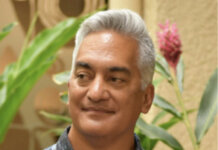
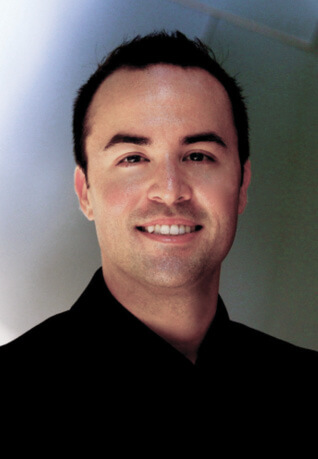
Rickey Hauʻoli-De Ponte Badua first sat in front of a piano at age 4. His teacher and babysitter, Estrellita Goulart, instructed him on notes and keys, chords and hand positions.
“That started my musical career,” Badua said.
Today, at 41 years old, he’s the director of bands and professor of music at California State Polytechnic University, Pomona. The Pasadena resident serves as a music adjudicator in Drum Corps International and the SoCal state chair for the College Band Directors National Association. Badua’s students leave rave reviews for him online.
“One of the kindest and most caring professors I have ever had,” a pupil wrote. “He truly wants his students to succeed and is always happy to help.”
Badua is also involved with Nā Koa Aliʻi Hawaiʻi All-State Marching Band and co-founded Aloha Music, a music education nonprofit. He created the Hawaiʻi wind band consortium to commission James M. David to compose E Ala Ē: Arise and Awaken, a song that is now played worldwide. He’s traveled to Thailand, Costa Rica, Australia and Spain as a guest conductor.
But Badua’s litany of accomplishments all started with one question. Goulart asked Badua, then 5, if he wanted to continue his piano lessons.
“I was confused because I was just like, ʻWell, why wouldn’t I continue?’” he said. “That’s how I knew music was an innate thing inside of me that I’ve always loved and was drawn to.”
Born in Honolulu, Badua’s earliest memories are of living in Kalihi with his maternal grandparents. “I remember being happy in that space,” he said.
The kūpuna of his mother, Elizabeth De Ponte Costa, immigrated to Hawaiʻi from Funchal, Madeira, and Porto, Portugal, to work in the sugar industry. Many relatives became paniolo in Waimānalo and Waiʻanae.
His father, Remigio Badua, was a descendant of Filipinos, Kānaka Maoli, Ukrainians and Poles.
After his parents divorced, Badua’s mom worked two jobs as a waitress and a bartender to support his ʻohana. He is one of four, plus has two half-sisters.
Throughout his childhood, Badua enjoyed music classes and soccer and dreamed of becoming a conductor one day. When he took part in the Kamehameha Schools Explorations Series, Badua relished learning how music, art and mele intersect with Hawaiian culture.
After his mother married Badua’s stepfather, Alan Costa, they moved to the suburbs of Waipiʻo Gentry. Costa, who was a Kamehameha Schools alumnus, encouraged Badua to apply to the school. He was admitted and started at the Kapā- lama campus in seventh grade.
“That completely changed everything else in my childhood,” Badua said. “It opened up so many cultural pathways that also fed my musical talents.”
He immersed himself in choir and band, playing trombone and serving as a drum major. Badua’s budding musical pursuits took him to the American West Coast and Europe. He recalled his first visit to Pasadena for the Rose Parade in his junior year. Marching down Colorado Avenue on the parade route, Badua admired the city.
He thought: “I would love to someday live here when I grow up.”
Badua’s career goals evolved into being a band director. He hoped to lead and support great musicians. Taking honors and advanced placement courses, he was set on attending college outside Hawaiʻi.
“I knew I wanted to get out and learn more about who I was and to see more of the world,” Badua said.
He applied to Boston University in Massachusetts, Ithaca College in New York, and the University of Puget Sound in Washington. After graduating from KSK in 2003, Badua was bound for the Pacific Northwest.
In Tacoma, Washington, he pursued a Bachelor of Music in music education. Badua studied conducting and performed as a trombonist with the orchestra, the jazz band and the wind ensemble. But it was in the school’s Hawaiʻi Club where he met his first friends.
“I can’t lose who I am,” Badua said.
Despite a heavy course load, he finished his undergraduate studies in three years. Badua’s mentor, Robert Taylor, encouraged him to pursue higher education to fine tune his musicianship. Badua earned his Master of Arts in teaching in 2007.
“I knew what I wanted to do, and I didn’t want to wait,” he said.
From there, Badua taught at Peninsula High School in Gig Harbor, Washington, as its band director. The community was hugely supportive of his aim to build out a music program. Badua also faced a cultural learning moment as an educator: better understanding socioeconomic diversity among his pupils.
Pursuit of a Doctor of Musical Arts in wind conducting – and another mentor, John Lynch – led him to the University of Georgia in Athens. There, he worked as a teaching assistant, traveling to Russia for research and accompanying the college marching band around the U.S.
But differing cultural norms, including blatant racism, challenged Badua during his three years there.
“I’ve learned how to adapt to survive,” Badua said.
After graduating in 2014, he secured a job as a tenure- track faculty member at Cal Poly Pomona. “It’s like winning a lottery ticket in academia,” Badua said. He was hired as an assistant professor and director of bands.
When the COVID-19 pandemic hit, Badua marinated on how to bring more meaning to his work, concluding that “there aren’t enough Native Hawaiian voices in the work that I do.”
Five years ago, Badua stepped up to the challenge. He’s commissioned new music featuring Kānaka. His nonprofit, Aloha Music, is focused on creating spaces for haumāna across Hawaiʻi.
“Not every island has the same opportunities,” Badua said. “There is a need for more support and opportunities for neighbor island students.”
For now, he is focused on growing away from the ʻāina, to bring that ʻike back.
“I was born on the island, and I will die on the island,” Badua said. “When I do come home eventually, I can give a wealth of things that will only elevate the future of Hawaiʻi.”