
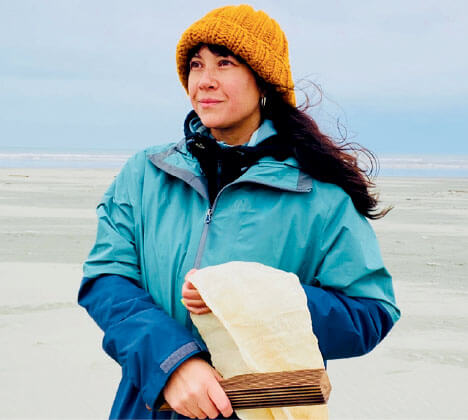
Malia Peoples, 45, has never shied away from being her own person.
Growing up in Olympia, Washington, during the days of grunge and riot grrrl (a 1990s underground feminist punk movement), Peoples recognized that she stood out from the homogeneity of the local Caucasian community. In second grade, a young Peoples wrote: “I look different than everybody else here.”
But “I didn’t try to, like, hide or shrink myself,” the Seattleite added. Instead, Peoples has consistently embraced her differences – a quality that has furthered her time and again as an artist, a student and a teacher.
“I’ve lived a lot of life somehow,” she said.
Born in 1980, Peoples is the descendant of Oregon loggers and farmers on her father’s side and Kānaka Maoli and Hakka Chinese on her mother’s side. Her mom, Harriet Kaholokula, met her dad, Philip Peoples, as students at Central Washington University.
Peoples is the youngest of three and the only daughter. Though her parents lived on the continent, a hāpai Kaholokula flew to Hawaiʻi with the hopes of giving birth to Peoples on the ʻāina. “For her, it was very important that we were all born there as Hawaiians,” Peoples said.
But Peoples entered the world on her own time in Yuba City, California. Her ʻohana resettled in Olympia when she was 3 years old. Her parents sold the trailer park they owned and managed, then they bought several ice cream stores, running Baskin-Robbins locations in Washington State from Tacoma to Centralia. Peoples remembers helping decorate the iconic clown cones.
In kindergarten, Peoples was asked what name she wanted to be called. She answered with her inoa Hawaiʻi, Malia. “I always knew that I was a Hawaiian person,” she said.
Peoples was a keiki of many passions. She once dreamed of being a choreographer because she loved to dance and took ballet for many years. She played piano and saxophone in the band and nurtured a budding interest in languages.
At Capital High School in Olympia, Peoples felt that she knew everyone, and everyone knew her. She sported combat boots and dyed her hair blue, orange and purple. Peoples frequented thrift stores and was enamored with Japanese street fashion.
“I was, like, this weird Pacific Northwest Kanaka punk,” she said.
After meeting a Chinese teacher through an exchange program, Peoples took a few trimesters of Mandarin and was extended the opportunity to attend Tsinghua University in Beijing.
She graduated high school in 1998, and, one week after turning 18, she was off to China. Peoples called it “life changing.” Over a year and a half, she traveled and learned more about her ancestors from southern China. Peoples completed a program at the Beijing Language and Culture University.
At the dawn of the Y2K era, she enrolled at the University of Hawaiʻi at Mānoa. Freshly returned from China, Peoples felt culture shock in reverse.
She moved on to Seattle Central College before transferring to the University of Washington as a junior. She graduated in 2004 with a bachelor’s degree in Chinese language and literature.
Her goal: To work as an interpreter.
Peoples headed to New York City for an internship at China Labor Watch, a nonprofit that reports on labor conditions at Chinese factories. She split her time between the Manhattan office and her residence in the Queens neighborhood of Flushing. Peoples translated documents smuggled out of China into English.
“Through that whole experience, I started to realize how harmful production was to workers overseas,” she said.
It prompted her decision to go to New York Fashion Academy in Seattle. She learned how to operate a sewing machine, make patterns and other skills. Peoples finished the program with a certificate in fashion design and construction in 2007.
She stayed to teach sewing, pattern making, grading and product development for 8 years. Peoples also served as a teaching artist at the Seattle Art Museum, Atlas Obscura and the Seattle Public Library, as well as a sewing and ceramics teacher at The Northwest School’s summer program. Peoples has also worked with the Seattle Housing Authority to teach refugees how to sew and repair clothing.
“I’m not trying to gatekeep knowledge,” she said. “I’m trying to share it as much as possible.”
In 2011, she launched her brand, Other Peoples Polyester, a line of clothing and accessories made of vintage, reclaimed and designer fabrics. Two years later, she got her own workspace studio in the Belltown neighborhood.
Feeling burnt out from clothes, in 2018 Peoples branched out to explore porcelain jewelry-making.
During the COVID-19 pandemic, she was drawn to learn more about her Kanaka roots – particularly through kapa making. She received a grant to travel to Oʻahu and learn kapa. While Peoples doesn’t have a kumu yet, she’s sat with several expert practitioners.
“I have learned about the process of turning a tree into fabric, but I’ve also learned a lot more about our ancestors,” she said. “All these doors to ʻike just started opening up.”
Peoples is reclaiming aspects of culture through art, which leaves her feeling excited and empowered. Now, she’s moving full steam ahead.
Peoples recently received a grant to film a documentary about kapa. She’s wrapping up her Hummingbird Indigenous Pasifika Storytelling Artist Residency and finishing art projects. She’s part of a Molokaʻi-based ʻoli group that learns chants together online. On top of that, Peoples continues to model for TCM Models and Talent.
As Hawaiians, “we should, as people, be so, so proud of the fact that the 5% who survived are still here,” Peoples said. “It’s a good time to be Kānaka today.”
, Peoples recognized that she stood out from the homogeneity of the local Caucasian community.)