
By Shani J.P. Butts
We just wrapped the 2026 King Kamehameha I Lei Draping Ceremony in Washington, D.C., and this one felt different. There was an air of excitement, celebration, and a call to action that left so many feeling invigorated and inspired.
Our mother, Darlene Kehaulani Butts, lovingly known as Aunty Kehau, was a pillar in the Hawaiian community and a constant presence at this event. She served as chair of the King Kamehameha I Lei Draping ceremony for decades.
Aunty Kehau had an appreciation and respect for protocol that went beyond the typical recognition for the necessity of order and procedures – she almost had a fascination with protocol and took pride in educating herself and others.
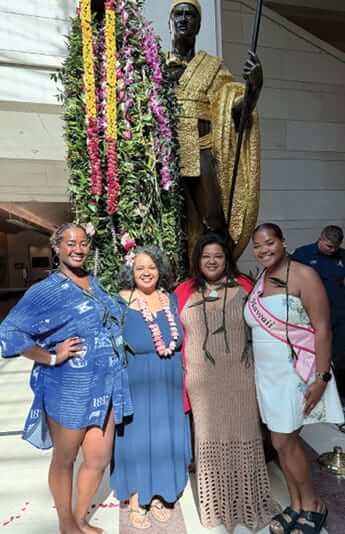
Combining Hawaiian and political protocol for an event on the East Coast honoring one of our aliʻi was no easy feat. As you might imagine, the Kamehameha Lei Draping Ceremony in D.C. was Aunty Kehau’s time to shine.
This year’s theme highlighted Kamehameha I’s last words: “E ʻoni wale nō ʻoukou i kuʻu pono ʻaʻole e pau” (continue the good that I have done for it is not yet finished). Those words have a whole new meaning for our ʻohana as we carry on our mom’s mission to honor our aliʻi on the East Coast.
May 2026 marks the 20th anniversary of the Aliʻi Diplomatic Missions and Other Business Travel to Washington, D.C., project completed in conjunction with the Office of Hawaiian Affairs. As shared in the publication:
“The inspiration for initiating this research were the leaders of the Royal Order of Kamehameha I, ʻAhahui Kaʻahumanu, Hale O Nā Aliʻi O Hawaiʻi and Māmakakaua – Daughters and Sons of Hawaiian Warriors who traveled together to Washington, D.C., the week of September 13, 2003, to walk the halls of Congress and speak with U.S. Senators. These representatives of the Native Hawaiian Royal Societies sought support for the establishment of a process of federal recognition for Native Hawaiians as a step in the process of reconciliation between the United States and Native Hawaiians, to reaffirm the legal and political legal status as Indigenous sovereigns, protect existing rights and assure perpetuation of the distinct Indigenous Hawaiian culture through self-determination.”
In September 2026, Ke Aliʻi Makaʻāinana Hawaiian Civic Club, in collaboration with the Hawaiʻi Ponoʻī Coalition, are excited to celebrate the 20th anniversary of this publication in our nation’s capital. We hope you will join us as we retrace the footsteps of our aliʻi in Washington, D.C.