Nearly 200 years ago, a Catholic mission group of three priests and three lay brothers arrived in Honolulu to establish a faith that would endure persecution, grow across the islands, and leave a lasting mark on Hawaiʻi through education, healthcare and service.
The missionaries, members of the Congregation of the Sacred Hearts of Jesus and Mary, departed Bordeaux, France, in 1826 on a nine-month journey to Hawaiʻi. When they arrived in Honolulu in July 1827, they faced opposition from Protestant missionaries who had arrived seven years earlier and who had gained considerable influence with Kuhina Nui Queen Kaʻahumanu.
However, the Catholic missionaries were welcomed by Oʻahu governor Boki who, with the approval of King Kamehameha III, granted them a plot of land in Honolulu. This allowed the group to establish its mission before a period of religious persecution and political opposition from 1829 to 1839 that became known as the “dark decade.”
According to the Catholic Herald, “At first, they were able to stay because they had one friend in a high place – Boki, the governor of Oʻahu, had been baptized Catholic years earlier on board a ship in Honolulu Harbor. But when Boki was lost at sea in 1830, the persecution began.”
Queen Kaʻahumanu, who abolished the kapu system and had converted to Protestant Christianity, ordered Catholic missionaries to leave.
In December 1837, King Kamehameha III enacted a law prohibiting the practice of Catholicism. Hundreds of Native Hawaiian Catholics were persecuted and were either imprisoned, starved or forced into hard labor.
Kalani Akana, Ph.D., wrote about the persecution that occurred in Maui: “There were many Catholics living in Wailuku at the time. They were ordered by the government to build a Protestant church, but they refused. Instead, they consented to fix the roads. When the government ordered them to send their children to the Protestant schools, however, they refused again. As a result, they were captured and bound and taken to Lahaina.”
In Honolulu, the land granted by Boki remained the center of the Catholic mission, and Catholics returned there following the end of their expulsion in 1839. The Cathedral of Our Lady of Peace was later constructed on the site of the mission’s small chapel.
As local Catholics prepare to commemorate 200 years since the establishment of the Catholic mission in Hawaiʻi, those difficult years also represent a formative period that helped strengthen and shape the faith in the islands.
The Reverend Monsignor Terry Watanabe, who was born and raised in Wailuku, began his priestly ministry at his hometown’s St. Anthony of Padua Catholic Church. He said, “If you trust in the Lord, which is what we’re called to do in our daily living and our daily lives, God will be with us both in the good times and the bad, and the joys and the sorrows of life.”
At St. Anthony of Padua Church in 1873, four young priests volunteered to serve those forced into isolation at Kalaupapa because of Hansen’s disease. Father Damien was among them, serving the exiled community for 16 years until his death in 1889.
Also answering the call to serve at Kalaupapa was Mother Marianne Cope, a sister of St. Francis.
“She’s the one that started Maui Memorial Medical Center here on Maui,” added Watanabe. “Because right next to St. Anthony was our first hospital, which was called Malulani Hale. I was born there.”
Mother Marianne managed Malulani Hospital, known today as Maui Memorial Hospital, and St. Anthony School.
“Mother Marianne was incredible because she promised her nuns that no one would ever get sick or contract leprosy by working in Kalaupapa. And … not one of the sisters who ever worked there ever got leprosy,” Watanabe said.
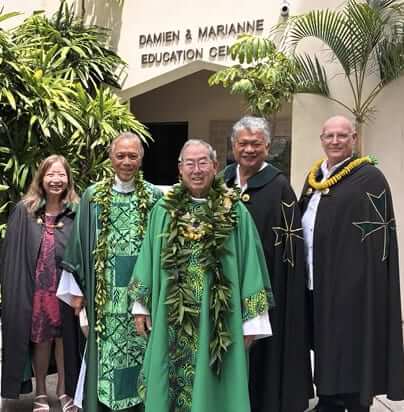
Kalaupapa was home to an interfaith community where multiple religious groups cared for patients. However, Father Damien and Mother Marianne left an enduring legacy for their fearless advocacy and transformative service which, today, is internationally recognized.
“Not every state can say that they have two saints,” said Watanabe. “We are so fortunate that these saints basically are models and witnesses to us of what it truly means to really live the faith and to proclaim the faith and to put the word of God into action for others. It’s not just something that was written about in history, but it’s something that lives today.”
As the Catholic Church became more established in Hawaiʻi, immigration also contributed to its growth. The expanding sugar industry brought waves of immigrants to the Hawaiian Kingdom, including Portuguese laborers, many of whom were Catholic.
A Catholic Herald article notes, “Hawaiʻi received its first major influx of Catholic immigrants with the arrival of the first Portuguese farm laborers from the Azores in 1878. Among them were the ancestors of Bishop Larry Silva, the fifth bishop of Honolulu.”
Today, Catholicism is the largest single organized religious body in the state with 66 Catholic parishes across Hawaiʻi. The Catholic Church has also made lasting contributions to education and healthcare. Twenty-six Catholic educational institutions continue to operate spanning early learning to higher education. St. Francis Healthcare System of Hawaiʻi provides medical services focused on kūpuna care.
The U.S. Province of the Congregation of the Sacred Hearts of Jesus and Mary – the same religious order that established the Catholic mission in Hawaiʻi nearly 200 years ago – is led by today by Father Lane Akiona, a Native Hawaiian priest from Molokaʻi. Akiona not only serves in Hawaiʻi and on the continent, but in Tonga as well. Here at home, Akiona shepherds St. Augustine by the Sea in Waikīkī.