
By Kyler Hood
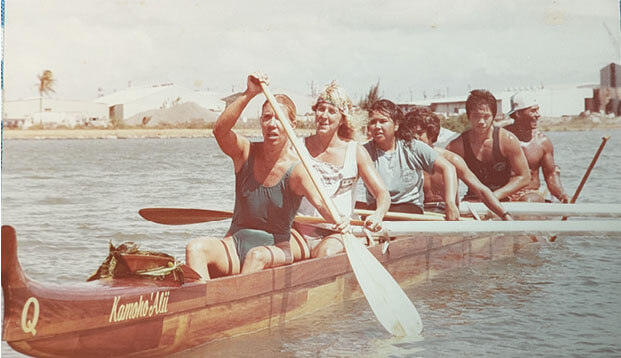
For more than four decades, Kamoho Aliʻi, beloved traditional koa waʻa of the Waikīkī Beachboys Canoe Club (Beachboys) has served as a physical connection to the club’s roots.
“Koa canoes are so important to our history [of the Beachboys], and to the history of the Hawaiians,” said Rae Kamaka, wife of the late legendary waterman William “Moku” Kamaka who was one of the club’s founders and the club’s head coach for years.
Origins
The canoe club was founded in 1973 by a group of Waikīkī beachboys to promote surfing and outrigger canoe paddling. Today, the Beachboys are a highly regarded canoe club known for embodying the Hawaiian waterman tradition, preserving outrigger canoe history, and for perpetuating aloha.
Kamaka shared that, back when the club was founded, traditional koa canoes were far more prevalent. Today, fewer than 60 are actively raced, and all are highly prized.
Kamoho Aliʻi was born in 1980 in Hilo, the creation of canoe-builders Ray Bumatay and Alex Apo. From the beginning, Kamoho Aliʻi was a source of pride for the Beachboys. Still a relatively new canoe club at the time, adding Kamoho Aliʻi to their fleet of canoes was the achievement of a goal that club members viewed as being a significant step towards becoming a respected canoe club.
Another goal was to win either the Molokaʻi Hoe or Nā Wāhine o ke Kai – both long-distance canoe races (approximately 41 miles) that cross the Kaʻiwi Channel from Molokaʻi to Oʻahu.
That goal was finally realized in 2011 when the club’s female crew took first place in Nā Wāhine o ke Kai. It proved to be a spectacular season for the Beachboys.
“2011 was really the culmination of carrying out what Moku and the Beachboys had set out to do when the club was founded,” said Dana “Gorecki” Yaross, a club member who paddled with the Beachboys for 18 years and served as its president from 2002 – 2017.
However, amidst the club’s success that year, the Beachboys also experienced tremendous loss. Club co-founder Moku Kamaka passed away in August 2011.
In Need of Repair
Around 2003, after paddling her for more than 20 years, the Beachboy’s prized koa canoe, Kamoho Aliʻi, was placed in storage. She needed repairs that the club could not afford.
Time passed and in 2019, the club began restoration work on its fleet of canoes. By 2026 all the club’s fiberglass canoes were restored. Kamoho Aliʻi is next.
After almost 23 years, the Beachboys are excited to begin restoring Kamoho Aliʻi. It will be a long process, but the waʻa is foundational to the club and its values. To this end, fundraising efforts are underway to restore Kamoho Aliʻi which club leadership estimates could cost $90,000. A hefty price, but they believe it is well worth it.
Eric Lenz is the current president of Waikīkī Beachboys. He has been with the club for about 16 years and is its Novice B paddling coach. Reflecting on the club’s canoe restoration efforts, Lenz emphasized that boats are meant to be on the water.
At the annual Waikīkī Beachboys Invitational Regatta on July 11, 2026, Kahu Dennis Salas offered the opening pule. Seventeen clubs competed this year at the event which, of course, was held at Waikīkī Beach. The regatta enjoyed clear weather and the Beachboys took home five gold medals that day.
At the conclusion of the regatta, beneath sunny skies and against the aquamarine backdrop of the ocean, the Beachboys celebrated on Waikīkī Beach with the other canoe clubs and paddlers who competed that day, win or lose.
“We want paddling to be competitive. That’s why we’re here. We’re here to win races. We’re here to paddle, but we’re mostly here to have fun,” said Lenz.
To donate to the restoration of Kamoho Aliʻi, go to: wbbcanoeclub.square.site/product/donation-for-kamoho-ali-i-our-1980-koa-canoe-/84
 has served as a physical connection to the club’s roots.)