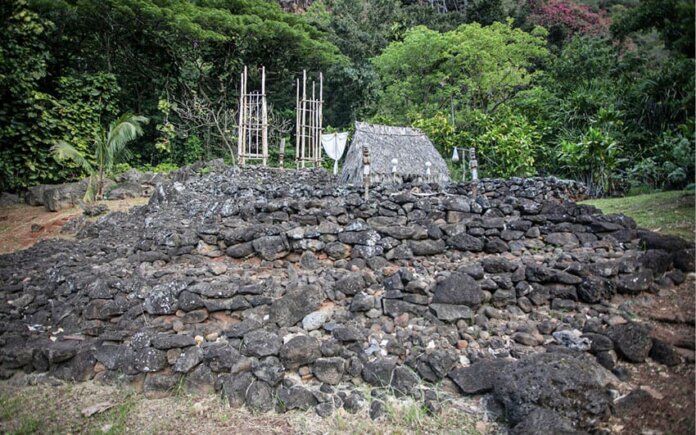
The history of Waimea Valley as a place set aside for the kahuna nui of Oʻahu dates to about 1092 A.D. Tradition holds that it begins with the arrival in Hawaiʻi of Māweke, a high chief from Kahiki. Like so many human stories, it is a tale of jealousy, betrayal, political ambition, and power that spans generations.
In one version of the story, Māweke had two sons: Olopana and Kahikiula. Olopana became high chief of Oʻahu. However, Olopana’s wife loved his brother, Kahikiula, and the two conceived a son they named Kamapuaʻa.
In a jealous rage, Olopana threatens to kill the child (his nephew) but ultimately does not and Kamapuaʻa grows to adulthood. However, years later when Kamapuaʻa is a young man, Olopana conspires to murder him, enlisting the help of the high priest, Lono-a-wohi. In an unexpected plot twist, however, Lono-a-wohi betrays Olopana, saves Kamapuaʻa, and kills Olopana instead.
Kamapuaʻa then becomes high chief and, for saving the chief’s life, Lono-a-wohi was initially awarded all ahu- puaʻa on Oʻahu that included the word “wai” in their names.
Kamapuaʻa later travels to Kahiki and his father, Kahikiula steps in as high chief of Oʻahu. To ensure that makaʻāinana (commoners) had sufficient lands to farm, he redistributes the lands of Oʻahu, assigning four especially sacred and resource-rich ahupuaʻa to the kahuna class: Waimea, Pūpūkea, Hakipuʻu and Waiāhole.
The ahupuaʻa of Waimea would stay with the kahuna nui class for roughly 700 years through the time of Kamehameha III.
In the 1770s, the high priest Kaʻopulupulu, a powerful prophet from Waimea, rose to prominence. He was chief advisor and priest to Kahahana, then the aliʻi nui of Oʻahu. Kaʻopulupulu was the last true kahuna nui from the Oʻahu line of priests.
It was a time of political turmoil. Kahekili, the ruthless and brilliant aliʻi nui of Maui, coveted Oʻahu. After a failed invasion of Oʻahu in 1775, cunning Kahekili – who was also Kahahana’s uncle – asked Kahahana to give him the wahi kapu of Kualoa.
However, the Kahuna Nui Kaʻopulupulu strongly advised Kahahana to deny Kahekili’s request.
Kualoa was an especially sacred land where the bodies of sperm whales often washed ashore. From the teeth of sperm whales came the ivory prized for lei niho palaoa (the whale tooth pendants worn by aliʻi). Kaʻopulupulu warned Kahahana that giving Kualoa to Kahekili would be like giving him the power of Oʻahu.
So Kahahana denied Kahekili’s request.
Seeing Kaʻopulupulu as an obstacle to his ambitions, Kahekili skillfully manipulated Kahahana into believing that his trusted kahuna nui was a traitor.
According to this version of the moʻolelo, when Kahahana removed Kaʻopulupulu from his council, Kaʻopulupulu returned to Waimea Valley and tattooed his knees (kuli) black, symbolizing that his chief, Kahahana, had turned a deaf (kuli) ear to his counsel and that any decisions the chief made moving forward were not made with his guidance.
After learning about this symbolic act of defiance, Kahahana ordered Kaʻopulupulu killed. Kaʻopulupulu and his son, Kahulupue, also a kahuna, fled Waimea but were later captured in Waiʻanae by Kahahana’s warriors where Kahulupue was killed.
Kaʻopulupulu was taken to Puʻuloa into the presence of the king where he, too, was killed. It is said that, with his dying breath, Kaʻopulupulu prophesied that the king’s own death was near and that his body, too, would be debased. After he died, Kaʻopulupulu’s body was taken to Waikīkī and hung from a coconut tree. This was in 1782.
The next year, Kahekili invaded Oʻahu landing at Waikīkī and slaughtering and pillaging his way to Waialua. His son, Kalanikūpule, became aliʻi nui of Oʻahu and the defeated Kahahana hid in the mountains with his wife and companions for nearly two years until he was captured and killed by Kahekili’s warriors in 1785.
As had been done to Kaʻopulupulu, the bodies of Kahahana and a companion, Alapaʻi, were taken to Waikīkī and hung from coconut trees by Kahekili and his priests.
Following Kahekili’s victory, a fearsome regiment of his warriors – known as “Pāhupu” warriors because their bodies were tattooed half black – remained in Waimea for a time. The Pāhupu warriors are likely responsible for the murder of three crewmen from the British Royal Navy ship, the HMS Daedalus. The ship anchored in Waimea Bay in May 1792, and the men ventured into the valley to replenish their freshwater reserves. They were never seen alive again.
In 1795, Kalanikūpule was defeated by Kamehameha at the Battle of Nuʻuanu. With the Oʻahu chiefs gone, Kamehameha awarded the ahupuaʻa of Waimea to his own kahuna nui, Hewahewa.
After Kamehameha died in 1819, Hewahewa helped to abolish the kapu system and later converted to Christianity. He served Kamehameha II and, briefly, Kamehameha III. In 1826, Hewahewa retired to Waimea to live out his remaining years. He died there in 1837 and, despite his adoption of Christianity, he asked to be buried in the old way. His iwi rest in Waimea Valley.
Mahalo to Waimea Valley Hiʻipaka Research Director Dr. Alana Kanahele and Cultural Programs Manager Kaʻulamealani Diamond for sharing most of the information used in this recounting of the moʻolelo.