By Dr. Ronald Williams, Jr.
I ka ʻōlelo nō ke ola, i ka ʻōlelo nō ka make.
The power to name, and in doing so create identity, in most instances lies close to home. A parent names a child, an artist names their work, a community names its streets, physical resources, and valued sites.
In contested situations, however, naming can become an instrument of control. It’s one of the spoils of war. To the victor goes the writing of history, not only in general ways, but also in the ability to represent identities.
On 17 January 1893, a committee of 13 men – supported by a private militia and U.S. troops brought ashore on orders of a rogue U.S. consul – proclaimed themselves to be the lawful government of the Hawaiian Islands.
Within hours, Queen Liliʻuokalani authored an official protest to the president of the United States asking that he undo the unauthorized actions of his diplomatic minister.
Less than 24 hours later, with the queen’s protest weeks away from reaching Washington, the Pacific Commercial Advertiser reported on the events, referring to Her Majesty as “the Late Queen.” The Hawaiian Gazette published a large photograph of the queen on its front page with the caption, “Liliuokalani, Ex-Queen of the Hawaiian Islands.”
The Daily Bulletin, on the other hand, referred to her as “Her Majesty the Queen” while Hawaii Holomua made their stance clear, designating her, “Aliiaimoku” (supreme leader). A battle was underway to shape the current and future identity of Queen Liliʻuokalani.
S. Percy Smith, head of the Polynesian Society in Aotearoa, wrote to William D. Alexander of the Hawaiian Historical Society in June 1894. The two institutions were founded concurrently in December 1892, and both had requested Queen Liliʻuokalani to do them the honor of being their founding matron. Her Majesty agreed, supplying the fledgling institutions with gravitas, personal funds, and critical connections.
Smith’s correspondence asked what should be done considering the ongoing political struggle in Hawaiʻi and the queen’s position within the two societies. Alexander replied, “I think it will be wise to relegate her name to the place of an honorary member, minus the title of “Her Majesty.”
Alexander’s own institution had already elided the queen from their published record. Although the cover page of the group’s 1892 constitution reads, “PATRON, HER MAJESTY THE QUEEN,” that designation disappears in the society’s annual report.
In fact, Queen Liliʻuokalani is not mentioned anywhere within the Hawaiian Historical Society’s Annual Reports of 1893-1902; not as matron, benefactor, nor even as a member.
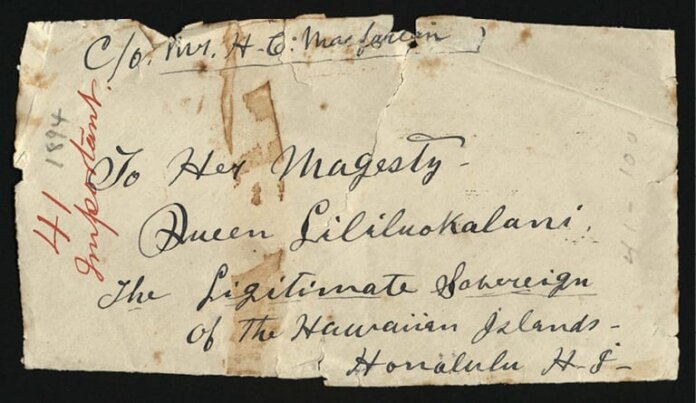
International supporters of the queen made their thoughts known in varied ways. One of the more original was an April 1894 letter mailed by a self-declared “right thinking American” who offered to take up arms and help the queen return to her throne. The envelope bore the recipient’s name and title, and while the author’s spelling may not have been on point, his message was clear. The letter was addressed to “Her Magesty Queen Lililuokalani, The Ligitimate Sovereign of The Hawaiian Islands.”
Those opposed to the queen could be just as deliberate.
Rev. Sereno Bishop, well-aware of the innate Hawaiian belief in the power vested in a full and correct pronunciation of a name, took to referring to Queen Liliʻuokalani as “Lil.”
In a letter to businessman Gorham Gilman, Bishop wrote, “My sister in N.Y. sends me a story clipping of a most sickening laudation of Lil and her talk about Hawaiians. What Lil calls the ʻdownfall of her nation’ due to the missionaries is really a redeeming movement for them. But for the missionaries, L. herself would have rotted away early as a common low creature.”
During its reporting on the 1895 imprisonment of Queen Liliʻuokalani within a room of ʻIolani Palace, Ke Aloha Aina made a statement on the identity issue that relied on style rather than content. The paper began capitalizing all pronouns referring to the queen; a distinct move that went beyond the common capitalization of pronouns within royal titles such as “Her” Majesty or “His” Honor. In one example, the paper declared, “E pono e hoihoi hou ia ka Moiwahine o Hawaii ma Kona kulana maoli.” (The Queen of Hawaiʻi should be restored to Her rightful position).
In another, the paper insists that Her rank and station have remained the same and will until the last days of Her life: “He oia mau no Kona kulana kapukapu alii, a aole loa e hiki ke hoololi ia ae ia mea mai Iaia ae, a hiki i na la hope o Kona ola ana.”
Despite more than five years [1893-1898] of near- constant attempts to delegitimize the queen, and a century of false histories that elided her true actions, Her Majesty Queen Liliʻuokalani continues to retain her rank and station in the eyes of her lāhui.
In 1982, a statue of the queen was erected on Palace Walk in Honolulu. A plaque at front reads, “Ola mau ko kākou Mōʻī Wahine i ke aloha ʻonipaʻa ma nā puʻuwai o kāna poʻe aloha ʻāina. Our Queen lives forever with steadfast devotion in the hearts of her loyal people.” The statue’s base holds the inscription, “Queen of Hawaiʻi 1891-1917.”
The ʻōlelo noʻeau, ʻonipaʻa ka ʻoiaʻiʻo, reminds us that the truth is indeed steadfast and once again we find ourselves looking back in gratitude to those who fought to record it.
Perhaps it was the Home Rule Republican of that era that made the issue most clear when they proclaimed: “Her Majesty Queen Liliuokalani will be addressed as above by every true Hawaiian and don’t you forget it.”