
Read this article in ʻŌlelo Hawaiʻi
Na Hema Yam-Lum, Kumu Aʻoaʻo Haʻi ʻŌlelo, UH West Oʻahu
Greetings to all my aloha ʻāina practitioners, friends, and colleagues of Hawaiʻinuiākea.
This voice rises from the land itself, carried by the breath of the ancestors and shaped by the responsibility entrusted to us all in this generation. From the bird-rich lands where the sacred bats of Hōlanikū dwell, to the heights where Mauna Hāʻupu stands watch, from the renowned warrior ancestors Kakuhihewa and Lānaʻikaula who guard the glowing kukui hill of Hālawa, from Molokini, the spiritual center of the eight seas, to the sacred sands of Kohemālamalama o Kanaloa – these places hold memory. They remind us that land, genealogy, knowledge, and language are inseparable, and that each generation is accountable to what it inherits.
Introducing a school that has taken root in Honouliuli on Oʻahu. It is a school nurtured under the protection and guidance of two foundational institutions in Hawaiian-language education: Ke Kula Kaiapuni ʻo Ānuenue and Kapolei Middle School.
From these schools come the ʻike, the pedagogical grounding, and the lived experience that allow a new Kaiapuni program to stand firmly. Today, this program is fully housed within Kapolei Middle School.
When the doors were first opened, they were opened with oli, not merely to mark the beginning of instruction, but to establish the space as one grounded in protocol, intention, and ancestral presence. The name was chanted as one would welcome a newborn:
E Kūlanihākoʻi kau maila i luna e; A ua maila ua; A kupu maila kupu; A muʻo maila muʻo.
Three years ago, the opening of this new middle school kaiapuni program was shared with families from Nānākuli and Waiau elementary schools. This invitation extended beyond enrollment; it was a call to all of us to participate in the return of the Indigenous language of this land as a living foundation for learning and identity.
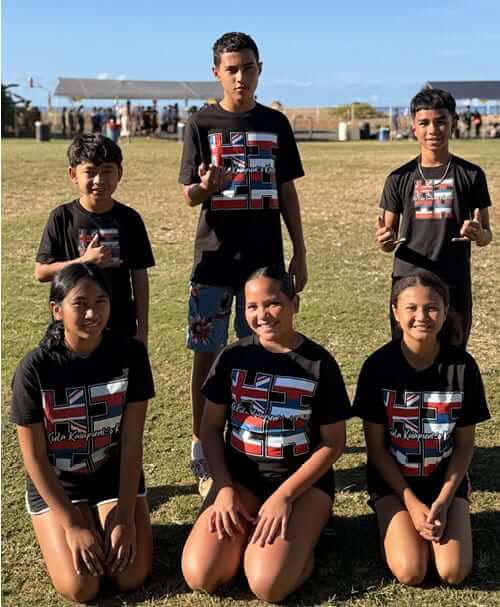
In that first year, only seven students entered, some from Nānākuli, others from Waiau. Today, the program has grown to a total of 22 Kaiapuni students.
This growth reflects not only increased enrollment, but a widening circle of responsibility. Families, educators, administrators, and community members alike have affirmed their role in supporting Hawaiian-language education. What began as a small planting has taken hold because many hands have tended it. Roots have strengthened. Branches are reaching outward. The chant continued, affirming this shared and intentional growth:
A liko maila liko; A lau maila lau; A lala maila lala; A kumu maila kumu; A kumu paʻa hina ʻole i ka honua.
This year, students fully engaged in every aspect of the kaiapuni program. Their learning extended beyond the classroom into communal meals, ceremonial transitions, shared labor both large and small, and the wearing of traditional attire. Through these experiences, students come to understand that ʻōlelo Hawaiʻi does not survive through instruction alone. It lives through use, through relationship, and through the collective commitment of those who choose to carry it forward in daily practice.
The responsibility to revitalize and sustain the Hawaiian language does not rest on any one individual or role. It belongs to all of us – educators and administrators, families and communities, learners and elders. The strength of Hawaiian language education depends on continuity across all levels of learning, from early childhood through higher education and into the broader community. When each level is supported, the whole system is strengthened. When responsibility is shared, the future becomes possible.
As we look ahead, the kaiapuni program stands ready to continue this work with renewed strength, firmly grounded in the foundation laid by Ke Kula Kaiapuni ʻo Ānuenue and Kapolei Middle School. The chant closes, gathering our collective intention and shared kuleana:
E hoʻoulu mai, e hoʻoulu mai; A ulu maila e; A he leo wale nō e!
As we continue to move alongside kaiapuni schools throughout Oʻahu, we weave stronger relationships between educators, students, and communities. As the ancestors remind us, “Ua liʻu i ka paʻakai,” and “He aha ka mua, he aha ka hope?”
This path was walked long before us. Our responsibility now is to carry it forward with humility, clarity, and resolve, so that the Hawaiian language remains not only remembered, but lived in our schools, in our homes, and in the enduring life of the lāhui, now and into the future.