
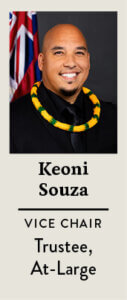
ʻAʻohe hana nui ke alu ʻia, no task is too great when we work together. This ʻōlelo noʻeau speaks to a truth that has guided Kānaka for generations and continues to guide my work. Stewardship of ʻāina is never the responsibility of one person or one institution alone. It is kākou collective work, grounded in partnership, purpose, and long-term vision.
OHA’s legacy lands are among our greatest responsibilities. These ʻāina carry history, cultural significance, and potential, not only for today, but for generations to come.
Whether the ʻāina has been held by OHA for decades or are lands we may acquire in the future, our kuleana remains the same: to steward them wisely, intentionally, and in a way that uplifts Native Hawaiians.
From my perspective, stewardship begins with understanding that ʻāina is not an asset to be controlled, but our pilina to our kūpuna. We are the land. As chair of the Investments and Land Management Committee, I take seriously the responsibility to ensure that decisions about OHA lands are rooted in purpose and long-term Native Hawaiian benefit. That responsibility led to advancing OHA’s Legacy Lands Investment Policy, adopted by the Board of Trustees in December 2025.
Our OHA Legacy Lands Investment Policy sets clear expectations for stewardship. It prioritizes long-term holdings for cultural preservation and environmental responsibility, while allowing for carefully planned uses that support self-sufficiency without compromising cultural integrity – not assets for liquidation or short-term return.
By emphasizing intentional planning, strong governance, and accountability, the policy ensures that land-use decisions are guided by purpose rather than immediacy, and that ʻāina continues to serve the lāhui for generations. These lands include Wao Kele o Puna, Kūkaniloko, Pahua Heiau, Waimea Valley, Palauea Cultural Preserve, and others.

During OHA ʻāina workdays, opportunities I strongly support and value, staff step away from their desks and onto the ʻāina we steward. We build pilina and our work becomes personal. Planting, clearing, restoring, and learning together reinforces that our mission is not abstract, it is grounded in place. These moments remind us that stewardship is active, hands-on, and shared.
Those experiences shape how we govern, grounding the board decisions in firsthand knowledge and reinforcing our commitment to long-term sustainability so ʻāina can support the lāhui.
Expanding OHA’s land base is not about accumulation, but the opportunity to protect cultural places, support housing and food security, create space for education and cultural practice, and strengthen Native Hawaiian presence across Hawaiʻi, while preserving the Native Hawaiian Trust Fund by pursuing only lands that support its long-term strength, through collaboration among trustees, staff, community partners, and beneficiaries.
At the board level, I support decisions that emphasize collaboration and long-range planning. When we work together sharing ʻike, listening carefully, and aligning around a common purpose, we make better choices for our lands and our people. Stewardship is not measured by how much land we hold, but by how well we care for it.
ʻAʻohe hana nui ke alu ʻia. No task is too great when we work together. By approaching our legacy lands with haʻahaʻa, and manaʻo, we honor those who came before us and ensure that the ʻāina we steward today will continue to sustain us into the future.

