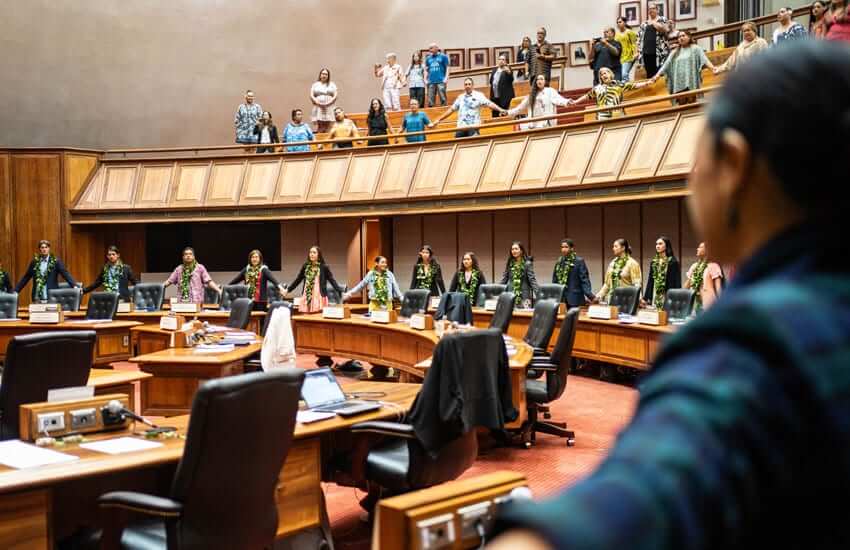
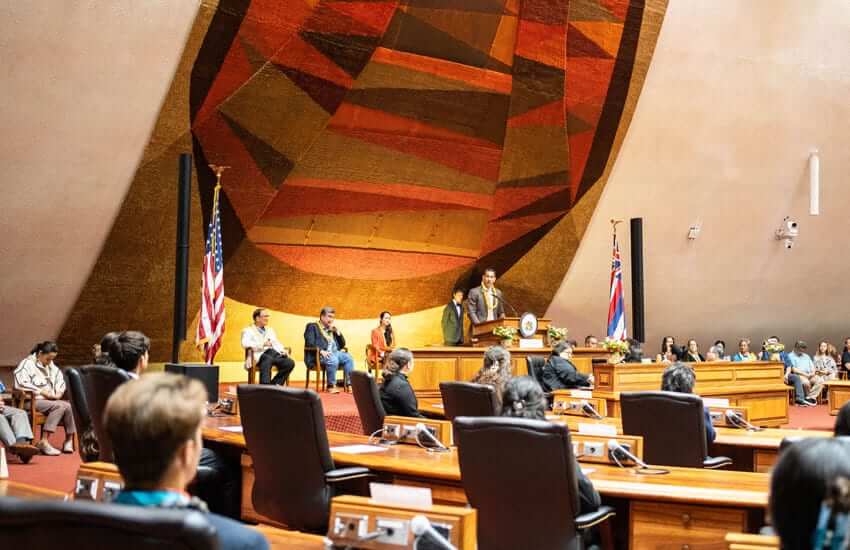
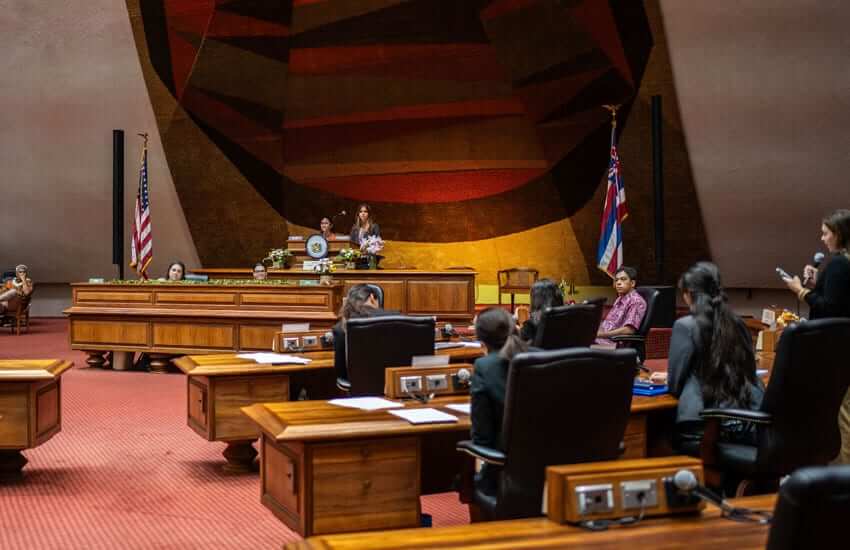
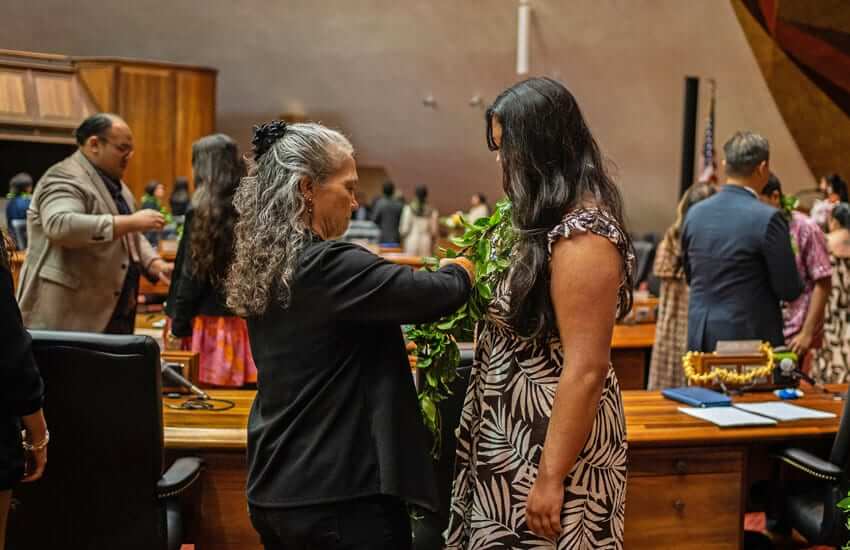
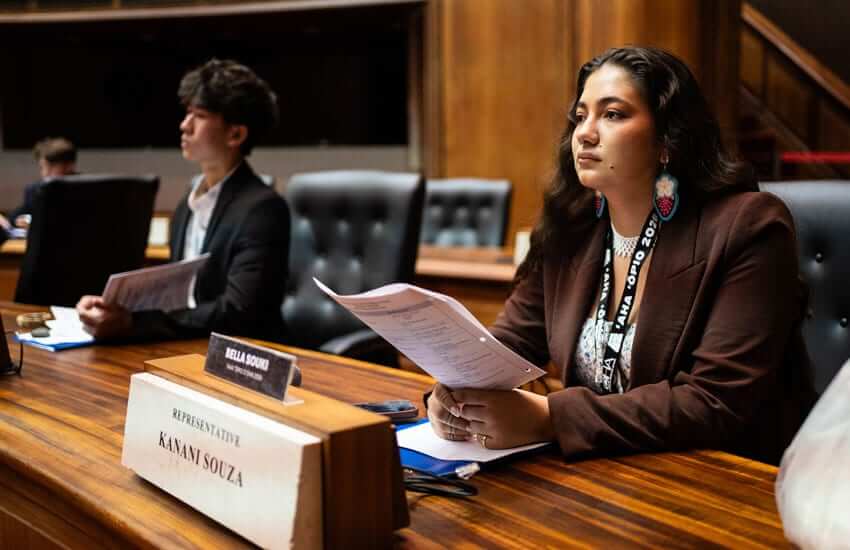
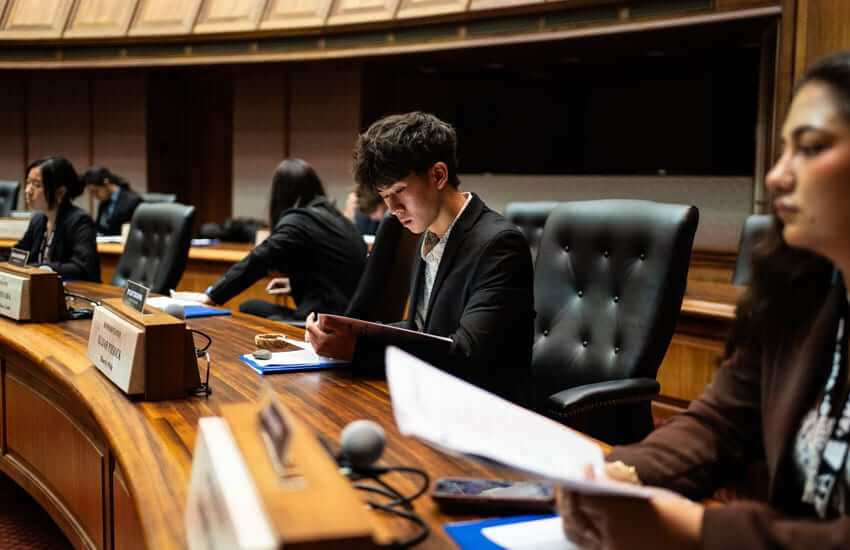
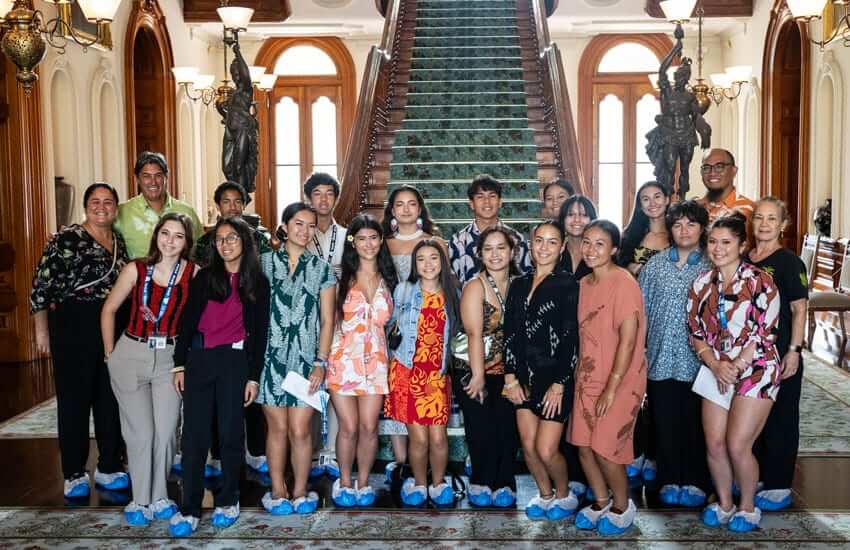
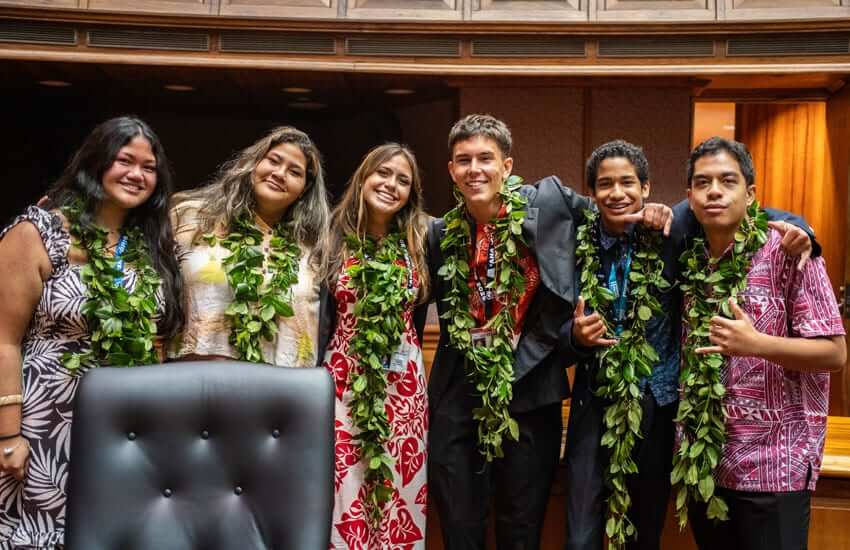
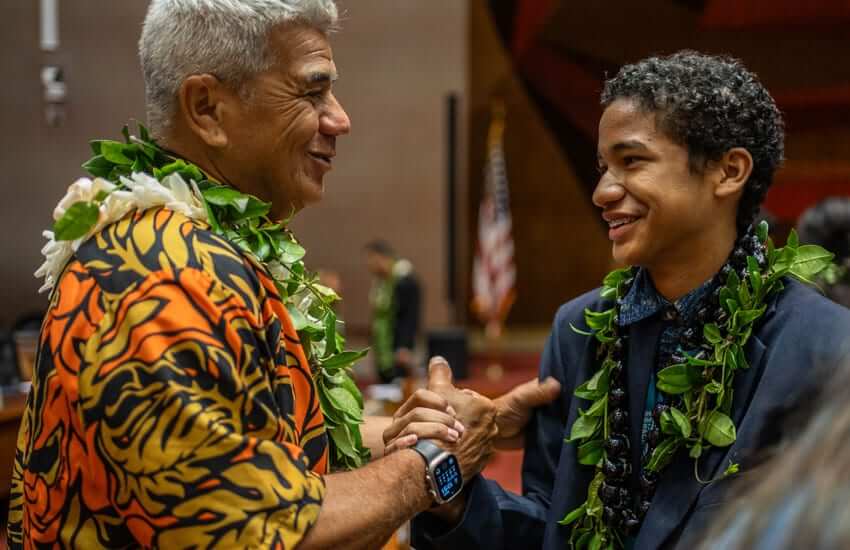
Chants echoed through the Hawaiʻi House of Representatives chamber as 38 Native Hawaiian high school delegates took their seats on the chamber floor, marking the opening of their legislative session. Dressed in business attire, they stood proudly, ready to debate bills, propose amendments and advocate for issues affecting the lāhui.
Just 24 hours earlier, many had been strangers.
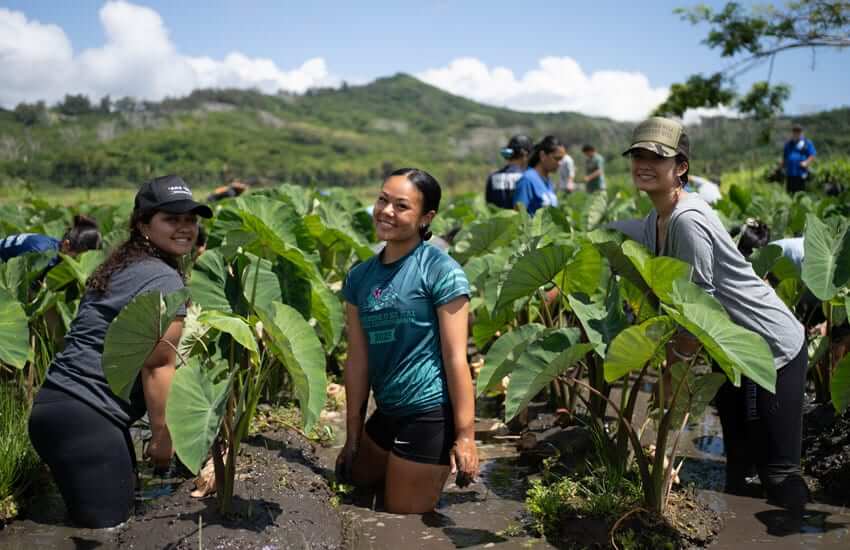
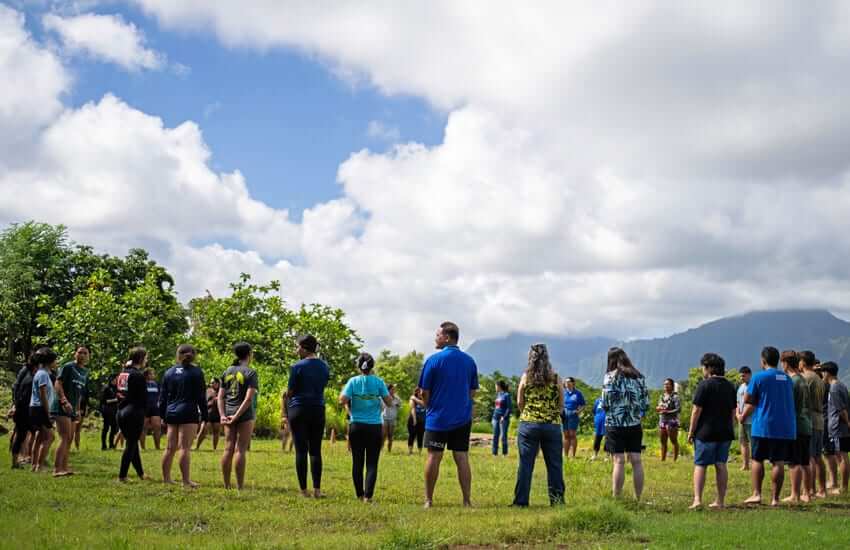
Delegates from across the pae ʻāina and Native Hawaiian communities on the continent had gathered at Hawaiʻi Pacific University before traveling to Kākoʻo ʻŌiwi where they worked side by side in the loʻi, connecting with the ʻāina while beginning to build the pilina that would carry them through the week ahead.
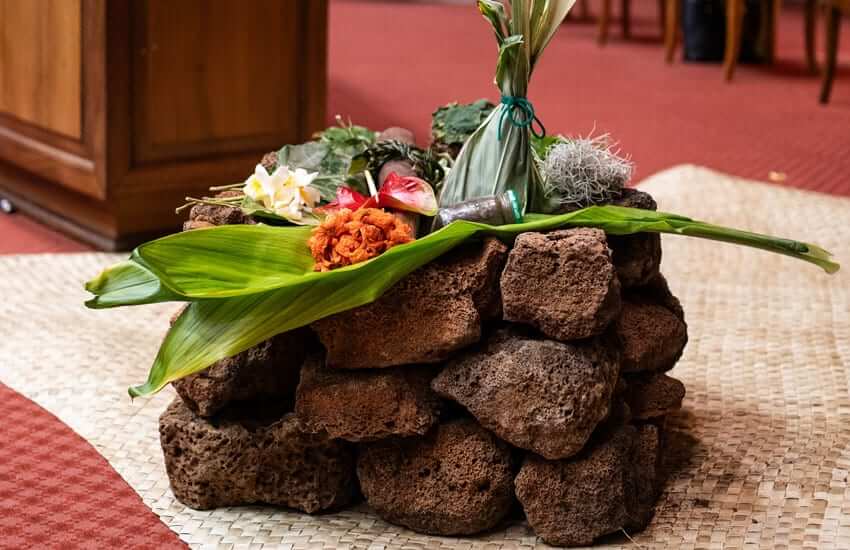
That evening, under the guidance of cultural practitioner Kimeona Kane, each delegate and staff member selected a single pōhaku to help build a traditional ahu that would remain in the House Chamber throughout the program. Stone by stone, the ahu took shape, symbolizing how lasting legacies are built through the contributions of many, each generation strengthening the foundation laid by those before them.
That philosophy has defined ʻAha ʻŌpio since its inception.
The return of ʻAha ʻŌpio marked more than the revival of a beloved youth leadership program. It celebrated the continuation of a legacy first established nearly four decades ago, rooted in the belief that Native Hawaiian youth belong in the spaces where decisions are made and that cultivating future leaders begins long before they are old enough to vote.
Created by the Office of Hawaiian Affairs in 1988, ʻAha ʻŌpio was designed to cultivate ʻike, leadership and civic responsibility through a culturally grounded legislative experience.
Conceived by OHA educators, kūpuna, community leaders and dedicated volunteers, the program blended parliamentary procedure with Hawaiian values, creating a space where ʻōpio could deepen their connection to lāhui, ʻāina and kuleana while learning how civic leadership can serve their communities.
Over the years, the program’s alumni have gone on to become educators, attorneys, public servants, policymakers and community advocates, carrying the lessons of ʻAha ʻŌpio into careers dedicated to serving Hawaiʻi and the Native Hawaiian community.
One of those alumni is Nani Medeiros, Hawaiian policy expert and public servant, who first participated in the program in 1989 before returning this year to mentor a new generation of delegates.
“My experience at ʻAha ʻŌpio was life-changing,” she said. “It was the first time outside of my family that I truly felt proud of being Hawaiian.”
For Medeiros, the experience wasn’t simply about understanding government. “We learned about our Hawaiian culture while simultaneously learning about the legislative process,” she said. “The program honored both.”
She returned to mentor another class of delegates as they embarked on their own experience. “I’m really looking forward to watching this new generation of ʻōpio go through that same transformation.”
Before they entered the House Chamber, the 2026 delegates began in the loʻi. Working together at Kākoʻo ʻŌiwi, they learned that leadership begins by serving others.
Throughout the week, they visited places central to Hawaiʻi’s history and governance, learned from kūpuna, policymakers and community leaders, and explored the challenges and opportunities facing Native Hawaiian communities today.
By the time they took their seats in the legislature, they had already been reminded who that leadership is meant to serve.
One delegate reflected that the experience in the loʻi revealed how quickly strangers could become a community saying, “Even though we just came together and met each other, we’re all connected and grounded by a shared purpose of service and serving our people and our ʻāina.”
Those relationships became the foundation for thoughtful debate, collaboration and mutual respect as delegates moved through committee hearings and legislative sessions.
OHA Public Policy Advocate Imiloa Borland watched the delegates grow into their roles throughout the week.
“ʻAha ʻŌpio is a really fantastic opportunity for our ʻōpio to experience leadership in a different form,” Borland said. “They get to take on the role of legislators and advocate for the issues they care about, the issues they see in their communities and that they want to address.”
Throughout the week, delegates embraced the responsibilities of public service. They drafted legislation, chaired committees, considered testimony, debated amendments, and guided bills through the legislative process from introduction to final reading.
Borland said she was continually impressed by how quickly they adapted to those roles.
“I was blown away by how quickly they were able to pick up on the legislative process,” she said. “They were all super engaged in their issues. They all had such unique perspectives and were really able to have substantive debates.”
One legislative session stood out above the rest. During a three-hour committee reconciliation session, delegates challenged one another’s language, questioned amendments and defended the intent behind their proposals. By that point, Borland said, staff had largely stepped aside.
“We watched them take the reins themselves and become actual legislators.”
The diversity of the delegation strengthened those conversations. Representing communities from across the pae ʻāina and Native Hawaiian communities on the continent, delegates brought different lived experiences into discussions while learning to understand perspectives beyond their own.
“Every representative and every senator is from a different geographical area, and their responsibility is to represent the experiences of their constituents,” Borland explained. “We were able to replicate that because of the geographic diversity of the ʻōpio.”
For many delegates, one of the most meaningful parts of the week wasn’t speaking but listening. “To be with people my age that are so intentional, read through all of the bills and recognize even the tiniest things to amend, it really pushed me to be just like them,” one delegate reflected.
Another said watching their peers advocate so passionately for their communities fundamentally changed how they viewed the future of the lāhui. “It gave me hope for the future that we, as Native Hawaiians, can share our voice and make changes for the betterment of not only us as a lāhui, but everyone.”
Yet for many delegates, the greatest lesson wasn’t parliamentary procedure. It was realizing that their voices belonged in the rooms where decisions are made. “I realized that I have a place in all of this,” another delegate said. “I will be able to make a difference. I can make a difference. And I actually do have a voice.”
For Borland, that realization reflects the true purpose of the program. “People always say young people are future leaders,” she said. “But really, what I hope they took away is that they already are leaders of their communities. You already have the capability to make change at your age.”
Leadership is no longer something waiting for ʻōpio after graduation or years into the future. It became something they could practice today through service, collaboration and a commitment to their communities. As one delegate reflected, “We’re always told we’re the future, but this was a good opportunity to be put into action and really understand that we are that change and we are that future.”
That sentiment embodies the 2026 program theme, E Hoʻounu i ke Ala. Building Indigenous Futures.
Hoʻounu describes the careful work of placing stones together to create a path. Each stone strengthens what came before while preparing the way for those who follow.
Like the ahu that stood in the House Chamber throughout the week, ʻAha ʻŌpio has been built one generation at a time. Since 1988, OHA has invested in Native Hawaiian youth through a program that challenges them to lead with ʻike, integrity and aloha. Alumni have returned as mentors, while former delegates have gone on to become educators, attorneys, policymakers, public servants and advocates.
As this year’s delegates returned home to their schools and communities, they carried with them more than an understanding of how laws are made. They carried the confidence to lead, the responsibility to serve and the knowledge that their voices matter.
Nearly four decades after the first class of ʻAha ʻŌpio delegates gathered, a new generation continues to build upon that legacy – one pōhaku, one leader and one generation at a time.