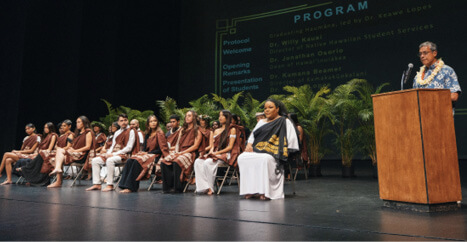
In 2007, after years of planning with the University of Hawaiʻi at Mānoa’s Hawaiian language and studies programs, the UH Board of Regents established the Hawaiʻinuiākea School of Hawaiian Knowledge to create a dedicated home for Hawaiian language, history, cultural practice, and worldview within higher education.
Dr. Maenette K. P. Ah Nee-Benham became the new college’s inaugural dean in 2008. She was succeeded in 2017 by Dr. Jonathan Kay Kamakawiwoʻole Osorio.
In less than two decades, Hawaiʻinuiākea has grown to include some 50 faculty members – plus numerous other support staff, graduate assistants and student workers. Since its founding, the college has conferred nearly 900 baccalaureate degrees, more than 130 graduate degrees, and is currently finalizing the details of a new Ph.D. program.
Additionally, Hawaiʻinuiākea is the only college of Indigenous knowledge within a Research 1 university (institutions that confer 50 or more doctoral degrees per year) in the U.S. – a distinction that reflects both opportunity and kuleana.
Hawaiʻinuiākea includes four centers: Kamakakūokalani Center for Hawaiian Studies; Kawaihuelani Center for Hawaiian Language; Ka Papa Loʻi ʻo Kānewai Cultural Garden; and Native Hawaiian Student Services. Together, they form a puʻuhonua – a refuge and source of learning – where haumāna can engage deeply with ancestral knowledge while preparing to lead in service of their ʻohana, lāhui, and community. For many, this experience is transformative.
Guided by Ancestral Principles
The work of Hawaiʻinuiākea is grounded in six principles drawn from primary repositories of Hawaiian ancestral knowledge. They provide both philosophical direction and day-to-day guidance in how we teach, research, lead, and serve.
Ka waihona o ka naʻauao
The repository of learning
Hawaiʻinuiākea will be a resource for courses and programs rooted in ancestral knowledge, supporting high-quality education for students, faculty, staff, and the global community.
ʻIke i ke au nui me ke au iki
Know the great current and the small current
We promote research that honors both tradition and innovation, generating new knowledge informed by ancestral foundations.
E lawe i ke aʻo a mālama, a e ʻoi mau ka naʻauao
Learn, apply, and knowledge will grow
We awaken and circulate ancestral knowledge through undergraduate, graduate, and community-based learning.
ka ʻāina, hānau ke aliʻi, hānau ke kanaka
Land, leaders, and people are born together
We strengthen genealogical relationships between people and ʻāina, preparing students to live their learning through action.
Hoʻoulu Lāhui
Strengthen the Nation
We cultivate self-determination and empower our people to lead with confidence and responsibility.
ʻIke ʻia ke kanaka ma kāna ʻōlelo
Identity is known through language
We revitalize and renormalize Hawaiian language and identity so they continue to flourish across Hawaiʻi and throughout the world.
Hawaiʻinuiākea organizes its work into four key priority areas, drawing from the metaphor of wai as life and knowledge: 1) Ka Wai Puna – Knowledge Generation & Dissemination; 2) Ka Wai Inu – Knowledge Transmission and Teaching; 3) Ka Wai Mana – Governance and Institutional Leadership; and 4) Ka Wai Ola – Community and Civic Engagement.
As wai sustains life, knowledge must circulate among classrooms, loʻi, community gatherings, and policy tables to nourish the lāhui.
The Legacy of Dean Jonathan Osorio
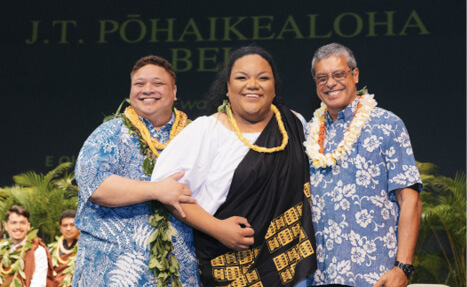
Osorio became dean of Hawaiʻinuiākea in 2017 after decades of service as a professor and as the former director of Kamakakūokalani. His leadership has been instrumental in Hawaiʻinuiākea gaining recognition as the only Indigenous-knowledge college at a Research 1 institution.
Under his leadership, in 2024 Hawaiʻinuiākea also earned a 10-year accreditation renewal from the World Indigenous Nations Higher Education Consortium (WINHEC), reaffirming the college’s essential role in revitalizing Hawaiian language, culture, and educational practices.
Born and raised in Hilo, Osorio began his teaching career in 1991 at Kapiʻolani Community College following a successful musical career. He joined UH Mānoa in 1994 and advanced from an assistant to full professor. His scholarship has helped shape the field of 19th century Hawaiian political and social history, while his music continues to resonate across generations. In 2019, he was recognized with a Lifetime Achievement Award from the Hawaiʻi Academy of Recording Arts.
After eight years of dedicated service as dean, Osorio has announced his return to teaching.
“It’s time to go back to teaching and let a younger, more vigorous and eager person take on this job. And I know it will be a blessing to that person – whoever it is,” Osorio said. His transition reflects continuity, humility, and trust in the next generation of leaders.
A Call to Future Leadership
UH Mānoa Interim Vice Provost for Student Success Kapā Oliveira, a former professor of Hawaiian Language at Kawaihuelani, will chair a committee to select the next dean of Hawaiʻinuiākea. Oliveira emphasized that this role is about service as much as leadership.
“The search represents a pivotal moment for Hawaiian higher education,” said Oliveira. “We seek a visionary leader who understands the profound kuleana of guiding an Indigenous knowledge college – someone committed to strengthening our lāhui through the perpetuation of ʻike Hawaiʻi and the cultivation of future generations of scholars and cultural practitioners.”
The position is expected to be filled by August 2026. It is a rare opportunity to step into a legacy grounded in ʻike kupuna and committed to the growth and future of the lāhui and guided by principles that continue to transform education for Hawaiʻi and beyond.
Those interested in learning more are encouraged to visit the University of Hawaiʻi at Mānoa Executive Search website: manoa.hawaii.edu/executivesearch/
Learn more about pursuing a degree in Hawaiian language and/or Hawaiian studies