Read this article in ʻŌlelo Hawaiʻi
The ʻuaʻu kani lay near the entryway of the Whole Foods market at Kahala Mall. It was unclear how long it had been there or how many people had unknowingly walked past a bird in distress.
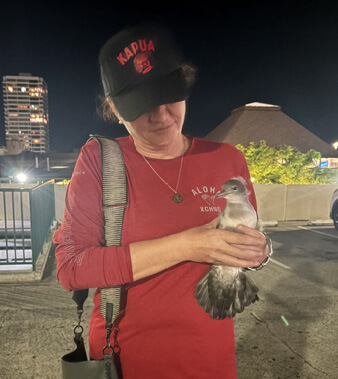
“I look down, and I see this bird, between the sliding glass door, the automatic doors, and the crates,” said Mary Moriarty who thought it was a pigeon until she looked closer.
Her quick recognition came from experience. Moriarty grew up on Kauaʻi at Kīlauea Point National Wildlife Refuge in the 1980s, where her father was the manager. “Kīlauea has the largest native seabird colony in the main Hawaiian Islands,” she said.
On that evening of Nov. 30, 2025, Moriarty’s son asked her if it was a duck. That’s when her instincts kicked in.
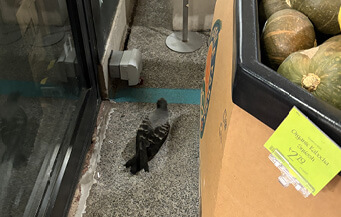
“The easiest way to identify any shearwater bird is by the web feet. That’s how you can tell that it’s not a pigeon. That and knowing that lights will down them,” said Moriarty.
Every November and December young ʻua’u kani (wedge-tailed shearwater) take their first flight out to sea led by the light of the moon. It also marks “fallout season,” as the young birds are often disoriented by the bright lights in developed areas.
“It’s called ‘fallout’ because when they go inland, they will circle lights, get exhausted and literally fall out of the sky. Or, if they go inland, they [often] hit light poles or buildings,” explained Rae Okawa, development director at Hawaiʻi Wildlife Center (HWC).
“So, malls, stadiums, road construction, parking lots – anything with bright, unshielded lights can draw these birds in,” said Okawa.
Moriarty understood that – and that predators might get to a fallen seabird. She recalled that there were areas on Kauaʻi that had boxes available for people to safely place seabirds that were found and in distress.
On that evening at Kahala Mall, Moriarty didn’t have a box. When she informed staff at the mall she didn’t get much of a response. So, instead she carefully picked up the seabird.
“I know how to hold them because I spent a lot of time banding shearwaters as a child,” said Moriarty. “You have to watch out so they don’t bite you.”
She carefully tucked it under her arm, and it calmed when she got it into her car.
Once she was home, Moriarty turned off the lights and set the bird on her lānai. “I just let it sit, and then it was gone, like, a couple hours later,” she said.
HWC recommends handling a grounded seabird by gently covering it with a pillowcase, towel, or t-shirt to reduce stress (and protect yourself from its beak), then placing it in a ventilated box in a quiet, dark space until it can receive proper care. HWC partners with clinics across Oʻahu to support these rescues.
In 2024, the HWC Oʻahu Seabird Aid Program cared for 645 ʻuaʻu kani during the peak fallout season. Early reports suggest that 2025 could surpass that figure, underscoring the growing need for community awareness and response.
If you find an injured or downed native seabird, please help. On Oʻahu, Feather & Fur Animal Hospital in Kailua is the primary drop-off location for downed or injured native seabirds. For more information go to: hawaiiwildlifecenter.org.