
The Hawaiʻi Supreme Court rules in favor of the Maui community
By Kaulu Luʻuwai, Esq.
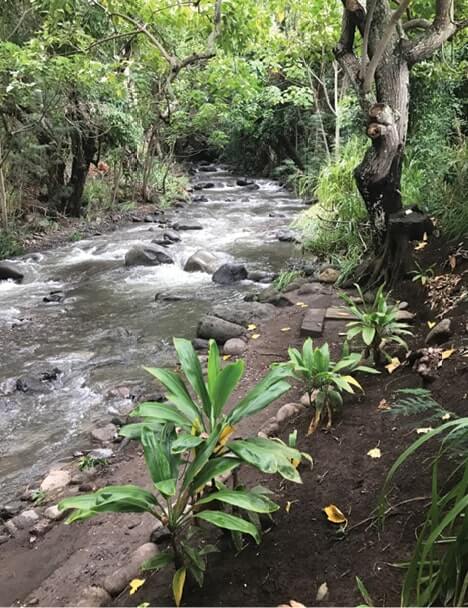
The streams win! Twenty years after filing the original lawsuit, community groups Hui o Nā Wai ʻEhā and Maui Tomorrow – along with the Office of Hawaiian Affairs (OHA) – finally celebrated the ultimate victory in the struggle to protect the four great waters of Waikapū, Wailuku, Waiehu, and Waiheʻe, collectively known as Nā Wai ʻEhā.
On June 20, 2024, the Hawaiʻi Supreme Court issued a landmark ruling in the long-running water case that makes clear private profit cannot trump public trust resources – such as free flowing streams.

“We are grateful that the supreme court continues to understand that the health and wellbeing of our community is directly linked to the health and wellbeing of our ʻāina (land), wai (water), and kai (ocean),” said Hōkūao Pellegrino, president of Hui o Nā Wai ʻEhā. “And we are also grateful for the opportunity to share this victory with OHA, who has been a steadfast ally in this lawsuit from day one.”
OHA was an early and reliable advocate for the restoration of streams and the rejuvenation of traditional Kānaka Maoli lifeways. OHA’s attorney, veteran litigator Pam Bunn, noted that “OHA has been instrumental in shaping water policy in Hawaiʻi, not only through its support for high-impact litigation, but also through its tireless education and advocacy efforts.”
Bunn’s sentiment was echoed by the lead attorney representing the community groups, Hui o Nā Wai ʻEhā and Maui Tomorrow. “OHA’s unwavering partnership with the Nā Wai ʻEhā community throughout this two-decade legal campaign has brought real and lasting change for our wai and kānāwai (laws). It’s been a model of movement building for the community and lāhui,” said Isaac Moriwake, managing attorney for Earthjustice’s Mid-Pacific Office.
This appeal comes out of a decision made by the Commission on Water Resources Management after Hawaiian Commercial & Sugar Company (HC&S) closed its sugar operations in 2016.
Instead of reassessing the actual remaining water need at the time, the commission issued a decision in 2021 that retained the existing flow levels that were set while HC&S was still in full operation. This begged the question: where was all that water going?
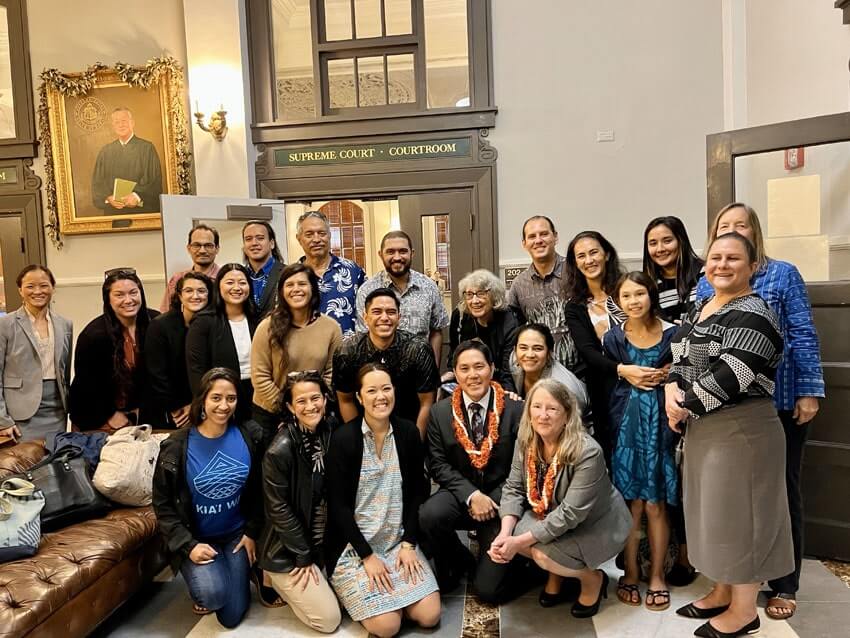
The community groups and OHA challenged the commission’s decision in court, ultimately turning to Hawaiʻi’s highest court to uphold the constitution and protect the streams, as well as everything that depends on them for survival.
During the oral arguments for this case in 2023, Moriwake poignantly expressed the “historic opportunity” we have to restore streamflow following the plantations’ closures on Maui – an opportunity that may only happen once in a century.
In its final 134-page written decision issued in June 2024 the court noted that, “Rather than proactively addressing the historic opportunity to restore stream flows,” the commission made a choice that demonstrates “a passive failure to take the initiative to protect the public trust in the light of HC&S’s closure.”
The court determined that the commission failed to meet its legal duties to restore stream flows following the end of HC&S’s water-intensive sugar operations.
In addition to its ruling on stream flows, the court rejected various challenges by large water users against their water allocations by the commission.
The court upheld the commission’s decision to restrict the amount of stream water allocated for two golf courses. The court rejected the argument by Mahi Pono, the company that bought HC&S’s lands, that it was entitled to more water than the commission allocated for diversified agriculture. Further, the court denied the objections by Wailuku Water Company, a former plantation now in the business of selling stream water, which opposed the commission’s authority to regulate the company’s operations.
“The court confirmed that the state is in no way obligated to give away public water for private profit, including sacrificing streams to water golf turf,” said Moriwake. “In this era of climate change, these rulings send a clear and strong signal for other critical water management decisions to come, including in West Maui.”
The Nā Wai ʻEhā region in central Maui was the island’s historical epicenter, supporting the largest continuous region of wetland kalo cultivation in all of Hawaiʻi. This land became ground zero for colonization and the plantations’ taking of stream and ʻauwai (traditional irrigation channel) flows as private property.
Twenty years ago, history came full circle when local community groups and OHA embarked on this legal campaign to reverse the plantation capitalism legacy of water diversion and restore local ecosystems and Kānaka Maoli cultural practices that depend on free-flowing rivers and streams.
In its decision, the court sent the case back to the commission to properly restore Nā Wai ʻEhā stream flows to the full extent practicable as mandated by law. This is not only a win for Nā Wai ʻEhā, but for all who love Hawaiʻi.
Ola i ka wai!
Kaulu Luʻuwai is a post-JD legal fellow at Ka Huli Ao Center for Excellence in Native Hawaiian Law at the William S. Richardson School of Law at UH Mānoa.