

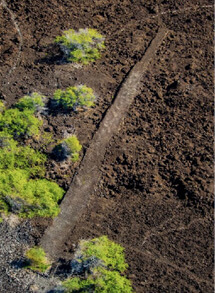
In the remote, barren, and arid landscape of South Kona, about six miles south of the ancient Native Hawaiian fishing village of Miloliʻi, sits the Āhole Hōlua.
To the casual observer, the area may appear empty or inactive. In reality, it is a cultural landscape shaped by generations of Native Hawaiians who lived, trained, competed, and gathered here. The land bears clear and deliberate evidence of planning, engineering, and social organization.
I first came to Āhole as a little boy with my father. Standing beside the hōlua, he shared moʻolelo passed down through our ʻohana, pointing across the land and toward the ocean, and speaking of the ancestors who lived here, trained here, and tested themselves here. He spoke of discipline, courage, and preparation, values shaped by this ʻāina long before they were ever written down.
Even then, I understood something important: Āhole was not a ruin. It was a reminder – a place where the past remained present, and where our ancestors felt close. Today, as a father myself, I bring my daughters here to share those same moʻolelo, continuing the responsibility to pass this knowledge forward.
In 1913, surveyor W.D. Kinney described the site as “a perfect papa hōlua, about 400 to 500 feet long, appearing as if it had been built but yesterday.” More than a century later, the accuracy of that observation remains striking. The Āhole Hōlua is exceptionally well preserved, retaining its form, alignment, and integrity.
Hōlua were massive stone sledding ramps used by ancient Hawaiians for heʻe hōlua, a highly dangerous and prestigious sport. The athlete sprinted along a prepared runway before launching headfirst down a steep, grass-covered stone chute at high speed. Participation was largely reserved for aliʻi, and success required exceptional physical conditioning, mental focus, and training.
The sleds themselves were long, narrow, and finely polished, closely resembling the design principles of double-hulled canoes – evidence of advanced craftsmanship and engineering knowledge.
Historian Kenneth Emory observed that true sledding traditions existed only in Hawaiʻi and Aotearoa (New Zealand), but that Hawaiian hōlua were unique in their construction and scale. Rev. Hiram Bingham described the sport as one in which the rider would run to gain momentum, dive headfirst onto the sled, and race down the lava chute, “scarcely valuing his neck more than the prize at stake.”
Legend holds that Kekūhaupiʻo, a renowned warrior and teacher of Kamehameha I, trained at Āhole. This association reinforces the site’s role as a place of discipline, preparation, and excellence. The hōlua itself is a carefully engineered structure, constructed primarily of ʻaʻā stone, with ʻiliʻili and coral near the base. Its varying slope is designed to control acceleration and deceleration, comparable in precision to a modern ski jump. One notable feature is the visual alignment that creates the impression the sledder is carried directly into the ocean.
The Āhole Hōlua, together with its surrounding terraces, platforms, walls, trails, and cultural deposits, reflects a complex and organized Native Hawaiian community. It is among the best-preserved hōlua complexes on Hawaiʻi Island and in the state. More than an archaeological feature, it is a cultural landscape that embodies innovation, social structure, and cultural continuity.
The Office of Hawaiian Affairs should seek to initiate the evaluation and, if appropriate, nomination of the Āhole Hōlua Complex to the National Register of Historic Places. As a constitutional trust entity serving Native Hawaiian beneficiaries, OHA carries the kuleana to identify, protect, and elevate cultural resources that affirm Native Hawaiian history, resilience, and enduring connection to ʻāina.

