
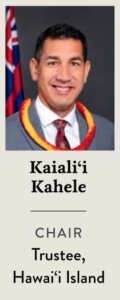
One of the greatest losses in Hawaiʻi’s history was not only political sovereignty, it was narrative sovereignty.
Before the overthrow of the Hawaiian Kingdom, Native Hawaiians built one of the world’s most vibrant Indigenous Hawaiian language newspapers, preserving moʻolelo, debating public policy, recording history, and shaping the future of the Kingdom. Native Hawaiians were not merely the subjects of the news; they were its publishers, editors, writers, and critics.
Over time, those voices diminished. As political power shifted so, too, did control over Hawaiʻi’s dominant narratives.
For generations, stories about Native Hawaiians have increasingly been filtered and illustrated through non-native institutions and worldviews, rather than through Native Hawaiian voices and lived experience.
Media does far more than report facts. It shapes what society values, whose voices are trusted, and how communities understand one another. Today, narrative is often shaped through quieter editorial choices: headlines, photographs, cartoons, and the stories that receive attention. Individually, these decisions may appear insignificant. Collectively, they influence public perception.
One need not look only at headlines to see this. Even positive stories celebrating Native Hawaiian youth have, at times, been paired with imagery that many reasonably viewed as diminishing rather than uplifting the very people the stories sought to celebrate.
I cannot know the intent behind those editorial decisions, but intent and impact are not always the same. Editorial judgment carries weight.
The recent discussion surrounding the Office of Hawaiian Affairs’ exploration of acquiring KITV and KIKU provides another example. OHA’s proposal deserves rigorous public scrutiny, and reasonable people can disagree about whether it represents a wise investment of trust resources.
But much of the conversation quickly shifted from evaluating the proposal on its financial and strategic merits to questioning whether Native Hawaiians were seeking to “influence” public opinion through media ownership.
That framing deserves reflection.
Every media organization is shaped by its ownership. Across America, much of the media landscape is concentrated among corporations, nonprofits, investment groups, and billionaire owners. Their priorities, investments, and editorial judgments inevitably influence the public conversation. Ownership has always mattered.
Yet when Native Hawaiians seek to participate in that same landscape, not to silence others, but to become owners themselves, the conversation often changes.
Suddenly, questions are raised about “influence,” motive, and objectivity in ways that are rarely applied to those who already possess enormous influence over public discourse. If ownership matters when Native Hawaiians are involved, then intellectual honesty requires acknowledging that it matters for everyone.
Political cartoons deserve broad protection as expressions of free speech. They challenge elected officials, institutions, and ideas, and they should. But they also shape public perception.
When Native Hawaiian institutions are repeatedly portrayed through ridicule or caricature without equal attention to the historical context in which they exist, those portrayals become part of a broader narrative.
None of this is an argument against criticism. OHA should be scrutinized. Its trustees should be questioned. Public institutions earn trust through transparency, accountability, and results.
Native Hawaiians are not seeking to control the narrative. We are seeking something our kūpuna once exercised freely: the opportunity to help tell our own story.
The question is not whether Native Hawaiians should own media, but whether they deserve a meaningful place within it. If we accept concentrated media ownership by wealthy individuals, powerful institutions, and national organizations as an ordinary feature of our modern media landscape, then Native Hawaiian ownership should not be viewed through a fundamentally different lens.
Reclaiming narrative sovereignty is not about diminishing anyone else’s voice. It is about ensuring that Native Hawaiians are no longer merely the subjects of Hawaiʻi’s story, but once again among its authors.

