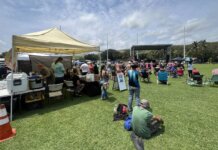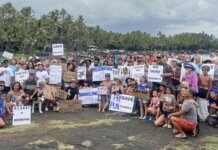
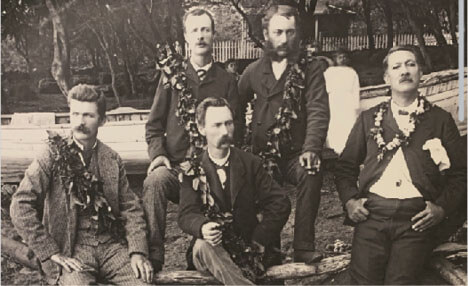
Many non-Hawaiian royalists stood alongside Kānaka Maoli to support Queen Liliʻuokalani after the overthrow
The Hawaiian Kingdom that Queen Liliʻuokalani inherited was a constitutional monarchy grounded in centuries of Indigenous governance and hybridized with the political vocabulary of the 19-century world.
It operated with kuleana as a governing ethic, alongside treaties, constitutions, and the law of nations. It was multilingual, multiracial, and globally engaged. Political belonging was defined by allegiance rather than exclusively by race.
When this constitutional order came under sustained attack, those who stood with the Queen were not only Kānaka Maoli. Some were kupa Hawaiʻi, Hawaiian citizens or nationals who were not Indigenous, but who understood themselves as belonging to the Kingdom and loyal to its sovereign.
Like their Kānaka Maoli counterparts, these royalists were subjected to the Republic of Hawaiʻi’s surveillance apparatus, including a network of spies known as the “specials,” overseen by Marshall Edward Griffin Hitchcock. Loyalty, in this moment, carried real consequences.

One of the most prominent non-Kānaka Maoli royalists was Paul Neumann. A German Jewish attorney, Neumann served as attorney general under King Kalākaua and later became Queen Liliʻuokalani’s legal counsel and confidant.
He assisted the Queen in drafting the proposed 1893 Constitution and, following the overthrow, traveled to Washington, D.C., to argue for her restoration at a time when the United States was moving decisively toward overseas empire.
When those efforts failed and the Queen was placed on trial by the Republic’s military tribunal in 1895, it was Neumann who stood beside her as her attorney. He was publicly mocked in the press and subjected to personal attacks, yet he remained loyal out of deep respect for the Queen and his adopted country.
Royalist resistance also took place beyond courtrooms and legislatures. George Lycurgus, a Greek immigrant and hotelier, ran the Sans Souci Hotel at Waikīkī, which became known as a gathering place for royalists opposed to the Republic.
After the 1895 uprising, Lycurgus was arrested and jailed for treason. Rather than retreat into silence, he later embraced the label “Jailbird of 1895” and organized reunions among former prisoners as a public reminder that imprisonment had not broken their political convictions.

While the 1895 uprising was led by Kānaka Maoli, non-Hawaiians also participated and were captured and jailed. William H. Rickard, a planter of British parentage, assisted with logistics and planning. Charles Creighton, an Irish lawyer born in New Zealand who had served under Queen Liliʻuokalani, also took part. After his arrest, Creighton was placed in isolated confinement. He and 11 other non-Hawaiians were ultimately deported by the Republic of Hawaiʻi, a reminder that dissent was treated as a crime regardless of origin.
People were guided by different motivations. Some royalists held paternalistic views toward Kānaka Maoli. Some had benefited from land or capital during the time of the Monarchy but found themselves excluded from the new Republic’s elite. Yet, when silence would have preserved comfort and status, many chose to stand with the Kingdom out of a sense of duty and moral obligation.
Resistance also unfolded through the press. Journalists who supported the monarchy faced harassment, interrogation, censorship, fines, deportation, and imprisonment.
Editors and writers, both Kānaka Maoli and non-Kānaka Maoli, at pro-royalist papers such as the Hawaiʻi Holomua, Ka Makaʻāinana, and Ke Aloha ʻĀina quickly learned the limits of press freedom under the regime.
Even journalists who were not royalists were targeted. American writers J. A. Cranston and J. B. Johnson were banished without trial for publishing critical reporting about the regime.
The overthrow also divided missionary families. Some descendants, such as Lorrin Thurston, became central figures in the Republic’s oligarchy. Others took more complicated positions. Rufus Lyman supported annexation but opposed the Republic itself. Still others remained loyal to the Kingdom.

Charles T. Gulick, born in Massachusetts and descended from a missionary family, had served as a cabinet minister under the Monarchy. In 1895, he helped lead the uprising and coordinated arms landings. He was captured, imprisoned, and sentenced to death. He was ultimately pardoned alongside Robert William Kalanihiapo Wilcox in 1896.
There were also royalists whose names were never recorded. Chinese and Japanese immigrants, many of them plantation workers, secretly donated money, arms, and logistical support to royalist efforts in 1889 and 1895.
Anonymity was a form of survival. Sugar oligarchs had the power to fire, jail, or deport royalists along with their families. Unlike figures such as Neumann or Gulick, they lacked protection due to their race, class, and citizenship. Yet some still chose to act, and some were brave enough to sign their names to the Kūʻē petitions in 1897.
These accounts force us to confront the illegal overthrow, the 1895 uprising, and the purported annexation not as distant or misunderstood events, but as sustained processes of pressure, coercion, and choice.
They challenge the claim that non-Hawaiians were unaware of what was unfolding. Many understood clearly.
Kānaka Maoli loyalty to the Kingdom was persistent, organized, and principled, sustained through petitions, resistance networks, and profound personal sacrifice despite overwhelming force.
Alongside them, some non-Hawaiian subjects of the Kingdom chose fidelity to Queen Liliʻuokalani and paid through their imprisonment, exile, surveillance, or banishment, while those who aligned with the Republic were rewarded with land, office, and protection.
For non-Hawaiians today, these histories offer concrete examples of justice-centered allyship. They show that solidarity is neither symbolic nor self-congratulatory. It is collective work that confronts unequal power, redistributes risk, and commits to sharing political and material burdens alongside Kānaka Maoli in the ongoing struggle to reclaim ea (sovereignty).