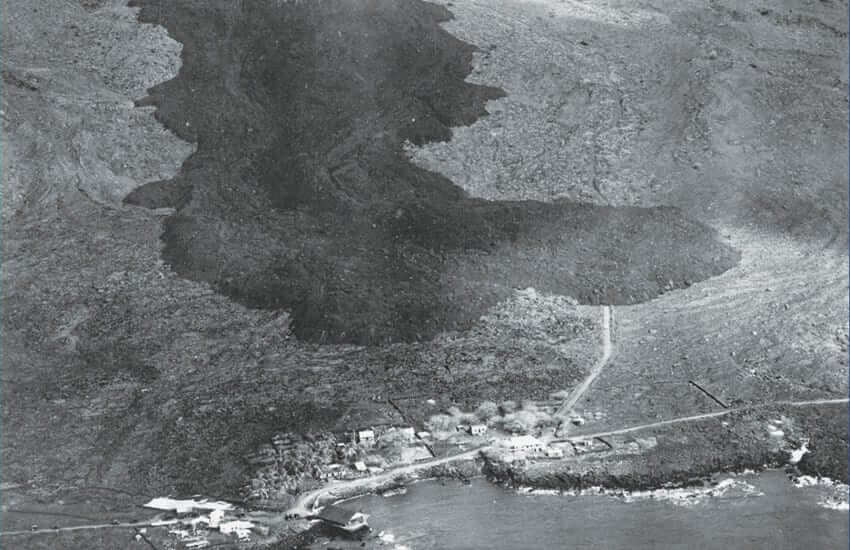
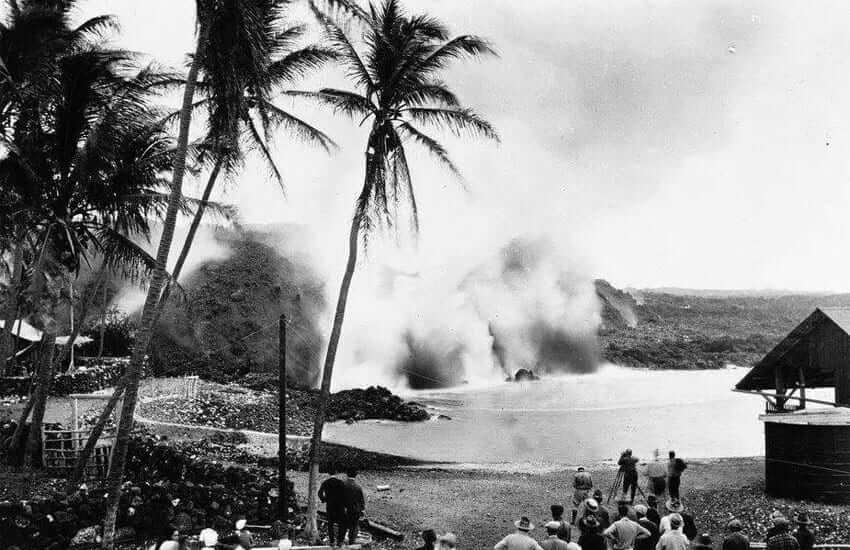
On the morning of April 18, 1926, a wall of lava – nearly 30 feet high and more than 1,000 feet wide – advanced on the fishing village of Hoʻōpūloa. Moving at roughly 7 feet per minute, it swallowed homes, overtook the school and church, and buried the shoreline community in a matter of hours.
Before the flow, Hoʻōpūloa was one of many thriving fishing communities along the Kona Coast. The village may have even predated western contact, stretching as far back as the first millenia.
According to, “Kīpāhoehoe ma Kapalilua – Kona Hema, Hawaiʻi: A Cultural Study of Kīpāhoehoe and Neighboring Lands in Kapalilua, South Kona, Island of Hawaiʻi,” researchers Kepā and Onaona Maly note that the people of Kona Hema (South Kona) thrived from fishing, but also cultivated ʻuala (sweet potatoes) and coconuts and further ma uka they cultivated dryland kalo, bananas, and ʻulu (breadfruit). “Fresh water came from either springs [or] water caves, or procured by rain catchment and dewfall. Back then, the forests extended further seaward, drawing the kēhau and kēwai (mists and dew) from the upper mountain slopes to the low lands.”
By the 19th century, Hoʻōpūloa had emerged as an active hub of coastal trade. Steamships moved regularly along the Kona coast, stopping offshore as goods and passengers were ferried in and out. Roads connected upland agricultural fields to the harbor, allowing farmers to bring their crops to the shoreline for exchange. For a time, Hoʻōpūloa drew both Kānaka and settlers, serving as a connection between land and sea.
The village rested below an old ʻaʻā flow. A small cove created a natural harbor where a wharf was constructed. Kiawe, monkey pod, and coconut trees were scattered throughout the village. Homes were equipped with water catchment tanks, collecting rainwater from their corrugated metal roofs.
At the center of the village stood a convenience store (its largest structure), alongside a schoolhouse, a church, and a post office. A road ran north to south, connecting Hoʻōpūloa to the neighboring village of Miloliʻi. Offshore, a rock called Kakakohola marked the boundary between them.
The disaster began eight days earlier. In the early hours of April 10, 1926, a series of earthquakes shook the summit of Mauna Loa. Engineers from the U.S. Geological Survey (USGS), who were camped on the mountain at the 11,400-foot elevation, witnessed the first signs of eruption.
According to USGS volcanologist Tom Jaggar, about an hour after the initial earthquake, glowing lava spouted immediately south of Mokuʻāweoweo, the summit crater. “A crack only 1-3 feet wide opened [and] vomited out pumiceous silvery pāhoehoe froth lava,” he wrote.
What began as a narrow vent quickly widened. The lava changed character from smooth pāhoehoe (unbroken lava) to jagged ʻaʻā (rough lava).
Over the next several days, the eruption would build in strength. Rivers of molten lava poured from Mokuʻāweoweo down the slopes of Mauna Loa, cutting through ma uka forests, and moving resolutely toward the Kona Hema (South Kona) coast.
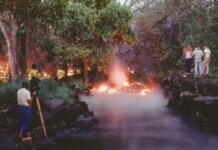
On April 16, the lava crossed the main road of South Kona. Crowds of onlookers gathered to watch its descent toward the Hawaiian fishing villages of Miloliʻi and Hoʻōpūloa. The lava pooled behind Hoʻōpūloa for two days, until it made its final descent.
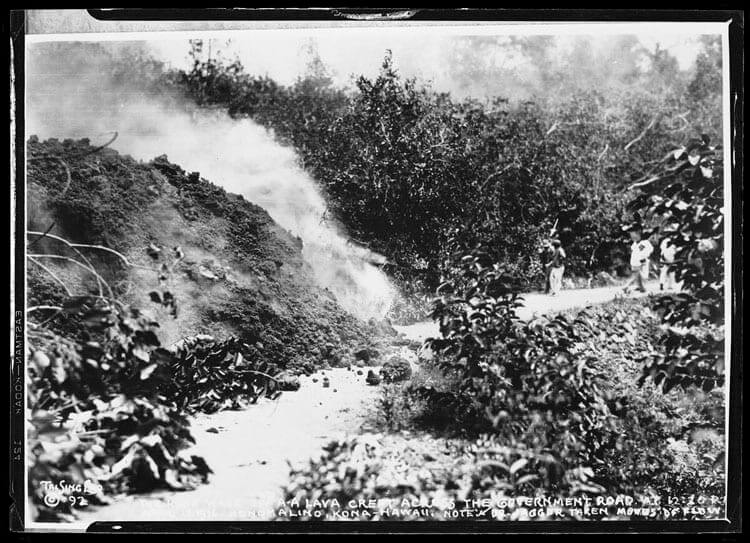
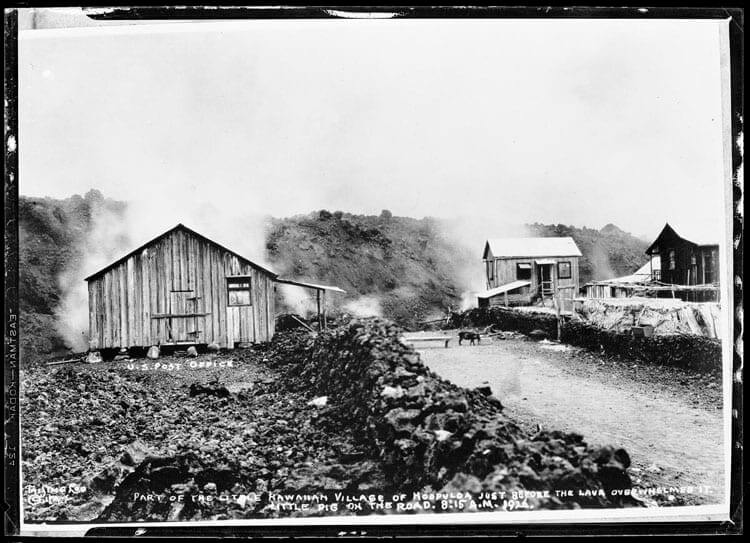
On April 18, at approximately 3:00 a.m., evacuated residents and spectators watched helplessly as the lava flow consumed their homes. Mere hours later the destruction of the village was complete; the lava piling over itself as it met the ocean. When it ended, Hoʻōpūloa was buried under approximately 50 feet of newly formed pāhoehoe.
Fortunately, the neighboring village of Miloliʻi was spared, allowing the residents of Hoʻōpūloa to find refuge there. Families whose lineage was rooted along that coast continued to live a subsistence lifestyle as their ancestors did.
Today, Miloliʻi is referred to as the “last Hawaiian fishing village,” in part because it absorbed the people and traditions of Hoʻōpūloa. But the community’s connection to this coastline has yet to be translated into legal ownership.
In 1982, the State of Hawaiʻi attempted to address the presence of the families residing in Miloliʻi by passing legislation to establish long-term residential leases. The state retained the land as part of the public trust but allowed families with historical ties to the area – including the descendants of those displaced by the eruption – to remain on their ancestral land.
The policy was intended to recognize the community’s generational connection to the coastline while maintaining the land under state stewardship. However, continued state ownership raises questions about long-term security for these families.
A century later, the name Hoʻōpūloa remains on maps of the island, marking the approximate location of the former village. The flow can still be traced from the summit of Mauna Loa to the sea, visible from satellite images as it cuts across the landscape.
The village of Hoʻōpūloa remains an important part of the history of South Kona. Although the lava covered its homes and roads, it did not bury its people, their knowledge, or their connection to the land.
Hoʻōpūloa lives on through the people of Miloliʻi, who continue to fish the waters, mālama ʻāina, and carry forward the ʻike of those who came before them. This centennial is not only a remembrance of Hoʻōpūloa, but a commemoration of the resilience of the people who have always called this place home.