
Submitted by Clean Slate Hawai‘i
“Have you ever been convicted of a felony?”
That one question, posed on an application for a pharmacy technician position, dashed any hopes Michelle Manalo had for getting the job.
After working at her local pharmacy for several years as a cashier and in the photo department, Manalo’s manager encouraged her to pursue the pharmacy’s technician program as a pathway to advance within the company. Manalo studied for months before preparing to fill out an application.
But a past conviction record meant Manalo would almost certainly be rejected, despite the fact she’d completed her sentence several years prior.
“My boss supported me and was behind me 100%, even knowing about my history,” said Manalo, who now works at Going Home Hawaiʻi, an organization that supports formerly incarcerated people as they reenter society. “I had the full support of the administration, but unfortunately, my record prevented me from pursuing that goal.”
Michelle’s experience is not uncommon: one in four adults in Hawaiʻi has an arrest or conviction record that creates a barrier to getting a job, securing housing, or pursuing educational opportunities. This makes it difficult for people to earn a dignified living and provide for their ʻohana.
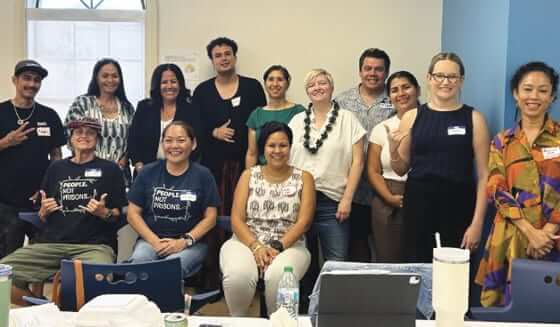
A coalition of community-based organizations, faith-based groups, and directly impacted individuals called Clean Slate Hawaiʻi is working to change this. The coalition, which includes the Office of Hawaiian Affairs (OHA), is advocating for a so-called “Clean Slate” law in Hawaiʻi’s next legislative session, which would shield or expunge past arrest or conviction records from most background checks.
Outside of Hawaiʻi, 14 states and Washington, D.C., have passed Clean Slate laws to make second chances more accessible to people with records. As a result, over 18 million people are on the pathway to a meaningful second chance.
Clean Slate laws streamline the process of shielding eligible arrest or conviction records for people who have paid for their past mistakes and remained crime-free for several years.
When a record is shielded, it no longer appears on background checks used for jobs, housing, or school. Record shielding doesn’t erase the record, however; law enforcement and courts can still access shielded records when needed.
While it’s currently possible to petition the Hawaiʻi Criminal Justice Data Center or the courts to shield an arrest or conviction record, the process is complicated and costly. Fewer than 1% of people who are eligible for records relief receive it.
Advocates say that establishing a record-shielding system, supported by technology with human oversight, would cut red tape, improve efficiency, and reduce the chances that someone reoffends.
“Record shielding actually keeps people out of the system, because they have a fair shot at finding work or stable housing,” said Jamee Miller, president of ʻEkolu Mea Nui and an advocate for a Clean Slate law in Hawaiʻi.
“Research from outside of Hawaiʻi shows that people whose records get shielded are much less likely to reoffend, which makes our communities safer.”
As Michelle Manalo experienced, having a record can make it difficult to find a good-paying job.
New research from The Clean Slate Initiative finds that people with arrest and conviction records experience a combined $440 billion in lost annual earnings nationwide – economic activity that could otherwise strengthen communities and drive growth. In Hawaiʻi alone, these earnings losses total an estimated $2.2 billion each year.
Employers are also impacted. With Hawaiʻi’s low unemployment rate, businesses struggle to fill open positions and miss out on qualified candidates, simply because of their record.
Advocates with the Clean Slate Hawaiʻi coalition are working to get a bill introduced during the 2027 legislative session. It would build on earlier efforts to reform Hawaiʻi’s record shielding system.
In 2024, Hawaiʻi’s legislators established the Clean Slate Expungement Task Force. The task force is responsible for making recommendations to the legislature for a state-initiated record-shielding program ahead of the next legislative session.
Legislators also established a pilot project in 2024 to shield certain arrest records for Hawaiʻi Island residents with low-level drug offenses, particularly for marijuana which was decriminalized in 2019. More than 1,300 people’s records were shielded without having to go through the court petition process, according to a report by the Department of the Attorney General.
Rep. David Tarnas, who represents North and South Kohala and serves as the chair of the House Committee on Judiciary and Hawaiian Affairs, introduced the bill that established the Hawaiʻi Island pilot project. In an interview with Hawaiʻi Public Radio in 2025, he shared, “I’m a firm believer in second chances and redemption, and expungement and record clearance is part of that.”
In many ways, Clean Slate reflects the spirit of ho‘oponopono: making things right, restoring relationships, and allowing people to move forward in harmony with their community. Clean Slate is about restoring balance, strengthening ʻohana, and ensuring that every person can contribute to a thriving Hawaiʻi.
Clean Slate Hawaiʻi, the coalition fighting for a Clean Slate law locally, believes everyone deserves a second chance to rebuild their lives.
To learn more, go to cleanslatehawaii.org. Share your support for Clean Slate legislation with your state representative and senator.