Kapualehuaonapalilahilahiokaala Kaʻapu Sproat Fonoimoana
March 9, 1938 – Oct. 2, 2025
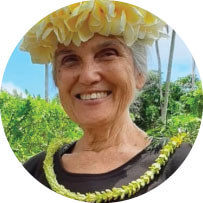
Honolulu, Oʻahu: Beloved traditional Hawaiian healing practitioner Kapua Kaʻapu Sproat Fonoimoana was a member of Ke Ola Mamo’s board of directors and the kūpuna council of practitioners of Hawaiian healing traditions. Sproat Fonoimoana was raised in Punaluʻu, Oʻahu, and despite being born in the mid-20th century, she had an unconventional upbringing. Her ʻohana lived in a traditional hale pili (grass house) without electricity or running water – part of a kauhale built by her father, David Kaʻapu, on the family’s 2-acre ʻohana parcel. The family planted loʻi kalo and lived traditionally and self-sufficiently on the ʻāina. Sproat Fonoimoana later attended Kamehameha Schools, her love of education fostered by her mother who was a school teacher. As a result of her extraordinary childhood and upbringing, Sproat Fonoimoana was an early advocate of ʻai pono as well as a lāʻau lapaʻau practitioner, and an avid gardener and farmer, who grew both food and medicinal crops. With ʻike gleaned from her childhood, she also taught public health educators and dietitians how to dry and preserve traditional Hawaiian foods in preparation for open ocean travel – and then she traveled with dietitian Kaʻiulani Odom to carry those dried traditional provisions to the Marquesas Islands in French Polynesia to supply crew members of the Hōkūleʻa as they made their way home to Hawaiʻi. Sproat Fonoimoana often worked with Koʻolau physician Dr. Miriam Chang, even sharing patients from time-to-time – including one patient with severe external injuries. Sproat Fonoimoana treated the patient with lāʻau lapaʻau, and they were healed without scars.

George “Keoki” Fukumitsu
June 2, 1953 – May 18, 2025
Hakipuʻu, Oʻahu: Keoki Fukumitsu, affectionately known as “Kalo Man,” was a seventh generation kalo farmer born and raised on ʻohana kuleana land in the ahupuaʻa of Hakipuʻu. A respected community leader, advocate and organizer, Fukumitsu was a kumu of kalo and traditional agro-ecological management, providing advice and guidance on restoration and farming efforts based on the ʻike kūpuna passed down through his ʻohana. Fukumitsu was also active in the Aloha ʻĀina movement and Protect Kahoʻolawe ʻOhana in the 1970s and 80s, and was one of the original members of the Hakipuʻu ʻOhana (part of a coalition of plaintiffs collectively known as “Windward Parties”) in the landmark Waiāhole water case in the 1990s that sought to restore streams diverted from Windward Oʻahu by Central Oʻahu sugar plantations. Fukumitsu was the founder of grassroots nonprofit Hoʻihoʻi Ea which offers programs designed to provide a comprehensive approach to cultural preservation, sustainable development and community empowerment. Fukumitsu was profiled in a 1985 Nā Maka o ka ʻĀina documentary, Today’s Makaʻāinana – the Fisherman and the Farmer, and in a 2011 segment on the Free Hawaiʻi Broadcasting Network called Kalo Man – A Visit with Keoki Fukumitsu. Fukumitsu served as an advisor on various taro projects for UH Mānoa, Windward Community College, Kauaʻi Community College, the Native Hawaiian Advisory Council, and the Kawainui Marsh Ulupō Heiau Project, and was appointed to the state’s Taro Purity and Security Task Force. Beloved by his ʻohana and friends for his strength and resilience, Fukumitsu was steadfast in his aloha for the ʻāina, for his ʻohana, and for his kaiāulu.
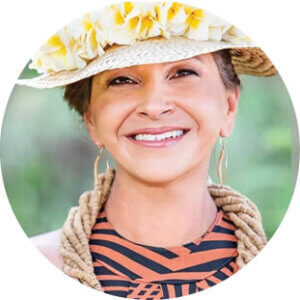
Jonelle Leināʻala Pavao Jardin
Nov. 26, 1973 – Oct. 4, 2025
Kalāheo, Kauaʻi: Kumu Hula Leināʻala Pavao Jardin was the beloved and celebrated kumu of Hālau ka Lei Mokihana o Leināʻala from Kauaʻi. Since 2011, the multiple award-winning hālau has been a top performer at the annual Queen Liliʻuokalani Keiki Hula Competition, but in 2022 Hālau ka Lei Mokihana o Leināʻala made history as the first hālau from Kauaʻi to win the prestigious Lokalia Montgomery Perpetual Award at the Merrie Monarch Festival after a clean sweep in all wāhine categories. Earlier this year the hālau made history again when Jardin’s niece, Jaedyn Janae Puahualani Pavao, was crowned 2025’s Miss Aloha Hula – the first dancer from Kauaʻi to earn the coveted title. Jardin was a graduate of Waimea High School on Kauaʻi and of UH Hilo. She began dancing at the age of 3 under Kumu Hula Kuʻulei Punua, and later trained under Kumu Hula Lovey Apana and Kumu Hula Beverly Muraoka. While attending UH Hilo, she continued her advanced training under Kumu Hula Rae Fonseca. A year after returning to Kauaʻi in 1995 to care for her mother, Jardin opened her hālau with Kumu Fonseca’s blessings. Over the past 30 years, her hālau has grown to include some 200 haumāna on Kauaʻi, and in Japan and Mexico. Beyond achieving excellence in the artform that is hula, Jardin emphasized culture, language and history, connecting her haumāna with experts, resources and service opportunities in the community to dignify cultural practices and inspire restorative action. Jardinʻs daughter, Breeze Ann Pavao, now leads the hālau as its kumu hula.
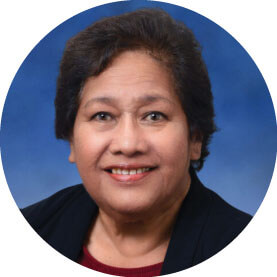
Natalie “Tasha” Kama
Aug. 14, 1952 – Oct. 26, 2025
Kahului, Maui: Respected community leader, social justice and housing advocate, kahu and Maui County Councilwoman Natalie “Tasha” Kama was in the middle of serving her fourth consecutive term when she passed. Born and raised on Oʻahu, Kama moved to Maui as an adult 10 years after her dad received a homestead lease there. Known as a woman of deep faith, compassion and aloha, Kama became a pastor at her fatherʻs Christian Ministry Church in Wailuku soon after moving to Maui in 1983. With an associates degree in human services and certificates of competence in case management and substance abuse counseling, she was a passionate social justice organizer with Faith Action for Community Equity on Maui and helped establish the Waiohuli and Keokea homestead community associations. A mother of 11 keiki – and raised with 11 siblings herself – Kama led the revival of the parent-teacher association at Iao Intermediate School. She won her first election to the Maui County Council in 2018 after beating former Maui Mayor Alan Arakawa. Kama said in an interview that she was motivated to serve on the county council because half of her children live on the continent due to the lack of affordable homes in Hawaiʻi. Kama was the council’s presiding officer pro tempore and chair of the Housing and Land Use Committee – handling some of the council’s most polarizing issues including Bill 9, the controversial short-term vacation rental phase-out measure and South Maui’s Honuaʻula master-planned community project. Kama was beloved for her grace, patience and kindness.
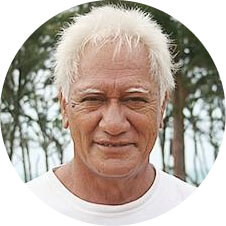
Parker Kaipo Kaneakua, Sr.
Sept. 24, 1943 – Aug. 29, 2025
Kalihi, Oʻahu: For decades, respected Loea Lāʻau Lapaʻau Kaipo Kaneakua was a pillar of Hawaiʻi’s traditional Hawaiian healing community. During his lifetime, he touched many people with his healing skills, intuition and discernment. Born to a family of traditional healers whose members specialized in treating specific diseases, Kaneakua began training when he was just 5 years old, learning how to identify, gather and prepare the plants needed for remedies, as well as in a variety of diverse healing practices. Although his training included instruction from more than a dozen of his kūpuna, he learned lāʻau lapaʻau and lomilomi from his father and pule, hoʻoponopono and pale keiki (midwifery) from his grandmother. Born and raised in Kalihi Valley on Oʻahu, he learned his healing skills the traditional way – by listening, observing and doing. Deeply spiritual, Kaneakua combined his faith in Ke Akua and Christianity with traditional practices, developing a holistic perspective on treating illness. Sought after as a healer, even from patients outside of Hawaiʻi, Kaneakua often healed injuries when western approaches were unsuccessful. He was steadfast in his belief that Ke Akua was the source of all healing. Generous with his knowledge, Kaneakua was kumu to those who wished to learn, taking his haumāna on “herb walks” in both rural and more urban settings, pointing out plants used for lapaʻau and explaining their uses and preparations. He also worked with physicians on Kauaʻi, Maui and in Kohala sharing the ways in which he used his senses – including smell, voice vibrations and pulse readings to diagnose illnesses.
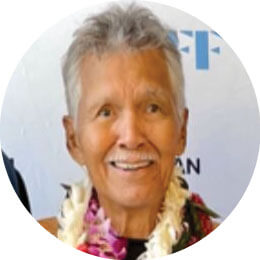
Mervin Lionel “Merv” Lopes
Sept. 23, 1932 – May 8, 2025
Waikoloa, Hawaiʻi Island: Best known as Chaminade University’s beloved basketball coach, Merv Lopes became a household name in Hawaiʻi in 1982 after coaching his team to a historic victory over top-ranked NCAA Division 1 University of Virginia – at the time, Chaminade was an underfunded NAIA school. Considered one of the biggest upsets in sports history, the win was followed by subsequent victories against nationally ranked teams like Southern Methodist earning the Chaminade Silverswords the nickname “Giant Killers” and Lopes the nickname “Merv the Magician.” Lopes coached basketball at Chaminade for 12 seasons, from 1977-1989, and remains the “winningest” coach in Chaminade history. Lopes was born in Nānākuli and his athleticism provided him with the opportunity to attend ʻIolani School. He graduated from ʻIolani as a three-sport athlete and went on to play football at San Jose State University. After earning a master’s degree from UH Mānoa and serving in the U.S. Army, Lopes became an educator, working for 30 years in the Hawaiʻi Department of Education as a middle school guidance counselor and as a high school P.E. teacher. In addition to coaching at Chaminade, Lopes coached at both Kalaheo and Kailua high schools, as well as in international sports programs around the world. Despite his success, those in the know say that for Lopes, coaching was more about building character than winning games. Known as a humble and aspirational leader, Lopes was devoted to his ʻohana and loved spending time at the ocean and fishing. In 2022, Lopes was named to Chaminade University’s Hall of Fame.
Author’s note: This hoʻomanaʻo is intended to recognize and honor the extraordinary contributions to our lāhui of those profiled. These are individuals who are widely known in our community, and this is a mere snapshot of their achievements based on information compiled from various community resources. The true richness of their lives – and how deeply they are loved and will be missed by their ʻohana and friends – cannot be captured in this format. We also acknowledge that there are many, many others who were lost to our lāhui this past year who we did not profile. For this, we apologize because we know their loss weighs heavily on the hearts of those who they loved and who loved them. As ever, our readers are invited to submit Haliʻa Aloha (fond remembrances) of their loved ones for publication in Ka Wai Ola newspaper. Ke Akua pū.