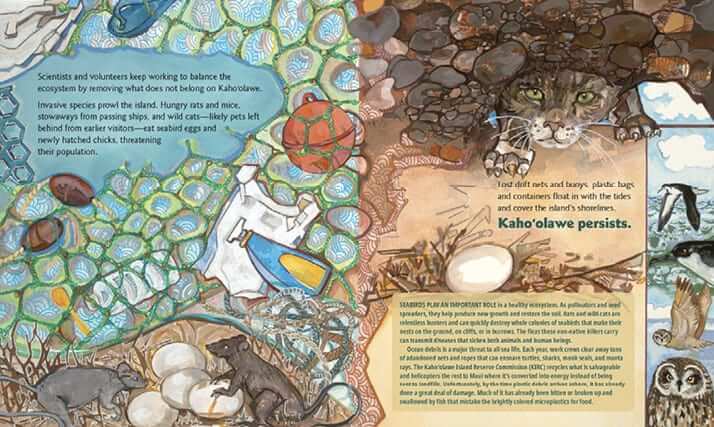

Book illustrations by Harinani Orme, “illustration © Harinani Orme for Kahoʻolawe, written by Kamalani Hurley, published by Carolrhoda Books
A collaboration between ʻŌiwi author Kamalani Hurley and ʻŌiwi illustrator Harinani Orme resulted in an illustrated children’s book, Kahoʻolawe: The True Story of an Island and Her People.
The nonfiction story traces the island’s birth, unique ecosystem, and voyaging history before explaining how the U.S Navy used the island for target practice and highlighting the first successful landing of kiaʻi to protest its destruction
“The book [is] my first project,” Hurley said. “I knew that I wanted to tell stories, but I wanted them to be real, true, especially about our people.”

Hurley spent 37 years working as a writing and linguistics professor at Leeward Community College. After retiring, she finally had time to write.
“There are so many books out there supposedly telling our stories but are not by us. So that’s what I wanted to do. And because Kahoʻolawe had been on my mind, I decided to go for it.”
Hurley grew up in Honolulu and, like many others, was taught that Kahoʻolawe was a barren rock. It wasn’t until she ventured off to the continent for college and returned home during the Hawaiian Renaissance of the 1970s, that she began to understand Kahoʻolawe was much, much more.
“Suddenly we were learning our history. Living on Oʻahu my whole life I didn’t hear the booms and window shaking that people on Maui and Molokaʻi could hear. They knew what was happening on Kahoʻolawe. But me, living near Chinatown on Oʻahu, I didn’t know any of this,” Hurley explained.
“A lot of us in my generation did not grow up with the language, did not understand the culture, did not really know our history,” she said, adding that her generation has evolved because of what they learned during – and since – the renaissance.

One of Hurley’s favorite things about Kahoʻolawe’s story is the leadership shown by the Protect Kahoʻolawe ʻOhana (PKO).
On Jan. 4, 1976, nine individuals (the “Kahoʻolawe Nine”) traveled to the island to protest the U.S Navy’s continued use of the island for bombing practice. The PKO later filed a federal lawsuit charging the Navy with violating environmental, historical, and religious freedom laws. The case was partially settled in 1980, with a Consent Decree which granted the PKO access to the island for religious, cultural, educational, and scientific activities.
In 1994, the Navy formally transferred Kahoʻolawe to the State of Hawaiʻi, marking an end to the military’s use of the island – an outcome that was only possible through the persistent, decades-long efforts of PKO.
This year, PKO will celebrate its 50th anniversary of aloha ʻāina.
For Hurley, in writing this story it was important to be respectful and pono. That is why both she and artist Orme give 100% of their proceeds to PKO.
“It’s not right to make money off this story, it’s not right to make money off the Protect Kahoʻolawe ʻOhana,” Hurley said.
It was also important to Hurley to have a Native Hawaiian illustrator work with her on the project. “For a topic like Kahoʻolawe, it just seemed pono,” said Hurley. “There are two Hawaiians [working on] this book and we’re coming from a different place. You can tell by Hari’s art.”
Orme’s appealing illustrations include myriad details – from footprints in the sand of the Kahoʻolawe Nine and the sprouting coconut they planted when they landed to bring life to the island, to the crater formed by “Operation Sailor Hat” that cracked the island’s water table – a permanent reminder of the way that the island has been wounded.
Although the island’s remarkable story is shared as a children’s book, it didn’t start off as one.
Hurley initially planned to write a book for older keiki without pictures, but after finishing the first chapter, she was advised to make it a picture book.
Despite this, Hurley said that the book is meant for everyone.
“The book is layered, meaning there’s language intended for the youngest readers [whose] teachers, or parents would read those words,” Hurley said. “But then there are sidebars meant for parents, teachers, and older readers that explain more.”
Since its publication, Kahoʻolawe: The True Story of an Island and Her People has received multiple awards including the Center for the Study of Multicultural Children’s Literature Best Books of 2025 and Junior Library Guild Gold Standard.
Hurley hopes that for anyone who reads the book will come away feeling her deep love and appreciation she has for Kahoʻolawe and its courageous protectors.