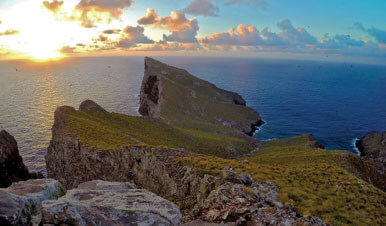
The past month was marked by advocacy to protect Papahānaumokuākea from commercial fishing. On September 16, members of the Papahānaumokuākea Native Hawaiian Cultural Working Group (NHCWG) stood in solidarity with the Office of Hawaiian Affairs (OHA), scientists, conservationists, and community organizations, to deliver powerful testimony to the federally funded Western Pacific Fishery Council (WESPAC).
Together, we spoke in defense of one of the world’s most ecologically and culturally significant marine protected areas. Papahānaumokuākea’s protections were not created overnight – they were built over years of public engagement, cultural leadership, scientific collaboration, and international cooperation.
Today, those protections face an unprecedented threat. WESPAC has repeatedly attempted to weaken marine safeguards, advancing proposals to reopen marine monuments and sanctuaries, including Papahānaumokuākea, to commercial extraction.
Acting under federal directives, NOAA Fisheries is now “reconsidering” key regulations through the so-called “seafood competitiveness” strategy. Framed as “modernization,” this process paves the way for commercial interests to override conservation efforts and Indigenous stewardship, undermining decades of work to protect these sacred waters.
In my testimony I emphasized that traditionally, Hawaiian families only fish in within the coasts and waters of our own land division. Fishing beyond one’s borders is considered disrespectful and a breach of protocol. I expressed severe disappointment at rhetoric perpetuated by WESPAC insinuating that “these are ‘American’ waters, and ‘American’ fishermen have the right to fish there.”
Papahānaumokuākea is in Hawaiian waters; no one has the right to fish there.
It is among the largest marine protected areas in the world. For perspective: if the Pacific Ocean were a football field, Papahānaumokuākea would be the size of a postage stamp. Yet, WESPAC and its allies are focusing on fishing in this tiny part of the ocean.
The ecosystem found within Papahānaumokuākea is an ancestral legacy from the Kumulipo, our cosmogonic chant. As Native Hawaiians, the salt waters of Papa- hānaumokuākea run through our veins, its waterways are our memories of oceanic migration paths connecting us to every living creature and island in this vast ocean of Moananuiākea.
For a thousand years, our kūpuna manifested Papahānaumokuākea’s pristine beauty and sacredness for the benefit of today’s generation and for the next thousand. This is true foresight. Yet, in just a few short years, it could all be destroyed through extractive activities like commercial fishing and deep-sea mining. Let us not be the shortsighted generation.
Final comments and a petition with 2,600+ signatures advocating for the fullest protections for Papahānaumokuākea has been sent to the federal government. As we await the forthcoming decision on commercial fishing policies in Papahānaumokuākea and other marine protected areas, we must remain vigilant and ready.
Mahalo nui to everyone who came together in support of this massive undertaking. When the opposition says no community exists in Papahānaumokuākea remember: We are the community!
Stay updated on this issue and other opportunities to amplify the story of our kūpuna islands by following the Papahānaumokuākea Native Hawaiian Cultural Working Group (alohacwg.com) and the Papahānaumokuākea Coalition (papahanaumokuakeacoalition.org) on FB and IG.