
By Kyle Kajihiro and Neta C. Crawford
In recent statements to the media, Gov. Josh Green has repeatedly asserted that unless he can negotiate a favorable deal, the U.S. Army may condemn Hawaiian trust lands for training it deems vital to U.S. “national security.” However, this assumes that he has the authority to negotiate away the state’s fiduciary duties over trust lands and implies that the national security interests of the United States should trump all other considerations, including the rights and security of the people of Hawaiʻi.
It is already clear that U.S. military bases cause significant negative environmental, social, and economic impacts and thus, endanger the long-term health and welfare of the residents of Hawaiʻi.
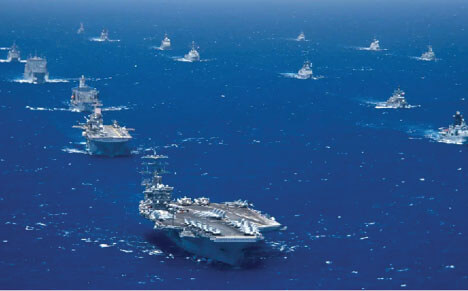
The U.S. military currently uses more than 250,000 acres of Hawaiʻi’s land and waters for housing and stationing troops and equipment, training and testing, supporting recreation such as golf and tourism, and conducting multilateral exercises, such as RIMPAC.
Most of this activity occurs on the so-called “ceded lands” – government and crown lands of the Hawaiian Kingdom that were seized by the U.S. military as a consequence of the overthrow. Of these lands, the military has access to more than 46,000 acres through leases and easements that expire between 2029 and 2030. For most of these leases, the military paid $1 to use these trust lands for 65 years.
And as these leases are set to expire, the military is intensifying and expanding training activities in Hawaiʻi.
The Navy has proposed an increase in bombing of Kaʻula (an island and seabird sanctuary off Niʻihau). It recently issued a record of decision on its Hawaiʻi-California Training and Testing Overseas Environmental Impact Statement. The Navy proposes an increase in training at sea around Hawaiʻi and California, an increase in the use of underwater explosives, and a higher authorized “take” of marine species.
Meanwhile, the Army has expanded its training with other countries in the region through the Joint Pacific Multinational Readiness Center.
What is driving these developments? The U.S. military in the Pacific is preoccupied with deterring Chinese aggression, and if necessary, fighting to win a war with China.
Indeed, the U.S. national security establishment — under both Biden and Trump — has often said that China will, if left unchecked, invade Taiwan.
So, for more than a decade, the U.S. has bolstered its military presence in the Pacific and increased military cooperation and joint exercises with regional allies and friends, including Australia, Japan, New Zealand and Taiwan.
In fact, there are 220 other sites under Indo-Pacific Command having at least 10 acres and $10 million Plant Replacement Value located in American Samoa, Australia, Diego Garcia, Guam, Japan, Johnston Atoll, Marshall Islands, Northern Mariana Islands, Singapore, South Korea, and Wake Island.
Then there are another 43 smaller sites located in Japan, the Northern Mariana Islands, Cambodia, the Marshall Islands, Singapore and South Korea in the INDOPACOM area of responsibility.
Of course, there are valid criticisms of China. Its human rights record is terrible. The government has squashed pro-democracy movements in the mainland and Hong Kong. It has imprisoned and killed dissidents and ethnic minorities and continues its long occupation of Tibet. China’s leaders have long asserted an interest in “reunification” with Taiwan.
The U.S. also fears China’s rising economic power and accuses it of unfair trade practices.
While China’s military has some access to ports in the region, it has just one overseas base in Djibouti (the horn of Africa) and may soon acquire a naval base in Cambodia.
From China’s perspective, it might seem like they are surrounded. In fact, that’s the point.
U.S. military bases encircle China, while U.S.-led multinational military training events send a message that the United States and its allies will respond if China attacks Taiwan or is too assertive in the South China Sea.
The U.S. military strategy against China – a deterrence by threat of punishment for aggression – includes launching deep conventional strikes into mainland China should China blockade or invade Taiwan.
If this strategy fails to deter, the strikes could escalate to the use of tactical nuclear weapons.
As the current U.S. Undersecretary of Defense for Policy Elbridge Colby has said, “if you want peace, prepare for nuclear war.” In fact, Colby has said the U.S. should not only threaten nuclear war but develop the “right strategy and weapons to fight a limited nuclear war and come out on top.”
However, if the United States uses nuclear weapons against China or strikes China’s nuclear sites with conventional weapons, a localized conflict could quickly escalate into a full-scale conventional and even nuclear war.
This could result in the annihilation of Okinawa, Guam, and Hawaiʻi, where U.S. military assets are concentrated.
The current U.S. strategy envisions U.S. military engagement and the U.S. is bolstering its offensive military capabilities against China.
More than $1 trillion in annual U.S. military spending — about three times what China spends each year — detracts from investments that could increase U.S. economic competitiveness.
U.S. strategies to contain China intensify a security dilemma which fuels the military expansion underway in Hawaiʻi and the Pacific and risks escalating into a catastrophic nuclear war.
There are alternatives that are less risky, including deterrence by denying China its military objectives through a determined defense. If China could not achieve its objectives because it is too costly and unlikely to succeed, it would likely not start a war.
Specifically, the scenarios the U.S. imagines for a Chinese invasion of Taiwan tend to ignore the fact that such an invasion would face significant obstacles due to Taiwan’s mountainous topography and the configuration of its coastline, which make it very defensible.
In other words, even if the U.S. does not get involved, Taiwan’s defensive capacity alone means that it would be folly to invade. Taiwan has invested heavily in bolstering its natural geographic advantages with a defensive strategy — “a thousand small things” — of denial that would delay, frustrate, and halt a successful Chinese invasion.
If China tried to occupy Taiwan, they would face a formidable challenge — one that is costly in blood and treasure. If China did make the attempt, the fighting would risk destroying the island and its people — a pyrrhic victory won at too great a cost to be worthwhile.
Instead of boosting its military presence in the Pacific, the U.S. could work with its allies to invest in military denial doctrines — defense to deter by denial of Chinese objectives rather than deep strikes.
In sum, although the military behaves as if there was only one way to deter a war with China, the current military doctrine of offensive deep strikes is not the only option.
A deterrence by denial doctrine poses less risk of escalation and is less expensive. It also allows the U.S. to reduce its military footprint in Hawaiʻi and elsewhere in the Pacific.
Moreover, investing in diplomacy and cooperative strategies to address common security concerns, including the global climate crisis, is an offramp from this dangerous path.
Dr. Kyle Kajihiro is an assistant professor of ethnic studies at the University of Hawaiʻi at Mānoa. Dr. Neta C. Crawford is a professor of international relations at St. Andrews University in Scotland.