Part 1 of a two-part series
By J. Kara Dumaguin
When people speak about Kaʻūpūlehu, they often begin with its beauty. The clarity of the water, the quiet of the bay, the slope of Hualālai rising behind it. But for those who belong to this place, or who carry kuleana to it, Kaʻūpūlehu is not first a landscape. It is a relationship.
It is a place where ʻike is practiced, not archived. Where governance is lived, not theorized. Where lāhui is not only spoken but enacted.
Lāhui is a word many of us carry with pride. It can mean people, nation, collective identity. But in ʻike Hawaiʻi, lāhui also holds another layer. It speaks to gathering together, shaping boundaries, even placing kapu when needed. In this way, lāhui is not only who we are, but what we are responsible for doing together, including knowing when to restrain ourselves for the good of the whole.
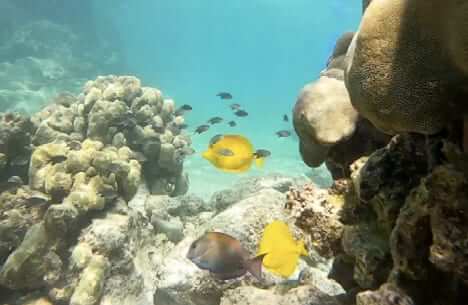
At Kaʻūpūlehu, lāhui is not expressed only through words or symbols, but through daily choices. Through when we take and why we wait. Through how we listen to place. Through how we mālama ʻāina and mālama kai in ways that are patient, disciplined, and deeply relational. This understanding of restraint is not unique to Hawaiʻi. Across Polynesia, communities have long practiced forms of collective stewardship that center care and limitation as much as use. In Rarotonga, Tahiti, and Aotearoa, raʻui and rāhui temporarily close areas to allow resources to recover, guided by local knowledge and collective agreement. These are living practices that continue to adapt across generations.
At Kaʻūpūlehu, this lineage continues through Hui Kahuwai, a community-based marine stewardship group formed to mālama approximately 3.6 miles of Kaʻūpūlehu’s coastline and the nearshore waters that sustain it.
Hui Kahuwai is a gathering of families, fishers, lineal descendants, cultural practitioners, scientists, and agency partners working together under a shared ethic that the health of the place and the health of the people are inseparable.
Kaʻūpūlehu has always been understood through the logic of the ahupuaʻa, where ʻāina and kai are not separate realms but parts of a single system, connected from ma uka to ma kai. What happens in the uplands shapes what happens along the shore, and stewardship of the nearshore cannot be separated from care for water, soil, and pathways that feed it. Hui Kahuwai’s work along the coastline is grounded in this broader understanding of place, even as it focuses its daily practice on the nearshore.
This work is rooted in an ʻike that predates modern management systems. An understanding that places have rhythms, limits, and needs that must be listened to, not overridden.
Historically, konohiki served as place-based managers who understood the patterns of land and sea, when certain iʻa (fish) would spawn, when areas needed rest, when abundance could be shared. Their authority did not come from enforcement alone, but from an intimate knowledge of place and trusted relationships within the community.
Today, while the konohiki system no longer operates within Hawaiʻi’s modern legal framework, its spirit persists in how Kaʻūpūlehu governs its relationship with its nearshore waters. Decisions are not made from afar. They emerge from observation, conversation, and collective care.
One of the most visible expressions of this, which many Ka Wai Ola readers may already be familiar with, is the practice known as Try Wait.
Developed by the Kaʻūpūlehu community as a way to care for Kaʻūpūlehu and a portion of the neighboring ahu- puaʻa of Kūkiʻo, Try Wait reflects a collective decision to hold back, allowing the kai, iʻa, and koʻa the time they need to regenerate.
Try Wait is not about restriction for restriction’s sake. It is about cultivating awareness, patience, and reciprocity. This is where lāhui becomes tangible through daily practice.
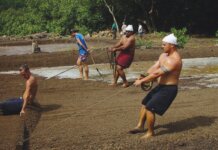
In many Western management systems, stewardship is often framed through regulation, enforcement, and extraction thresholds. At Kaʻūpūlehu, stewardship begins with relationship. With knowing the currents. With remembering who taught you to throw net. With recognizing that your actions ripple far beyond the shoreline.
This does not mean science is absent here. On the contrary, Kaʻūpūlehu is a place where ʻike Hawaiʻi and contemporary science walk together, sometimes in tension, often in alignment.
Community monitoring, fish counts, spawning observations, and long-term data collection all inform how Hui Kahuwai understands what is happening along the coastline. But these tools serve the place. The place does not serve the tools.
What emerges is not rigid management, but adaptive stewardship, a way of responding that honors change, uncertainty, and the limits of any single knowledge system.
And this is perhaps one of Kaʻūpūlehu’s most powerful lessons. Governance grounded in place is not about controlling nature, but about listening to it and adjusting ourselves accordingly.
As pressures on Hawaiʻi’s nearshore resources increase, Kaʻūpūlehu stands not as a perfect model, but as a living example of what becomes possible when communities are empowered to steward their own places. It reminds us that lāhui is not only something we claim in moments of pride or protest, but something we practice quietly, every day, through care, restraint, and relationship.
In the next part of this series, we will look more closely at how this stewardship unfolds in practice, how Hui Kahuwai navigates modern governance, scientific partnership, and community decision-making through an adaptive approach that remains deeply rooted in ʻike and aloha ʻāina.