Some of the lāhui’s most brilliant minds gathered at the East West Center at UH Mānoa for the annual Piʻo Summit on March 4. This year’s summit – ʻĀinahoʻi: Land, Law & Justice – brought together aloha ʻāina, community organizers and land stewards from across the pae ʻāina to discuss the intersections of land, law and justice in Hawaiʻi.
ʻĀinahoʻi (land back), the theme for this year’s summit, amplified the collective movement to reclaim our ʻāina and our future by showcasing some of the creative ways that communities are not just navigating but challenging existing systems through legal frameworks, nonprofit land trusts, and grassroots action. It is a call for ʻāina to be returned to community stewardship and the importance of seeing land as ʻāina to ensure a regenerative future.
With a focus on micro to macro approaches to ʻĀinahoʻi – from strengthening relationships to ʻāina to advancing self- determined governance rooted in ancestral innovation and courage – the summit featured three panels: Aliʻi Trusts and Land Legacy; Nonprofits and Land Trusts; and Community Governance and Land Return.
The day began with mele aloha ʻāina by musician Raiatea Helm. Host and emcee, Dr. Kamana Beamer, opened the event with a presentation on Hawaiian Land Tenure, emphasizing that the Kingdom of Hawaiʻi’s original 1840 constitution stated that the people of Hawaiʻi belong to the land in perpetuity and guaranteed our rights to the ʻāina.
Keynote speaker for the event was Justice Joe Williams, Aotearoa’s first Māori Supreme Court justice who addressed the colonization of Aotearoa. Referencing his kuleana to oversee the system that has affected so much loss for the Māori people, Williams shared the story of 19th century Māori resistance leader Te Kooti Arikirangi Te Tūriki saying, with regard to using the master’s tools to unpick its injustices, “I think the master’s tools will do just fine.”
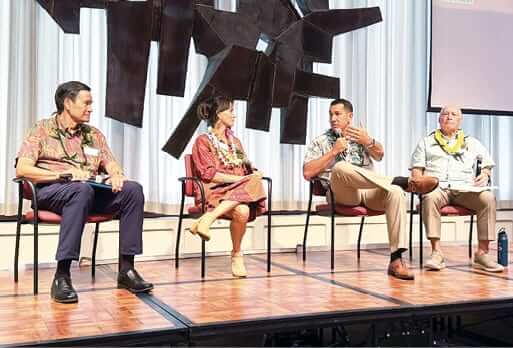
The first panel on Aliʻi Trusts and Land Legacy was moderated by former Kamehameha Schools executive and Hoʻokele Strategies CEO Neil Hannahs. Panelists included Kamehameha Schools Trustee Dr. Noelani Goodyear-Kaʻōpua, Office of Hawaiian Affairs Board of Trustees Chair Kaialiʻi Kahele, and Hawaiian Homes Commission Chairman Kali Watson.
Panelists discussed the importance of collaboration and synergy between the Aliʻi Trusts (to include the Office of Hawaiian Affairs and the Department of Hawaiian Home Lands) providing examples of how that is already happening. During the course of the discussion it was noted that, collectively, our Aliʻi Trusts, OHA and DHHL control hundreds of thousands of acres. “When you put it all together, weʻre talking about nationhood,” said Watson.
Nonprofits & Land Trusts, the second panel, was moderated by attorney Mahina Tuteur and included Trust for Public Land Aloha ʻĀina Project Manager Reyna Hayashi, Lahaina Community Land Trust Executive Director Autumn Ness, and Ka Huli Ao Center for Excellence in Native Hawaiian Law Director Kapua Sproat.
Their conversation touched on the tension of operating within the American real estate system that views land as a commodity while honoring the Hawaiian worldview wherein land cannot be owned. With goals ranging from preserving conservation lands to protecting residential land from being scooped up by outside investors, panelists talked about various strategies – the most straightforward (and expensive) of which is buying back our lands and placing them in land trusts or conservation easements.
The final panel of the day was Community Governance & Land Return moderated by Beamer. Panelists included NDN Collective Senior Domestic Policy Strategist Davis Price, Koʻihonua Executive Director Camille Kalama, Nation of Hawaiʻi Deputy Head of State Brandon Makaʻawaʻawa, and Hawaiian Studies Professor Kaipu Keala representing the Protect Kahoʻolawe ʻOhana.
Their discussions centered on resisting militarism and asserting our personal and collective sovereignty. Noting that sometimes, we have to “get in front of the trucks,” Kalama said that some of our biggest wins have been when the community shows up. “The ones living in relationships with that ʻāina are the fiercest, strongest, most peaceful fighters for those places. There are strategies and tactics for doing that. We can still survive as a people in the face of the biggest, most powerful and lawless military – at this point – on the planet.”
Wrapping up the ʻĀinahoʻi discussions and touching on current community conversations around military land leases, Beamer challenged the audience to question the status quo.
“The military industrial complex creates an economy of death and I believe Hawaiʻi deserves better,” Beamer said. “I believe we can do better to create jobs and wellbeing and life in our islands than to continue to support weapons that destroy our ʻāina, that kill and damage ecosystems, and are basically training grounds to kill other people across the planet. We can’t be the epicenter of that any longer.”