Kiʻi Pōhaku Revealed on Waiʻanae Coastline
74 Acres of Hilo Ag Land Protected

The Trust for Public Land (TPL) and the Hawaiʻi Land Trust (HILT) recently teamed up with O.K. Farms in Hilo to protect 74.28 acres of agricultural land along the north side of the Wailuku River in Ahupuaʻa Puʻuʻeo.
For more than 20 years, the Keolanui ʻOhana has managed O.K. Farms, growing it into one of the largest tropical fruit producers in the nation and a crucial steward of Hawaiʻi Island’s food security, in part by offering community supported agriculture (CSA) boxes with food sourced from their farm and other island farmers and dairies.
However, in recent years the land that O.K. Farms leased was under threat of being sold and repurposed unless the Keolanuis could raise the funds to purchase it.
With the help of PTL and HILT, $1.6 million was raised and the lands placed into a conservation easement to protect it in perpetuity. Beyond preserving the land for agriculture and food security, preservation of this ʻāina is critical to safeguarding the watershed that directly supports Wailuku River and Hilo Bay.
O.K. Farm was co-founded in 2002 by Troy Keolanui and the late Ed Olson, a businessman and philanthropist to perpetuate sustainable agriculture in Hawaiʻi – Olson had purchased the land from C. Brewer around 2000. When Olson passed last year at the age of 93, his trust offered the Keolanuis the first chance to purchase the property.
Maui County to Help Fund Rebuilds
More help is forthcoming for survivors of the August 2023 wildfires who need kōkua to rebuild their homes
Maui County is preparing to pay for new single-family homes using federal funding. On August 11, the county began accepting applications from low- and moderate-income households to replace housing lost in the disaster.
Officials are rolling out three subsidy programs using $391.5 million of a $1.6 billion federal grant approved last January. Under two of the programs, property owners who lost their home in the fire can seek up to $400,000 to help rebuild or get reimbursed for reconstruction if it has already begun or been completed.
Eligible households may earn no more than 140% of Maui County’s median income and the home must be their primary residence. If the primary residence condition isn’t maintained, the grant must be repaid. The income limit equals to $132,020 for a single person, $150,780 for a couple, and $188,440 for a family of four.
A third program provides up to $600,000 for renters displaced by the fire to buy a single-family house. Eligible renters must be able to obtain a fixed-rate mortgage to help finance a purchase, cannot already own a home, and cannot earn more than 120% of Maui County’s median income ($113,050 for a single person, $127,600 for a couple and $159,500 for a family of four).
Preference will be given to households at or below 80% of the median ($75,400 for a single person, $86,200 for a couple and $107,700 for a family of four). For more info go to: mauirecovers.org.
Kalaʻi Makes His Broadway Debut

Makoa Kalaʻi from Panaʻewa made his debut on Broadway in New York City last month as part cast of the hit musical Mamma Mia!
Kalaʻi performed with the Mamma Mia! national tour for 18 months, beginning in October 2023. He then earned a spot in the New York City production’s ensemble and is also an understudy for one of the supporting roles. Mamma Mia! is being performed at the Winter Garden Theater for six months – with the potential to be extended.
A graduate of Kamehameha Schools Hawaiʻi, Kalaʻi was involved in hula and theatre as a student. While in high school he joined Hālau Hula ʻo Kahikilaulani and performed in two ʻōlelo Hawaiʻi operas. After graduating he left Hawaiʻi to attend college at New York University’s Tisch School of Performing Arts.
Kalaʻi told Hawaiʻi News Now that it’s been his life-long dream to perform on Broadway. After graduating with a Bachelor of Fine Arts degree in 2022, Kalaʻi spent the next year auditioning for various Broadway shows but had no luck until he auditioned for Mamma Mia!
In an interview, Kalaʻi said the culture shock he experienced after moving to New York initially caused him to doubt his dream. And because there are few Hawaiians living in New York City, he initially struggled to find his place – although that has since changed.
“We are the minority in this industry,” he said. “There is a need for representation.”
Pohoʻiki Boat Ramp Restoration
Seven long years after the 2018 Kīlauea eruption deposited some 58,000 tons of black sand, rocks and boulders at Pohoʻiki Beach in Puna, the Department of Land and Natural Resources’ Division of Boating and Ocean Recreation (DOBOR) has begun dredging the bay to reopen access to the ocean.
The debris completely blocked – but did not destroy – the Pohoʻiki boat ramp. Pohoʻiki has long been a critical ocean access point to area fishers. Since the 2018 eruption, Puna fishers have had to travel 32 miles away to the Wailoa Small Boat Harbor in Hilo to launch their boats – a costly and time-consuming work-around that resulted in several small commercial fishing operations going out of business.
The dredging at Pohoʻiki is the result of years of advocacy by the Puna community responding to inaction by the state. Heavy equipment is now being used to remove the volcanic debris. Once the inner basin is cleared, a crane will be used to create a wider entrance to the bay.
“The entrance will be approximately 320 feet wide. There really wasn’t a channel before. It was just an open bay, but the designated entrance, I think, was 40 feet,” said DOBOR engineer Finn McCall.
Pohoʻiki and the adjoining Isaac Hale Beach Park have long been an important gathering place for ʻohana in Puna.
Hawaiʻi Film Alliance Pushes for Tax Incentives
The premiere of Chief of War on August 1, the Apple TV+ series about the unification of the Hawaiian Islands created by Thomas Paʻa Sibbett and Jason Momoa, has helped inspire Hawaiʻi’s film industry to organize and fight for improved state incentives to bring filmmakers to Hawaiʻi.
Filmmaker and camera operator Vince Keala Lucero, who worked as a digital image technician and stunt camera operator for Chief of War, said that the production hit a Hawaiʻi tax credit cap and, as a result, most of the nine-episode series was filmed in Aotearoa.
“It was a total shame,” Lucero was quoted as saying in a July article in the Hawaiʻi Tribune- Herald. “If we didn’t have a cap, it would have been [filmed] here, and [they] would have spent all those millions here.”
Lucero is helping to lead a new coalition, Hawaiʻi Film Alliance, to push the state to make tax credits for film work in Hawaiʻi more competitive. He said considerable individual efforts have been made, including work completed by the Hawaiʻi Film Office, but they have not been effective.
Other members of the coalition include producer and waterman Brian Keaulana, director Wainani Tomich, and Honolulu Film Office Deputy Film Commissioner Sanoe Damon. The coalition’s web site at hawaiifilmalliance.org describes the economic benefits from the film industry when supported by tax credits, noting that tax incentives generate a five-fold return in economic activity.
Hawaiʻi Captures Flag Football Gold and Silver at Junior Olympics

Bishop Museum Returns Items to Guåhan
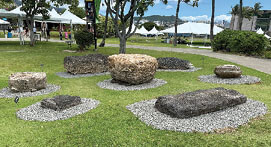
Last month, the Bishop Museum initiated a phased “rematriation” of more than 10,000 pieces from the museum’s permanent collection to the Mariana Islands. Bishop Museum’s Board of Directors unanimously voted to deaccession pieces in the Cultural Resources collection originally acquired by Hans Hornbostel, an amateur archaeologist who worked for the museum in the early 20th century.
The decision comes after three years of collaboration with government officials and is in response to requests from Guåhan’s (Guam) government dating back to the 1930s, as well as the museum’s present-day consideration of ethical museum practices.
Whereas “repatriation” refers to the physical return of human remains and burial belongings, “rematriation” focuses on restoring Indigenous peoples’ relationships with their ancestral lands and cultures.
“Rematriation can be the beginning, not the end, of connecting source communities with their art and human record,” said Healoha Johnston, Bishop Museum director of cultural resources, and curator for Hawaiʻi and Pacific Arts and Culture.
Bishop Museum is partnering with governments, museums, and universities in the Pacific and around the world through its Te Rangi Hīroa Fellowship program designed to integrate Indigenous frameworks and museum best practices.
Ka Wai Ola News Represented at IJA Conference

Commercial Fishing in PIHMNM Halted
In early August, U.S. District Judge Michael W. J. Smith granted a motion challenging an April 2025 executive order (EO) by President Donald Trump to allow commercial fishing in the Pacific Islands Heritage Marine National Monument (PIHMNM) located in the Central Pacific, about 900 miles west-southwest of Hawaiʻi.
Fishing in the monument began weeks after EO was issued. The ruling by Smith calls for an immediate halt to fishing in waters between 50 and 200 nautical miles around Johnston Atoll, Jarvis Island and Wake Island.
A coalition of Indigenous leaders and environmentalists, represented by Earthjustice, challenged the executive order which stripped regulations preventing commercial fishing – which includes long-line fishing, an indiscriminate industrial method that uses baited hooks on lines that are 60 miles or longer – in this protected area.
The PIHMNM is a region of extraordinary biodiversity – from endemic seabirds to countless species of coral, fish, giant clams, sea turtles, and reef sharks. Beyond the reefs, dolphins, sharks, whales and other threatened and depleted species thrive in the deep water between the islands.
The lawsuit brought by Earthjustice asserts that, in addition to environmental concerns, commercial fishing in PIHMNM would also harm the “cultural, spiritual, religious, subsistence, educational, recreational and aesthetic interests” of Native Hawaiian plaintiffs who are connected genealogically to the Indigenous peoples of the Pacific.
Powwow Will Honor Shared Values
Sky Brothers Collective (aka Oʻahu Intertribal Council) is planning a celebration of Indigenous unity, culture and diplomacy in September to honor the shared values of the Native Hawaiian and Native American peoples.
The first-ever Circle of Nations 2025 Honolulu Intertribal Powwow on Sunday, September 21, at Kapiʻolani Park in Waikīkī will bring together Indigenous peoples from across Moananuiākea.
Organizers Loa Simoes (Meskwaki Nation) and Edie Hanohano say the inspiration for this celebration comes from the 1887 journey of Queen Kapiʻolani and Princess Liliʻuokalani across Turtle Island en route to Queen Victoria’s Golden Jubilee – a journey that embodied cultural diplomacy and mutual respect.
Preceding the powwow, on September 20, dignitaries from Native Nations from across Turtle Island and the Pacific will be received as honored guests at a Hoʻokipa Aliʻi event at ʻIolani Palace.
Then on Sunday, Kapiʻolani Park will be transformed for the powwow. Everyone is invited to experience the heartbeat of the drums and see dancers moving in honor of their ancestors. The powwow will include a “Feast of Nations” serving Hawaiian, Pacific, and Native American foods, as well as crafts and artwork for sale and storytelling. Organizers hope to create a space where Indigenous peoples exercise sovereignty, practice cultural diplomacy, and create intergenerational bridges.
This event is separate from the 49th Annual Honolulu Intertribal Powwow that will be held on September 6 at Ala Moana Beach Park’s Magic Island.