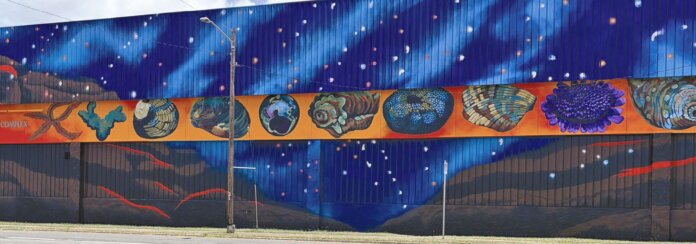
A beautiful new mural representing the Hawaiian creation chant, Kumulipo, now graces the east-facing wall of the Waiakamilo Industrial Complex building on the corner of Nimitz Highway and Waiakamilo Road in Honolulu. The massive mural depicts images of the deep sea and invites reflection on creation itself.
The Kumulipo tells us that all life originates in the deep sea. The uku koʻakoʻa, coral polyp, is the first living creature and its birth begins an unbroken genealogy that ends with humanity. For Hawaiians, therefore, our genealogy comes from the deep sea.
Significantly, the genealogy recorded in the Kumulipo has become a powerful instrument in the fight against deep-sea mining.
“The Kumulipo describes everything created in the vertical water column of the deep sea up to the nearshore reefs, onto the land, into the hills, and even taking flight. People are not created until millions and millions of years later, but when we do come into this honua, we have an inherent responsibility to be part of nature and therefore, our kuleana is to care for nature,” explains cultural practitioner and international ocean advocate Solomon Pili Kahoʻohalahala.
“There is this idea of caring and receiving. I believe that this is what the Kumulipo intends for us to understand: if we care for the environment and for all things in nature of which we belong, then we, too, will be cared for.”
Kahoʻohalahala is Hawaiʻi’s foremost advocate working to stop deep-sea mining (DSM) before it begins. In addition to the irreversible ecological damage to the ocean ecosystem that DSM represents, it is an assault on the Indigenous people of Oceania many of whom, like Native Hawaiians, trace their lineage and creation stories to the deep sea.
For four years, Kahoʻohalahala has taken his message of mālama honua to the United Nation’s International Seabed Authority (ISA), pointing to the Kumulipo as a foundation for humanity’s relationship to the natural world.
In 2022, Greenpeace, a global network of environmentalists, invited Kahoʻohalahala to utilize their platform as a non-governmental organization (NGO) at the ISA. Since then, Greenpeace has partnered with Kahoʻohalahala to help ensure that Indigenous voices are represented in international deliberations on DSM at the ISA.
This is critically important since Hawaiʻi does not have standing at the UN as a sovereign nation state. In this international arena, it is presumed that the United States speaks for Native Hawaiians.
A recent hard-won victory in the fight to stop DSM is the UN’s new “High Seas Treaty” which became international law on January 17, 2026 (see related article in the June issue of Ka Wai Ola). While the ISA governs the seabed floor, the High Seas Treaty governs the living ocean above it – a critical distinction that will factor into future deliberations around deep-sea mining.
To celebrate the High Seas Treaty, “Greenpeace had an idea to commission murals around the world,” recounted Arlo Hemphill, Greenpeace U.S. project lead for its global Oceans for Life campaign. Greenpeace’s campaign to elevate ocean awareness has resulted in dozens of murals on city walls in 13 countries on five continents.
“In his interventions to the United Nations, Uncle Sol regularly talks about the Kumulipo and uses it as an illustration that deep-sea mining is not just an environmental issue. It is a cultural issue. Deep-sea mining attacks the very place of creation of the people who live in the region,” Hemphill said.
When Greenpeace first approached Kahoʻohalahala in January, their idea was to paint a mural depicting the Kumulipo in New York City where it would be visible to the international states housed at the UN General Assembly. But it was the middle of winter and freezing, so they pivoted and decided to site the mural in Hawaiʻi instead which all parties agreed felt right.

Finding a location was next. Kahoʻohalahala reached out to Kamehameha Schools (KS) and they were excited to support the project. KS offered the building on Waikamilo Road that serves as the “canvas” for the mural and provided the paint and other supplies.
“This mural offers a powerful lens for understanding who we are as a people and our relationship to our ʻāina,” explained Kamuela Cobb-Adams, managing director at Ke Kula ʻo Kamehameha on behalf of the schools.
“It reflects our commitment to caring for our oceans and lands by ensuring our kaiāulu (community) can learn about and deepen their connection to our moʻokūauhau (genealogy), while inspiring stewardship of ʻāina in ways that sustain future generations.”
Artist Kai Kaulukukui was invited to paint the mural. “We had met Kai early on and really wanted to work with him,” Hemphill recalled. Greenpeace commissioned Kaulukukui and paid for his work.
Born on Hawaiʻi Island, Kaulukukui cannot remember a time that he did not draw. Since 2012 he has worked as an artist full-time and has painted numerous murals. He also does a lot of ocean-themed art, so when he was asked to paint a mural depicting the origin of life in the deep sea as described in the Kumulipo, he didn’t hesitate.
“I’m super honored to be involved in this project,” said Kaulukukui who was already aware of the cultural and ecological danger that deep-sea mining poses to Oceania – and that proponents of DSM want to begin mining for rare metals in the Clarion-Clipperton Zone which is located just 500 miles south of Hawaiʻi Island.
He approached the project by reading and reflecting on the Kumulipo and by having long talks with Kahoʻohalahala. “I’d draw up a couple ideas then go to sleep and dream on it,” he said. “Through my dreams I’ll come up with a composition that I feel is strong. I think I did maybe 28 designs for this mural.”
Kaulukukui said that his last design “kind of just jumped out and I knew that was it.” He presented the design to Kahoʻohalahala and Greenpeace and they agreed. He began painting the mural in late May and finished in mid-June. In all it took him 11 days, working about 16 hours each day with help color-blocking from his wife, Angela.
His vision of the deep sea is based on the first wā (section) of the Kumulipo. “I included 14 of the creatures from the first 19 verses, like the primordial slime and phytoplankton and coral polyp,” he said.
Barely visible in the bottom left corner of the mural is an image of Queen Liliʻuokalani who translated the Kumulipo into English during her imprisonment following the 1893 overthrow. At the upper right corner are the words, “Hānau ka ʻuku koʻakoʻa” (born is the coral polyp) from the 15th verse of the Kumulipo.
“Being able to represent this stuff visually is awesome, but it’s the work that these scientists and people like Uncle Sol are doing – trying to get laws to change – that is making the difference,” Kaulukukui said.
“Most people have never heard of the Clarion-Clipperton Zone and when I talk about the mural, 95% of the people don’t have any idea of this issue [deep-sea mining]. I would love it if this [mural] helps get more eyes on what is happening.”
“We are at a really dangerous moment in time where the Trump administration is trying to force through deep-sea mining, both in U.S. and international waters, in defiance of international law,” Hemphill warned.
“The Trump administration is trying to say that, rather than the UN, they are the regulator of deep-sea mining in the international seabed – a position no other country agrees with. This mural is a symbol of defiance against that. And a symbol of Hawaiian connection to the ocean as a sacred place of creation that needs to be kept off limits to destructive industrial activity.”
“We know very little about the deep sea,” adds Kahoʻohalahala. “I’m hoping that, with the combination of science, research and a cultural perspective like ours, people around the world can support the idea that we should allow things that are created in nature to continue – rather than destroy them before we understand them.
“We [Hawaiʻi] need to be aware of what is happening around us; what is already happening just beyond the horizon. That is the urgency I feel.”