By Gene Kaleo Parola
She was not asked to make the trip. But if she were to go, there would be no doubt about its outcome, nor the official nature of that result.
She was Queen Keōpūlani, a sacred chiefess of such high stature that the departure of the huge kaulua (double-hulled canoe) had been delayed until twilight so that her shadow would not fall accidentally on some unfortunate.
The death that she was about to cause would not be accidental.
“She does not trust us to bring Kekuaokalani to Kailua,” Chief Nāihe whispered.
“We are his ʻohana,” Chief Ulumāheihei responded.
“We are all ʻohana!” came the retort.
“Yes, but now we must all be an ʻohana of the haole god.”
When the canoe’s hulls slid silently ashore at Kaʻawaloa, Keōpūolani remained behind as the two uncles of the rebel chief met with him and tearfully begged him to return with them to the royal councils at Kailua.
“You are my sister’s son, and the chiefs are blaming you for the uprising because you remain aloof,” Ulumāheihei said. “Come to Kailua and talk the matter over with King Liholiho. And practice free eating or not, as you please.”
Chief Kekuaokalani was silent a long moment and then replied. “I will go to Kailua, but I will go tomorrow.” He paused and then: “But I will never practice free eating.”
Some said the free eating of kāne with wāhine was the most flagrant part of the lifting of the kapu; that Keōpūolani and Queen Regent Kaʻahumanu had forced young King Liholiho to practice it, then proclaim it. It was a tangible departure from the many sacred laws that governed Kānaka life for centuries, and the sides were clearly drawn.
When the Kekuaokalani’s answer was conveyed to Keōpūolani, she was not relieved as the uncles expected her to be. Instead she said, “He is an uku (deep sea snapper). He must be drawn in quickly, else he will spit out the hook.”
“It is a trick,” Manono said to Kekuaokalani with the firmness of a wife who sees beyond the emotional argument.
“They will kill you. If you go to Kailua, go as the warrior that you are. But you know that Kaʻahumanu has brought 300 muskets from Oʻahu to use against you.”
“We fight in the name of our gods, Kū, Lono, and Kāne. They will not abandon us,” Kekuaokalani argued. “The royals fight for a haole god.”
“They fight with the haole’s muskets. Just as the great king fought for all the islands. He built a great war heiau to the god Kū, but the haole red-mouthed guns killed Kānaka who stood against him with wooden spears,” Manono argued. “Which were more powerful – the gods or the guns?”
“I, too, have muskets,” Kekuaokalani insisted.
“But, we have too few – and too few warriors who will stand up to the sacred chiefs.”
“How can chiefs who love the haole god still be sacred?”
It was not a question Manono could answer, nor could the best Kānaka minds. In the faint morning light, the kaulua was ready to leave. Kekuaokalani stood resolutely on the shore. His warriors, alerted by night-long runners, stood behind him, torches, spears, and sandals proclaiming their readiness for war.
“You cut the navel cord, my brother, by this act,” Keōpūolani said. “There is nothing left but war.”
Upon returning to Kailua, Keōpūolani, with Kaʻahumanu at her side, rallied those reluctant chiefs who knew the terrible ramifications of a war pitting family against family.
And while the two queens railed against the weak at heart, Liholiho wondered silently, “Is this the way of the new religion? That I kill my cousin who does not pray as I do?”
But he knew the answer, for both the Protestants and Catholics had expressed their particular hatreds and prejudices prior to the queens’ conversions.
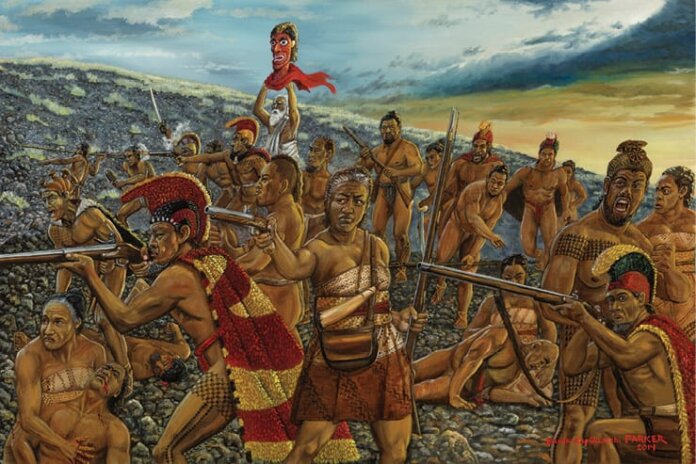
It was a short war. The two armies met at Kuamoʻo on the Kona Coast of Hawaiʻi Island as Kekuaokalani marched north from Kaʻawaloa and the royal army, led by Kalanimoku, prime minister for King Liholiho, marched south from Kailua.
A final attempt was made to prevent battle as the advance scouts exchanged fire, but the rebel threat posed by Kekuaokalani was too great to be tolerated by the Christian converts whose influence was comparatively fragile.
Kekuaokalani fought bravely, continuing even after being wounded several times. Manono fought beside him until he could not rise again. Then, wounded herself, she asked the advancing chief for mercy since he and she had the same father. He denied her plea, and she fell under a volley of fire.
This particular act of cruelty made it clear that there would be no mercy for any who dared deny the Prince of Peace.
This incident and these quoted utterances are based on “Ruling Chiefs of Hawaiʻi,” rev. ed., by S. M. Kamakau, Kamehameha Schools Press, 1961, pp 226-228.