Read this article in ʻŌlelo Hawaiʻi
Na Kaimana Bacarse, Dre Kalili, a me Malia Nobrega-Olivera
Prince Jonah Kūhiō Kalanianaʻole, a visionary aliʻi and statesman, established the first Hawaiian Civic Club because he understood that the Hawaiian people needed education to thrive in a changing world. His vision of education was not strictly Western, but an adaptive framework that firmly rooted Hawaiians in their cultural identity.
Today, the resulting Association of Hawaiian Civic Clubs’ (AOHCC) work encompasses education, health, housing, economic development, wellbeing, and self-determination, but its commitment to the proliferation of ʻōlelo Hawaiʻi is a focal point.
For AOHCC, the preservation, revitalization, and normalization of ʻōlelo Hawaiʻi is an act of sovereignty to ensure our language lives in Hawaiʻi and beyond. Hawaiian Civic Club members, individually and collectively, aim to integrate ʻōlelo Hawaiʻi into everyday life, from government proceedings to community gatherings, ensuring it remains a primary medium of expression for future generations.

During AOHCC deliberations, observers may hear motions made in ʻōlelo Hawaiʻi alongside other phrases found in Nā Lula Hālāwai, a Hawaiian companion to Robert’s Rules of Order. There are at least two Hawaiian Civic Clubs whose members conduct business only in Hawaiian language.
Annual convention participants wear badges designating their status as ʻElele, ʻElele Pani, or Lālā. AOHCC’s standing committees routinely adopt resolutions at the annual convention that are written in both languages.
AOHCC’s most powerful tool is its collection of adopted resolutions. Each year, dozens of these adopted resolutions form the AOHCC’s advocacy platforms and priorities and several emphasize ʻōlelo Hawaiʻi, its use, and education. Here are a few examples of how this organization takes action to amplify the voice of the lāhui:
- Urging a state ʻŌlelo Hawaiʻi Commission;
- Calling on the Board of Education to fulfill its obligations to provide Hawaiian immersion education;
- Bolstering legal requirements for Hawaiian language interpretation services;
- Restoring Hawaiian language place names, including Pāʻulaʻula at the Russian fort in Waimea, Kauaʻi; and
- Requesting a minimum Hawaiian language requirement for state government spokespersons.
These resolutions also honor the work of partners and institutions like ʻAha Pūnana Leo, Ka Haka ʻUla o Keʻelikōlani, ʻAhahui ʻŌlelo Hawaiʻi, and Awaiaulu for their achievements in language proliferation, as well as business like Bank of Hawaiʻi when it incorporated ʻōlelo Hawaiʻi in its ATMs.
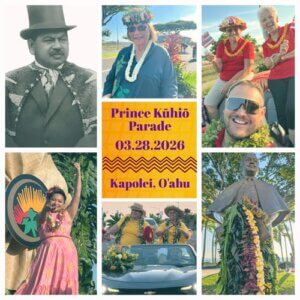
Each year, AOHCC finds new ways to honor its commitment to advancing the Hawaiian language. In 2025, commentators at one of the review stands along the Prince Kūhiō Parade route announced the units in Hawaiian. In 2026, in celebration of Mahina ʻŌlelo Hawaiʻi, AOHCC will sponsor Ola Ka ʻĪ: Hawaiian Language Thrives and will provide the cash prizes for the hoʻokūkū ʻōlelo Hawaiʻi or Hawaiian language speech competitions for students of all ages.
Through these efforts, the Hawaiian Civic Club movement fosters a new generation of leaders fluent in our language that fulfills Prince Kūhiō’s dream of a thriving, self-determined people.