

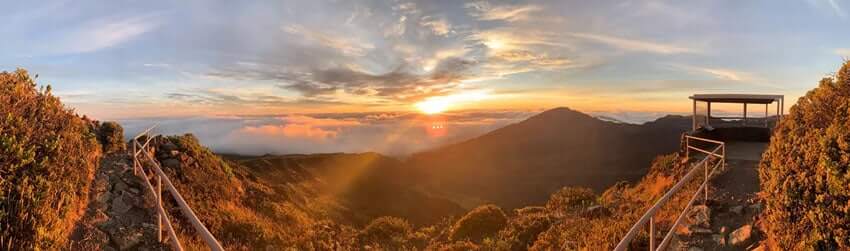
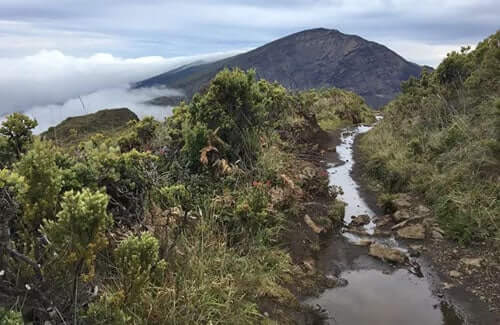
Majestic Haleakalā on Maui is Hawaiʻi’s third tallest mountain and a wao akua, or spiritual realm, that is also home to many endangered endemic species. Soaring more than 10,000 feet above sea level it, like Maunakea on Moku o Keawe, is coveted as an ideal location for telescopes. – Photo: © FernandoM/Adobe Stock
Maui County Council Backs the Community’s Opposition to More Telescopes
Kuahiwi nani o Maui
Haʻaheo wale ʻoe Hawaiʻi
Hanohano Maui nō ka ʻoi
Beautiful mountain of Maui
Prized by you, Hawaiʻi
Glorious Maui is the very best
In a decades-long conflict over development on Haleakalā, Maui County officials took the unprecedented step of unanimously standing with community in opposition to a military proposal to build up to seven telescopes atop Maui’s most sacred summit.
In April 2024, the U.S. Department of the Air Force (DAF), a division under the Department of Defense (DoD), announced its proposal to build the new telescopes. The proposed project is known as AMOS STAR, which stands for Air Force Maui Optical and Supercomputing Site Small Telescope Advanced Research.
In May, the DAF hosted three public meetings on Maui where they heard overwhelming opposition to the proposal. The community expressed concerns about cultural and spiritual impacts to Haleakalā as well as the negative impacts to the mauna’s still mostly pristine natural environment, citing the U.S. military’s long history of environmental destruction and negligence.
“We have reached such a critical point that if local elected officials are not holding other government agencies responsible for their actions, then we are complicit in the harm they are causing to our people,” said Maui County Councilmember Keani Rawlins-Fernandez, who authored and introduced the resolution.
“After numerous proven examples wherein the military has lied to our community, our state and local government, they cannot be trusted.”
Rawlins-Fernandez worked with community groups Kākoʻo Haleakalā and Kilakila ʻo Haleakalā to paint a more complete picture of the history, conflicts and impacts in the resolution. Rushing to submit their statement by the public comment deadline, the council unanimously passed its resolution on June 5.
Two days later, Maui Mayor Richard Bissen released a formal statement opposing the proposal, stating in part: “The County of Maui stands in strong alignment with the Maui County Council, seeking that no action be taken by the Department of the Air Force to construct and operate an optical and supercomputing telescope research facility on the culturally sacred site of Haleakalā.”


Maui County Council’s vote to oppose the AMOS STAR project is the first time that a governmental body here in Hawaiʻi has taken a unanimous position on a issue like this.
This recent challenge to the construction of telescopes on Haleakalā is not the first. Telescope construction on Haleakalā is a long-standing issue for Maui residents.
Despite three court challenges, community meetings, scoping meetings and years of protests, construction of the Daniel K. Inouye Solar Telescope on Haleakalā began in 2013 and took eight years to complete.
According to a Space Force official, the DoD began conducting research and development and operational missions on Haleakalā in the early 1960s at the Advanced Research Projects Agency Midcourse Observation Station, known today as the Maui Space Surveillance Complex.
The reasons for opposing development on the mauna then and now remain the same; they are rooted in religion and culture, which are essentially codified scientific observations made over millennia, explained long-time educator and community organizer Kahele Dukelow.
“When we talk about an area that is ‘wao akua’ (a region inhabited by gods) there is limited human interaction.”
Dukelow serves on the State of Hawaiʻi Board of Education and is the vice chancellor of academic affairs at the University of Hawaiʻi Maui College. She helped coordinate public involvement in this issue in the mid 2000s and continues to be involved with Kākoʻo Haleakalā.
“The purpose [of a wao akua] is to maintain an area untouched by humans for different reasons – spiritual reasons and environmental reasons. Our spiritual and cultural understandings come from scientific underpinnings. You don’t do things in a certain area because it is going to have negative impacts in another area.”
Dukelow noted that when Native Hawaiians carry out their cultural practices on Haleakalā they are forced to work around telescopes to do so. “It’s heartbreaking. We constantly see this symbol of dominance. Basically, nobody wants [us] there.”
None of this is new. For decades all across Hawaiʻi – at places like Kahoʻolawe, Mākua Valley, Pōhakuloa, and Haleakalā – Hawaiians have challenged, and continue to challenge, military occupation.
Like protests in opposition to the Thirty Meter Telescope on Maunakea, the resistance to building additional telescopes on Haleakalā has been mischaracterized as being “anti-science” by those pursuing the development.
“This has nothing to do with Hawaiians being anti-science,” asserted Dukelow. “This has everything to do with Hawaiians being anti-American – if you’re talking about the American military that is dominating the Hawaiian space in all [the] ways that it does – and anti-imperialism and anti-colonialism. They don’t talk about any of those things. They just default to our objections being ‘anti-science.’”

In addition to Maui County’s government, other leaders have articulated their opposition to the AMOS STAR proposal. In a June 6 letter, Office of Hawaiian Affairs Board of Trustees Chairperson Carmen “Hulu” Lindsey wrote: “The disrespect to the sacredness of the wao akua on the summit of Haleakalā with the construction of the Department of Air Force’s planned AMOS STAR project absolutely will not be tolerated and the no build alternative, or not building at all, is the only alternative.”
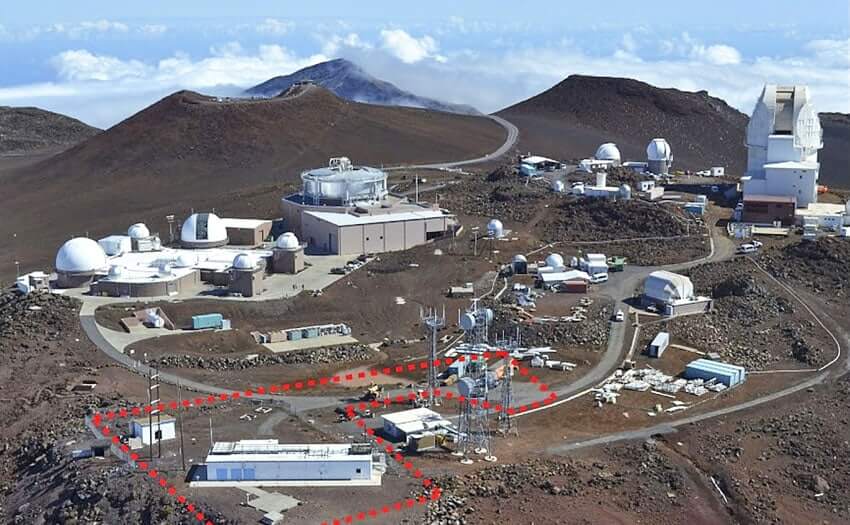
According to DAF, the facility would involve the construction and operation of up to seven telescopes enclosed in individual domes. The development would require utilities and infrastructure, including fiber optic links, a paved access drive and parking facilities, surface water runoff management measures, and other site improvements.
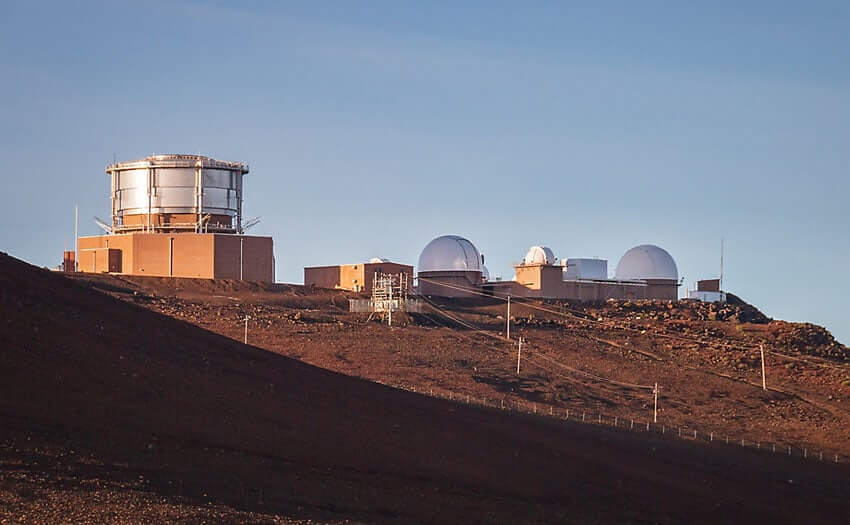
There are already seven different astronomical facilities spread out over 18-acres on the summit of Haleakalā. Most of these facilities have multiple telescopes.
For the AMOS STAR project to move forward, five federal agencies and two state agencies must review and provide permits. These include the National Park Service, Federal Aviation Administration, U.S. Fish and Wildlife and the Board of the Department of Land and Natural Resources.
Brad Sturk, chief media ops and mission partner support for U.S. Space Force, sent a written statement that said: “To adequately perform America’s Space Domain Awareness mission, optical telescopes require clear weather, dark skies, and excellent atmospheric ‘seeing’ conditions. Hawaiʻi is a very remote geographic location with critical strategic significance.”
The statement went on to read that “The summit locations on Haleakalā offer pristine conditions for tracking threats across the region, in addition to allowing observation of satellites over the Hawaiian Island chain. Given the remoteness and strategic location, there are no other similar summit locations within thousands of miles that offer such viewing conditions.”
In the statement it was also noted that the project intends to use existing developed land adjacent to the Maui Space Surveillance Complex.
But Dukelow says that the military’s plan to use already-developed land on Haleakalā is irrelevant. “What we want [the military] to do is to walk it back. We want them to decommission [the telescopes]. We want them down,” she said.
“When a telescope is no longer in use, we want them to remove it. And you know what? It is totally possible. We’ve watched people remove entire hotels.”
Regardless of the project’s proposed footprint, Rawlins-Fernandez noted that emerging technology – including powerful space telescopes (like the Webb and Hubble space telescopes), and the development of autonomous telescopes and neutrino telescopes – could soon mean that spending hundreds of millions of dollars to build massive observatories on mountain summits is no longer necessary.
“While our county and community members recognize the importance of monitoring satellites and space debris, we also understand that there may be other ways to accomplish this that are also respectful of our culture, people, and ʻāina.”
Another concern is that the proposed site for the seven AMOS STAR telescopes is zoned for conservation and lies outside the 18-acre parcel of land managed by the University of Hawaiʻi Institute of Astronomy.
According to Maui County Council resolution 24-103, the university-managed parcel is the only site on Haleakalā set aside for observatory purposes.
Additionally, in recent years, the military has come under increasing scrutiny for fuel and chemical spills that have polluted – or threatened to pollute – Hawaiʻi’s groundwater.
In November 2021, approximately 20,000 gallons of jet fuel leaked from the US Navy’s Red Hill Bulk Fuel Storage Facility at Kapūkakī on Oʻahu, contaminating the drinking water of more than 92,000 residents. Oʻahu’s main aquifer, the Hālawa Shaft, was affected by the fuel spill and remains closed almost three years later.
Then in 2023, the U.S. Space Force, which operates the Maui Space Surveillance Complex at the Summit of Haleakalā, reported that 700 gallons of diesel fuel was spilled at the facility. A year later they are still assessing and mitigating the impacts of that spill.
A DoD audit of fuel spills at its 591 defense fuel support points (DFSP) facilities worldwide was initiated after the 2021 incident at Red Hill. The audit, issued in April, reported that between FY2020-2022 there were 172 fuel spills at U.S. military DFSPs – the largest of which was 136,000 gallons. Most of the spills were due to equipment failure. The audit concluded that the Defense Logistics Agency, which manages and oversees DFSPs, did not consistently provide required oversight of the facilities.
“Our communities want to decide what happens in our places, especially in our most special places,” said Dukelow. “We’re tired of being the pawns in somebody else’s game. They control all the rules. They control all the pieces. We are left with crumbs – and sometimes there are no crumbs. I think the community is feeling marginalized to the greatest extent that they ever have. ”
The draft Environmental Impact Statement (EIS) for the AMOS STAR proposal is due in early 2025. It will include three alternatives: the proposed development; the development with one less telescope; and a “no action.” Sturk would not comment on the number or the nature of the public comments that were submitted. He said that information would be released with the draft EIS.
Rawlins-Fernandez and other officials who have submitted public comment want the military to withdraw its proposal altogether.
“Although the scoping period is not yet complete, it will be interesting to see how the military responds to our county council’s unanimous decision, the [position taken by the] Office of the Mayor, and the hundreds of people who participated in the recent community meetings about this project and expressed their opposition to the destruction of their sacred mauna,” said Rawlins- Fernandez.
“What does it say about the military if they disregard the unanimous vote of another government body and of the mayor duly elected by the people of this place?”