


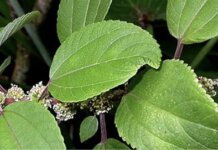
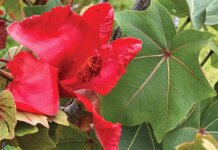
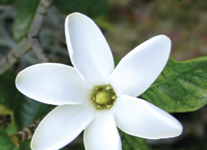
ʻIliahi, (Santalum paniculatum) of the island of Hawaiʻi. Liko stand above waxy lau, and beaded droplets of light rain. Muted colors and typical four-parted stars bloom on Hawaiʻi. Fragrance is held in the heartwood of the tree. – Photos: Bobby Camara
“He aloha nō he aloha, ka liko pua ʻiliahi;
Truly loved, yes truly, is the bud of the sandalwood”
– from the mele “Pua ʻIliahi” by Bill Aliʻiloa Lincoln
Hawaiʻi is blessed with four endemic species of ʻiliahi (Santalum). Of those, one, Santalum paniculatum, is only found on Hawaiʻi, and one, S. Haleakalae, is unique to Maui. Each can be easily visited on their respective islands, at either Hawaiʻi Volcanoes or Haleakalā National Parks.

An aliʻi-sanctioned, and controlled, industry thrived in Hawaiʻi during the late 1700s and early 1800s, when ʻiliahi was exported to China so its fragrant heartwood could be used for incense and in architecture. Remaining on Molokaʻi is a lua moku ʻiliahi, a pit dug to approximate the size of a shipʻs hold, so it could be filled by tree harvesters. Loads were measured in “piculs” – in China equal to about 133 pounds, or the weight able to be carried by one man. Makaʻāinana, while neglecting their kuleana to ʻohana, toiled to enrich aliʻi.
ʻIliahi is a partial parasite, with roots entwining those of its neighbors to gain sustenance. Despite its rarity, ʻiliahi is still harvested. Some make efforts to grow and outplant trees, but slow growth prevents a good return on investment, thus making an especial treat when we can enjoy the company of large trees in the wild.
. Of those, one, Santalum paniculatum, is only found on Hawaiʻi, and one, S. Haleakalae, is unique to Maui.)