
By Kaci Stokes
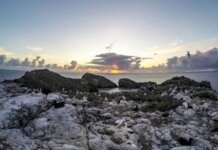
Though the sky was just beginning to soften in the light of dawn, the thousands of birds soaring overhead were well awake. As we turned slowly in the gentle rocking of the sea, Nihoa appeared in full view. With the sun low behind the island, Nihoa was illuminated with the pale yellow-gray of vegetation and rocks. As stunning as it was to see our kupuna island with a swirling atmosphere of seabirds, the excitement left me and was quickly replaced with a chilling fear.
Part of our huakaʻi’s mission was to bring back 40 individuals of Endodonta christenseni. This snail is endemic to Nihoa and the last surviving species of its genus in the world. Sadly, they are threatened by the non-native ants that have made their way to the island.
While we set our intentions and grounded ourselves in oli, I worried that the oli and hoʻokupu we offered were not enough. It seemed incredulous to ask from an island to take some of the rarest animals in the world to raise them in captivity elsewhere.

For the first three days we couldn’t locate any of the E. christenseni. Then we got notice that our huakaʻi was being cut short due to an incoming hurricane.
One crew member searched for two hours in a known population area and could not locate any. I remember hearing the exasperated radio call and my head dropping in defeat while tears ran down my cheeks. I was trying to suppress the fear that maybe we were already too late.
At that moment, the reality of extinction consumed me.
The conditions on the island didn’t exactly help morale either. The deep-cut valleys and rough ridges fit the name of Nihoa. There was no escaping the blistering heat, and there were very few substantial pools where freshwater could collect. Shrubs and grasses were the dominant vegetation, apart from the couple of valleys with loulu (Pritchardia remota), which provided little relief.
While Nihoa does not foster comfortable living conditions, the island was teeming with life. From the numerous heiau and structural evidence of our kūpuna’s residence to the sheer number of birds in the sky and on the ground, it was as if every inch of Nihoa was alive.
With a nesting bird at each step and sprawling vegetation in every direction, just getting to a site to search was a feat.
On the second-to-last day, the pūpū of Nihoa, at last, revealed themselves. Up on the highest peak of the island, there they were – hidden in the decaying blades of kāwelu (Eragrostis variabilis).
They had found refuge from the unwavering heat in these dense grass clumps. I sat there and cried again – in relief – and within minutes, it began to rain. I smiled up at the clouds and, with this affirming hōʻailona, we collected 27 individuals.
This huakaʻi took place in September 2025, and as of December 2025, they have had hundreds of keiki. They will soon be given an inoa Hawaiʻi, a recognition they, and Nihoa, quite deserve. E ola nā pūpū o Nihoa!
Kaci Stokes was born and raised on Oʻahu. She works as a field technician with the Snail Extinction Prevention Program. Her first huakaʻi to Papahānaumokuākea was in September 2025 to Nihoa.