
By Jonathan Likeke Scheuer, Ph.D.
Four times over the last two years, proposals have been placed on the agenda of the state’s Board of Land and Natural Resources (BLNR) authorizing a 30-year East Maui water license to a foreign corporation – the $300 billion Canadian Public Sector Pension Investment Board doing business as (dba) “Mahi Pono.”
A recent plot twist to this 150-year-old fight might change the dynamics of this struggle. The state has been confronted with a long-ignored issue: “Who actually owns the East Maui Irrigation (EMI) System?”
The system was built from the 1870s to the 1920s across Hawaiian Kingdom crown lands and private land. It has over 400 stream intakes, 50 miles of tunnels, and 24 miles of open ditches, siphons and flumes. Operated by Alexander & Baldwin (A&B) for decades, it was sold in two transactions in 2018 and 2025 to dba Mahi Pono, giving them ownership over 41,000 acres of land and the EMI Company.
To allow private access of the water off these crown lands, the Kingdom of Hawaiʻi, and then the Territory of Hawaiʻi, issued long term licenses. For the last few decades, BLNR has issued month to month, annual revocable permits. Much of the litigation for the last 30 years has been over these permits and how much water should be diverted.
Wary of the change in the ownership, Maui voters in 2022 created the East Maui Water Authority (EMWA) in a Maui County charter amendment that passed with 64% of the vote.
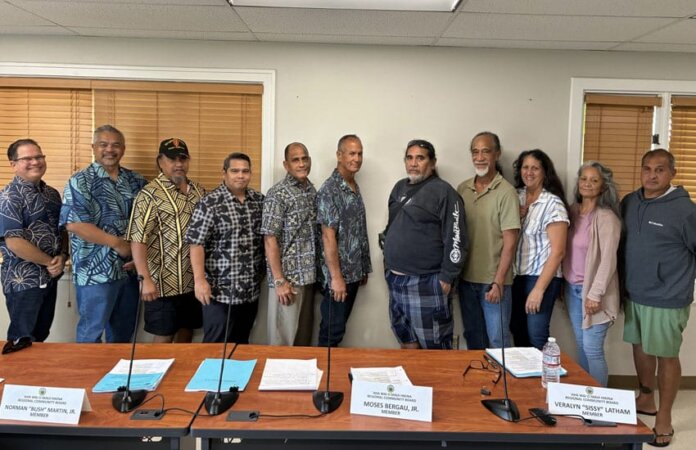
The ʻAha Wai o Maui Hikina – the EMWA Community Board – governs the Authority and is mandated to acquire the East Maui water licenses. The ʻAha is composed of stakeholders in the source and delivery areas including kalo farmers, watershed experts, and a representative for the Hawaiian Homes Commission.
Less than one month after the first ʻAha meeting, a letter was sent to then BLNR Chair Dawn Chang, asking that “DLNR (Department of Land and Natural Resources) initiate the processes for the East Maui Water Authority to acquire and manage the East Maui water license and systems …”
Replying 4-1/2 months later, Chang said, in part, that “It is important to note that [DLNR] does not own the water diversion and transmission system, [which] is privately owned by the East Maui Irrigation Company, LLC …”
While Chang was absolute in her statement, DLNR, the state’s attorneys, A&B, and now dba Mahi Pono have been saying much the same thing for many years.
- A&B’s final EIS for a proposed 30-year water license was approved by BLNR in 2021 and states “The EMI Aqueduct System is owned and operated by the EMI.”
- In February 2026, the legislature considered House Bill 2434, which would have given a “right of first refusal” to the county for this system. In opposition, the state’s Deputy Attorney General said that “… these are not public infrastructure [so the county would] have to prove that one they are in the process of eminent domain …”
- In April 2026, dba Mahi Pono testified to BLNR that “EMI owns the Ditch System and has no intention of selling it.”
However, records held by DLNR – the department governed by BLNR – contradict this.
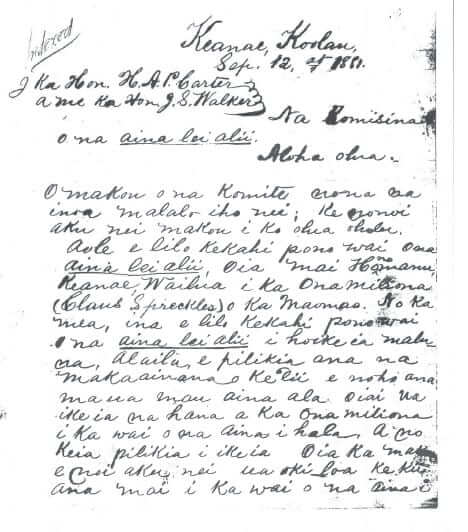
The territory’s previous long-term licenses all expired decades ago: Keʻanae in 1971, Nāhiku in 1976, Huelo in 1981, and Honomanū in 1986. Each lease contains language providing that, upon termination, the entirety of the system on those lands would revert to and become the sole property of the territory.
These important points have been raised occasionally before. However, since much of the debate for the last three decades has been focused on how much water should be taken from East Maui, less attention was paid to who owns the system. That changed in April when the EMWA and the ʻAha presented this information to the BLNR.
This issue matters right now. These are not merely historical or academic questions.
In their most recent proposed action in August 2026, the DLNR only recommends a 30-year license to dba Mahi Pono and argues against issuing a set-aside of the system to Maui County.
DLNR uses the lack of ownership of a portion of one ditch as its reason to deny county management, even as they ignore the fundamental questions of ownership of the majority of the EMI System.
Ownership also matters to all beneficiaries of the Department of Hawaiian Home Lands (DHHL), the Office of Hawaiian Affairs (OHA), and the public.
Even if a license is issued to dba Mahi Pono, under the Hawaiian Homes Commission Act, 30% of revenues from these licenses go to DHHL, and 20% to OHA because the revenues derive from “ceded” lands. The remaining 50% goes to the public.
If the state owns more of the ditch system than it currently recognizes, the license price should be much higher.
Perhaps most importantly, this confusion about ownership reflects a fundamental problem with the current bodies controlling the crown lands.
If BLNR, DLNR, and dba Mahi Pono do not even know what is owned on these lands, how well are they stewarding them for the future?
The EMI remains central to how water moves across Maui. Before BLNR decides who should control it, they should first establish who actually owns it.
Update: At its August 14 meeting, BLNR voted unanimously to reject the proposal to initiate a public auction and the set-aside of land to Maui County. A contested case on the matter, requested by Sierra Club of Hawai’i, is still pending.
Dr. Jonathan Likeke Scheuer’s firm Kahālāwai Consulting helps clients embroiled in environmental conflict seek shared, sustainable prosperity for the communities and ʻāina involved. He currently is Vice Chair of the ʻAha Wai o Maui Hikina (East Maui Regional Community Board). He is coauthor of the 2021 book, “Water and Power in West Maui,” has numerous published essays on public policy issues, and has been quoted as a water policy expert in the “New York Times,” the “Washington Post,” the “Guardian” and other media.



 authorizing a 30-year East Maui water license to a foreign corporation.)