
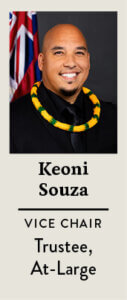
As a trustee of the Office of Hawaiian Affairs (OHA), I am often asked how we balance investment performance with our deeper kuleana to lāhui.
It is a fair question. In today’s economy, too many decisions are driven solely by profit margins and short-term gains. But at OHA, our mission has never been about investment for profit alone. Our charge is to steward the Native Hawaiian Trust for the benefit of our people, today and for generations of lāhui.
There is a fundamental difference between investing to extract value and investing to build value for community. The first asks, “How much can we make?” The second asks, “How much can we uplift?” As trustees, we are bound to the second question.
That is why our support for responsible residential development in Kakaʻako Makai is rooted in stewardship, not speculation. Kakaʻako is more than a parcel on a map; it is ʻāina with history, memory, and meaning. For decades, Native Hawaiians have watched as prime lands were transformed into luxury spaces disconnected from local families. We cannot stand idle as our own people are priced out of the communities they helped shape.
When we speak about residential opportunities in Kakaʻako Makai, we are speaking about creating pathways for local families to remain in Hawaiʻi. We are speaking about stabilizing communities, supporting workforce housing, and ensuring that Native Hawaiian Trust assets are activated in ways that serve beneficiaries first. Stewardship means making prudent decisions that generate returns, yes – but returns that are measured not only in dollars, but in homes, jobs, and stability.
Our Native Hawaiian Trust Fund assets are not abstract financial instruments. They represent resources owed to the Native Hawaiian people, long-recognized obligations that must be managed with integrity and purpose. Every decision we make must honor that responsibility.
Responsible development can generate long-term revenue to fund scholarships, housing programs, cultural initiatives, and health services. At the same time, it can provide tangible opportunities for our community to live and work in places that have too often been reserved for outside interests.
Equally important is how we build.
When development moves forward in Kakaʻako Makai, it must include strong partnerships with Hawaiʻi’s labor unions. Supporting union labor is not a political gesture, it is a community commitment. Our unions represent skilled local workers who live here, raise families here, and spend their wages here. By engaging organized labor, we ensure fair wages, safe working conditions, and apprenticeship opportunities that open doors for Native Hawaiian and local youth to enter the trades.
When we invest trust assets in projects that prioritize union labor, we create a multiplier effect. Construction jobs lead to household stability. Apprenticeships lead to lifelong careers. Union wages circulate back into local businesses, strengthening our island economy. This is how development becomes community building.
OHA has the opportunity and the responsibility to help change the narrative. Mission-driven investment means shaping projects so they reflect our values: mālama ʻāina, economic justice, and intergenerational prosperity.
We must also acknowledge that stewardship requires vigilance. Any residential development must respect shoreline access, cultural resources, and environmental protections. Growth cannot come at the expense of our ʻāina or our identity. The future of Kakaʻako Makai must balance housing needs with preservation, ensuring that development enhances, not erases, what makes this place sacred.
At OHA, we pursue projects because they align with our mission to improve the wellbeing of Native Hawaiians. When we leverage our trust assets thoughtfully, partner with labor, and center our community, we move beyond profit toward purpose.
That is the difference between investing for gain and investing for generations.

, I am often asked how we balance investment performance with our deeper kuleana to lāhui.)