
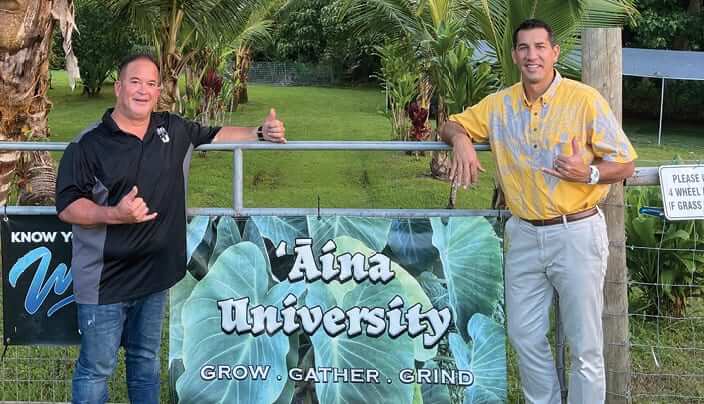
As Hawaiʻi faces growing challenges around food insecurity, climate change, and the disconnection of our keiki from place, leaders like Kāwika Lewis and his wife, Kaipuaʻala, are showing us a path forward – one firmly rooted in ʻāina, Indigenous wisdom, and community leadership.
Just four miles from the hustle and bustle of Hilo, in the ahupuaʻa of Paukaʻa, Kāwika and his ʻohana steward nine acres of land known as ʻĀina University. It is a living classroom, a place for the community to grow, gather, and grind. More than a farm, ʻĀina University is an expression of aloha ʻāina in practice.
At ʻĀina University, keiki to kūpuna learn about the ahupuaʻa system, Native Hawaiian plants and crops, food security, and the responsibilities that come with caring for land and community. These lessons are not abstract, they are lived. They are hands-on, physical, and rooted in the ʻike kūpuna that allowed Hawaiians to thrive on islands with finite resources for generations.
Long before sustainability became a modern concept Hawaiians mastered regenerative systems that balanced food production, ecosystem health, and social wellbeing.
Loko iʻa, loʻi kalo, agroforestry, and dryland farming were not merely techniques, they were expressions of values: kuleana, mālama, and collective responsibility. ʻĀina University carries that knowledge forward, translating ancestral practices into contemporary solutions for today’s challenges.
Kāwika, a kanaka mahiʻai (farmer), understands that working the land teaches more than how to grow food. It teaches work ethic, respect, language, culture, and protocol. It teaches people how to function as a hui – a team, a community. These are real-world life skills, learned through an Indigenous lens grounded in aloha ʻāina and service to something greater than oneself.
Food security, from an islander’s perspective, is not simply about supply chains or imports. It is about relationships to ʻāina, to each other, and to future generations. When communities can feed themselves, they gain resilience, dignity, and sovereignty over their future.
This work matters most for our children. If we want a better Hawaiʻi, we must teach keiki the right values and the right vision – one that honors place, respects limits, and understands leadership as service. Indigenous wisdom does not belong in the past; it offers inspiration for the solutions our world seeks today.
If you want to find the future you seek, you must be willing to seek change. Through ʻĀina University, Kāwika and Kaipuaʻala remind us that the future of Hawaiʻi begins with the land – and with the Kānaka willing to care for it and pass that kuleana forward.

