
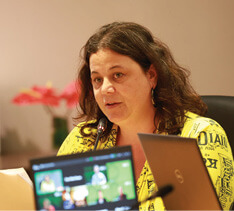
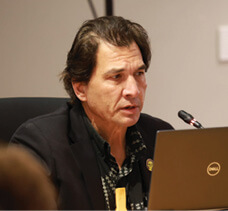
‘Ilima Long (left) and James Maioho (right) were two of the dozen beneficiaries who testified against military leased lands at the Nov. 13 OHA board of trustees meeting. – Photos: Nelson Gaspar
“We have to fight for our rights. We have to fight our best and we have fight smart,” said ʻIlima Long, testifying before the Office of Hawaiian Affairs (OHA) Board of Trustees (BOT) on November 13.
Long was just one of nearly a dozen beneficiaries who testified before the trustees ahead of its vote on how OHA will response to ongoing military land-lease and funding negotiations between the state and federal governments.
Without exception, beneficiaries testifying that day objected to the renewal of military leases.
Ben Schafer, an Air Force veteran, testified that the military today “is very different” saying that “if they train on our lands, then we become part of that killing wherever it might be. We donʻt want to be any part of it.”
James Maioho, who has toured the impact zone, testified that the level of devastation “was really shocking” and asserted that the military’s claim that they are making Hawaiʻi safer is false. “What happens on these bases makes Hawaiʻi one of the hottest nuclear targets on the planet. This cannot be allowed to continue,” he said.
For months, Gov. Josh Green has been working with U.S. Secretary of the Army Dan Driscoll to fast-track renewal of expiring military leases in Hawaiʻi despite community sentiment and the Board of Land and Natural Resource’s rejection of both of the Army’s Environmental Impact Statements to renew state land leases in Pōhakuloa and on Oʻahu earlier this year.
Green has repeatedly expressed concern that the federal government may invoke eminent domain to seize the lands – something he wants to avoid – under the assumption that invocation of eminent domain is inevitable.
A November 4 Civil Beat article by Blaze Lovell reported that, in an October 29 letter to Driscoll, Green proposed $10 Billion from the federal government to renew leases for Pōhakuloa and about 400 acres on Oʻahu. The funds would be used, among other things, for environmental, energy, transportation, and housing projects.
Green also proposed convening a negotiation team to set parameters on a settlement, saying in the letter that “a negotiated settlement, rather than a protracted contested condemnation, offers the clearest, most efficient path.” Members of the proposed negotiation team have yet to be named.
OHA’s military lease response plan was approved on November 13 and calls for OHA to be included in Green’s “Joint Negotiation Team,” and to co-chair the state’s “Technical Working Group” along with the Department of Land and Natural Resources.
“The state constitution requires that Native Hawaiians and OHA not only be considered and consulted, but also compensated for any use of lands of the public lands trust,” said OHA BOT Chair Kaialiʻi Kahele. “Our beneficiaries are insisting that OHA be a leader with the state in talks with the military about the future use of our lands.”
Trustees also voted to hold community consultation sessions on its military lease negotiating positions to further inform OHA’s stance. The first meeting was held at UH Hilo on November 26, with a second planned for December 17 at the Kamehameha Schools Community Learning Center at Māʻili on Oʻahu.
The BOT also approved inclusion of a bill in OHA’s 2026 legislative package calling for a constitutional amendment to prohibit live-fire military training on the state’s public trust lands to be included on the 2026 ballot.
While the November 13 meeting was in process, a press release from the governor’s office announced that an Advisory Committee for Military Leased Lands comprised primarily of Native Hawaiians had been selected. OHA Chief Advocate Leināʻala Ley brought this to the board’s attention during the meeting, noting that the OHA’s Interim Administrator Summer Sylva was named to the committee.
However, Long, who has experience working for labor unions, testified that, “Advisory teams do not negotiate. Advisory committees are nothing. Hawaiians need a meaningful seat at the table; a meaningful pathway and space to fight for the return of our lands. I very much support OHA’s direction to assert its rights to negotiate.”
In a November 14 statement, OHA acknowledged the governor’s announcement, expressed appreciation that Sylva was invited to participate, but clarified that OHA’s role in the group would be to examine legally and politically viable alternatives to condemnation, recognizing what is at risk should the federal government pursue condemnation in a manner that disrupts state rights, undermines historical land claims, weakens the political trust relationship, and disregards the unresolved history of Hawaiʻi’s unrelinquished sovereignty.
“It’s important these conversations do not occur in silos or in a rigid, linear sequence,” said Sylva said. “The idea that condemnation is inevitable – and that discussions must focus solely on valuation – overlooks the viable paths still available. Exploring all options is not only prudent—it is essential to avoid forcing Hawaiʻi into false choices.
“At the same time, the committee’s work to assess the valuation of these lands should not alarm those who oppose condemnation,” Sylva, a Native rights attorney, continued. “Accurate valuation serves multiple pono purposes far beyond preparing for potential legal action. For decades, military leases have been significantly undervalued.
“Conducting long-overdue due diligence on the true worth of our lands is essential – whether the path forward involves new or renewed leases, non–live-fire training arrangements, or other alternatives to condemnation. Responsible stewardship of trust lands cannot wait for crises, particularly when their very purpose is to be restored to the people from whom they were unlawfully taken.”
Following up on November 17, Kahele sent a letter to the U.S. Senate and House Armed Services Committees, with copies to government leaders including Green and Hawaiʻi’s congressional team, regarding the lands leased by the military. The letter requested inclusion of Section 2831 in the final version of the FY 2026 National Defense Authorization Act, along with a targeted amendment requiring formal consultation with OHA and Native Hawaiian organizations.
“Section 2831 helps address the complex issues that the State of Hawaiʻi, the Department of Defense, OHA, and Native Hawaiians are facing, and can ensure that negotiations lead to timely decision-making while preventing indefinite delay. It also promotes a coordinated federal–state process, rather than fragmented or service-specific approaches,” Kahele said.
A background memo included with the letter provided information about the Public Land Trust and the federal government’s relationship with the Native Hawaiian community.
“It is important for our national leaders to understand the history and the responsibilities that the federal government, the Office of Hawaiian Affairs, and the State of Hawaiʻi all have on this issue,” added Kahele.
Kahele notes that OHA wants to work transparently with all parties involved and also include the community in the important decisions to be made. To this end, OHA has also launched a comprehensive public education website on the military leased lands issue that includes an anonymous community survey.
“There is meaningful opportunity in this process if the governor and the committee approach it with courage, conviction, and a commitment to leading not from fear but from principle,” reaffirmed OHA Board Chair Kahele. “OHA stands ready to contribute in that spirit.”
For more information about the history of military land leases in Hawaiʻi or to share your manaʻo on this issue via our confidential survey, scan the QR code or go to: www.oha.org/aloha-aina


 Board of Trustees (BOT) on November 13.)