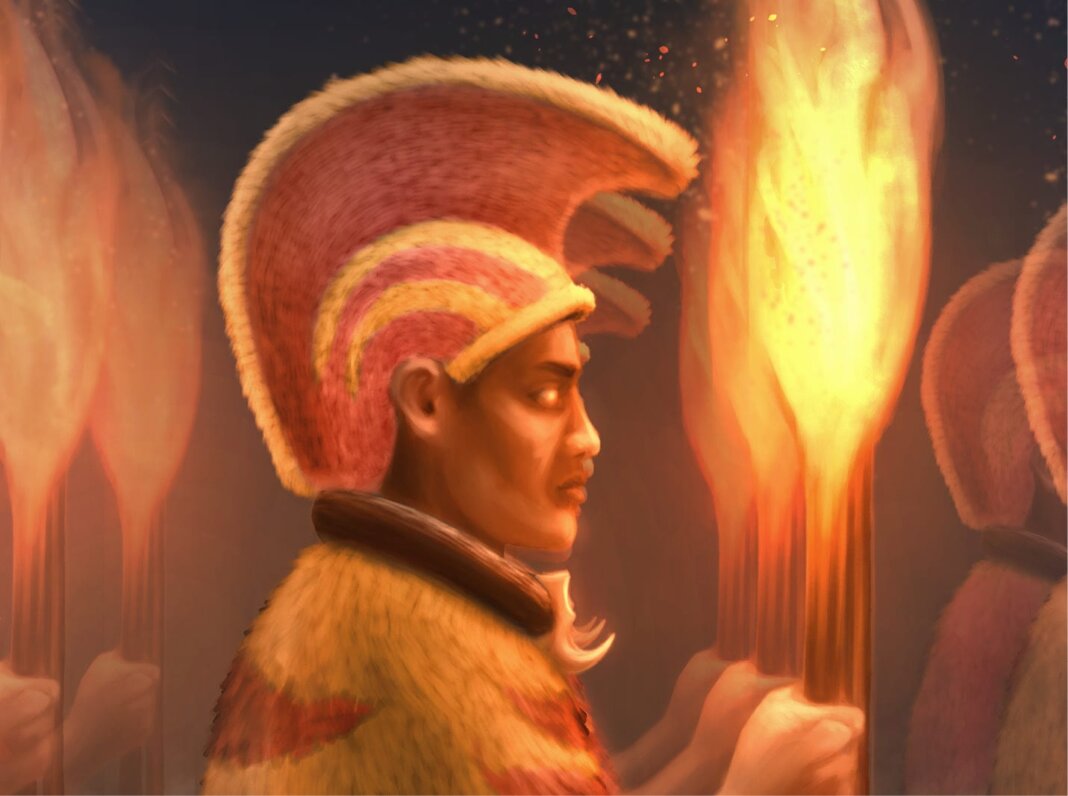
One of the most enduring haunted tales of ancient Hawaiʻi is that of the legendary night marchers.
ʻOiʻo, nā huakaʻi o ka pō, spirit ranks, phantom army, huakaʻi pō. There are several names for them, but each refers to the same ghostly procession that brings chills to those unlucky enough to witness the phenomenon.
The Legend
Almost anyone who has lived in Hawaiʻi for a while can recite the tale. It starts with the sound of drums, distant at first, then louder as they get closer. You will sense a foul odor in the air, the smell of something long dead, and then you will see a long line of torch lights that grow brighter. These are your warnings to get out of the way.
If you can’t run, you must hide. If it’s too late for either, then you must prostrate yourself and hide your eyes and pray that the night marchers will ignore you. If you know it, you should call out your moʻokūʻauhau, your family genealogy, in hopes that you might have an ancestor in the procession that will speak for you, thus saving your life.
Carrying on Oral Traditions
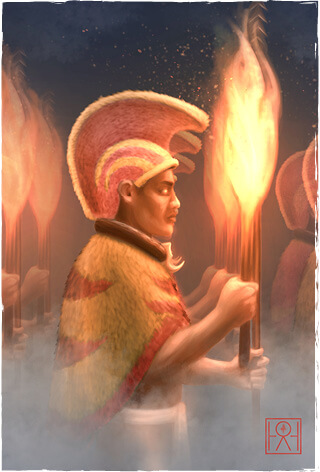 The oral traditions of Hawaii’s night marchers have been passed down from mouth to ear from time immemorial. Stories of the huakaʻi pō were spread through whispers and late-night gatherings. Their tales have survived hundreds of years of change and the influx of missionaries and other cultures.
These processions have been witnessed by Hawaiians and non-Hawaiians from many different walks of life as their similar stories of fear and wonder are recounted over and over. But the question always comes back to, “Who are the night marchers?”
As a young man, I learned at the side of my mother, Angeline Kapanui, and my Aunty Ella Kalawa Alcon, who shared the teachings of their kūpuna. From them, I came to understand that our Hawaiian traditions are our own, meaning that we, our family, do not speak for all Hawaiians. The stories shared with me and the stories I tell about our family and lineage won’t always be the same as those from another village or island.
Because Hawaiians preserved our history through the oral traditions of haʻi moʻolelo, hula, and ʻoli, stories naturally change over time. Witnesses move about, storytellers adapt details to their settings, and meanings shift through interpretation. In addition, ʻōlelo Hawaiʻi is a profoundly poetic language, where kaona, or hidden meaning, often shapes how a moʻolelo is told and understood.
When comparing oral traditions with written sources, patterns emerge.
Consistent references describe the night marchers traveling along familiar paths during certain phases of the moon, and witnessing their march would mean instant death. These enduring accounts carry greater weight than modern inventions, which often portray the ʻoiʻo as violent or fantastical beings.
My purpose in this article is to share the knowledge of my kūpuna and distinguish authentic Hawaiian oral traditions from later misrepresentations.
The knowledge I’ve gathered over the last two decades comes from my kūpuna, from scholarly works, and from the accounts of those who have witnessed these events. I recognize that there is much more information beyond what I share here, but please trust that I present this material with respect and have made every effort to be as accurate as possible.
Filtering Out Misunderstandings
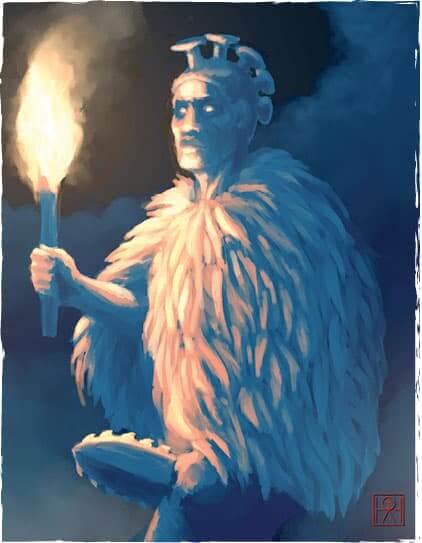
While there are numerous personal accounts of the huakaʻi pō, there are just as many misconceptions. A quick search online for “Hawaiʻi’s night marchers” often reveals dozens of websites repeating the same information, but repetition does not guarantee accuracy. With so much material copied from one source to another, it becomes difficult to separate authentic oral tradition from modern invention.
Some websites claim that the night marchers will chase you and kill you, that they are the souls of relatives who died tragically and remain in our world to cause mischief, or that they are ghosts tasked with hunting down the descendants of their enemies. We even found a blog post that describes an encounter with the ʻoiʻo as “jungle warriors dressed in grass skirts,” although we know that Hawaiian warriors did not wear grass skirts.
One contributor on the Wikipedia Night Marchers page describes the phantom army as if they were characters in a video game, stating that, for the offense of looking upon a sacred body part of a chief, “bolts of intense light and flaming heat originating from several of the warriors’ eyes aimed toward the mortal. The violating mortal is incinerated instantly, and the bodily remains dissipate as vapors.”
Stories like these, once published online, are easily spread and mistaken for cultural knowledge. But in over two decades of research, I have found nothing in written records or oral traditions to support these claims of violent pursuit, mischievous haunting, or supernatural laser attacks.
What we do find, in both the words of our kūpuna and the research of scho-lars, is a consistent thread. While details vary, the core understanding remains the same.
The huakaʻi pō were accepted as a part of everyday reality. They are the ghosts of warriors tasked with escorting their aliʻi in death as they did in life. Those who witnessed them knew how to respond with respect and avoid getting in their way. For that reason, fear was not the central reaction of ka poʻe kahiko, the people of old.
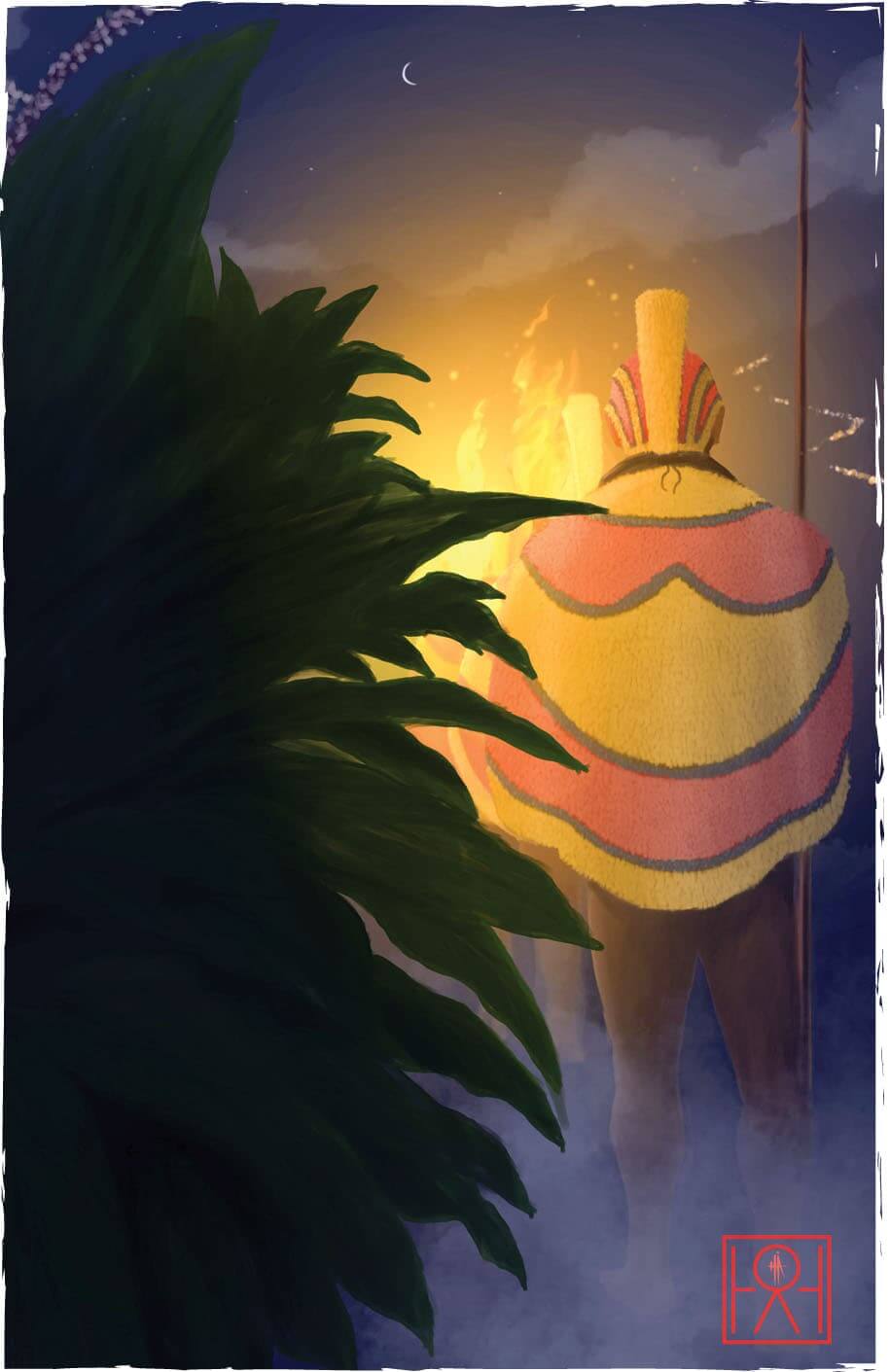
The rules were simple. If you’re able to run, then do so. If not, you should hide and never attempt to look upon the sacred procession of warriors, kāhuna, and aliʻi. If it is too late to do either, then you should present your moʻokūʻauhau while you prostrate yourself in hopes that an ancestor or ʻaumakua might recognize you and save your life.
The Hawaiian historian Kepelino stated that if you do not know the lineage of your ancestors, your next hope is to strip off your clothing and lie flat on your back to convince those in the procession that you are mad and, therefore, have pity for you and leave you in peace. Anthropo- logist Katharine Luomala recorded that some say you should remove your clothing and rub urine on your body so that you may repulse the huakaʻi pō.
Some processions are made up entirely of akua, and some have only ʻaumakua marching. Other night marcher processions are meant to escort a deceased descendant to the afterlife.
Accounts of the night marchers also vary depending on when and where the ghostly armies are witnessed. These haunted processions are said to continue the customs, attitudes, rituals, and protocols they observed in their lifetimes.
Within this tradition, anyone who violated a kapu while a procession passed met the same fate as their ancestors, whose lives were taken for such transgressions. Unexplained or sudden deaths might be attributed to natural causes such as heart failure, but kūpuna, the elders, often understood them as the effects of witnessing the huakaʻi pō.
The following tales of the huakaʻi pō are personal to my ʻohana.
On the Black Sands of Kalapana
At night, the darkness in Kalapana can feel overwhelming, folding in around you until even the faintest path disappears. In my mother’s time, electricity had not yet reached many parts of the area, and there were no streetlights. On a moonless night, the blackness was nearly complete.
One such night, my mother was walking home from a neighbor’s party with her brothers and sisters. All of her siblings were a little drunk, but she was not. Pregnant and weary, she just wanted to lie down and rest. She knelt on the cool, black sand and dug a shallow hole to ease her stomach, lying briefly on her side. She closed her eyes and breathed in the ocean-scented air.
Suddenly, something shifted. The silence of the coast gave way to voices, dozens of them, speaking ʻōlelo Hawaiʻi, quick and animated, like relatives gossiping. The chatter grew louder, sharper, until it merged into the rhythmic pulse of chanting.
My mother sat up. A grand procession was moving across the beach, six abreast, hurrying with purpose. Each man and woman carried a torch, the flames glowing only red, without a trace of orange or yellow.
Believing they might be family, my mother prepared to join them and called out, “I hea ana ʻoukou?” Where are you going?
But before she could take a step, her eldest brother Joe appeared from the shadows. He seized her from behind, pulling her to the ground, one arm locking her shoulders, the other clamping firmly over her mouth. She struggled, frightened, but he held her still. Together they lay pressed to the sand as the fiery procession swept past.
Despite the cool breeze, sweat dripped from Joe’s face onto my mother’s. She recoiled, not knowing why her brother held her like this, wondering what he was going to do. Only when the last of the torches had vanished into the night did Joe release her.
His voice was low and harsh as he scolded her, “What the hell are you doing?”
The stress and fear had sobered him completely, and he admonished his sister for being so stupid. What she had seen, he said, was no gathering of family, but the sacred march of the goddess Hiʻiakaikapoliopele, Pele’s youngest and most beloved sister. To interrupt such a procession was to invite disaster, not only upon herself, but also upon her unborn child.
Years later, my mother told me the story again and added that on that night in Kalapana the child she carried in her belly was me.
Beneath the Pineapple Tower
In June 1963, an Oldsmobile station wagon sat parked near a warehouse on the edge of Iwilei and Kūwili. Inside that crowded car lived a mother and her four children. The youngest, just a few months old, suffered from malnutrition.
Though everyday life pressed on with school and church on Sundays, survival was always uncertain. Showers and meals were stolen at their grandmother’s house when the grandfather was away, and their mother worked days as a secretary at an appliance warehouse, the youngest children kept in a corner behind her desk. Their car was their home.
The eldest boy, Joshua, often stared out the wide car window at the looming pineapple tower. To him, the sharp, acrid smell of the factory seemed to seep from that hulking structure. In his imagination, the tower was a monster from a Godzilla film, waiting to hurl radioactive fruit across Honolulu. In bleak moments, those fantasies were his only escape.
At night, the hum of traffic and the rhythm of city life usually lulled him to sleep. But one late evening, Joshua woke with a start. Something was wrong. The sound was gone. No cars, no voices, no movement – only silence. He glanced at his mother and siblings, all fast asleep, unbothered by the quiet. Alone in his unease, Joshua felt a weight of dread settle over him.
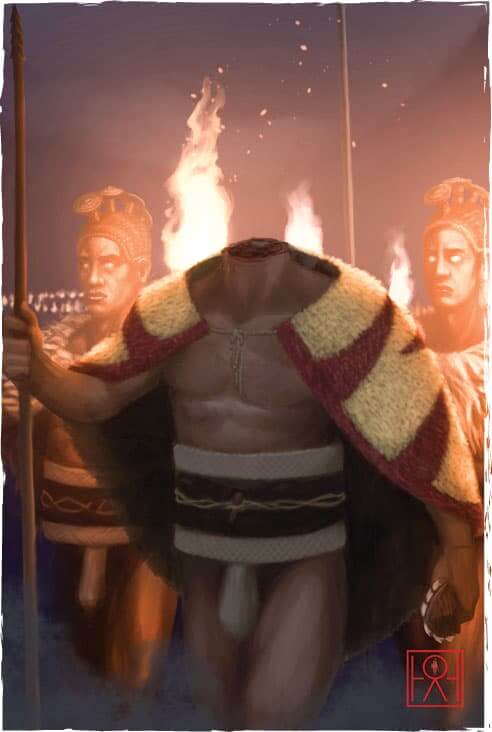
Then he saw it, the dim glow of the streetlights gave way to a deep, orange and crimson light. Down Kuwili Road came a line of half-formed men carrying bright torches. A procession of ghostly warriors advanced. Chiefs in feathered cloaks and helmets strode among them, their presence commanding, their eyes alive with awareness.
Joshua’s gaze locked with one of the warriors. The spirit’s face contorted in rage. He shouted a command and pointed directly at the boy. Joshua froze. Terror rooted him in place. He could not move. He could not scream. The fiery procession drew closer, step by step, until it seemed certain they would engulf him and his sleeping family.
At the final moment, a hand pressed the back of Joshua’s head into the car seat. His mother’s voice rose in prayer, strong and urgent, unlike any tone he had heard from her before. She was not scolding, not arguing. She was declaring their genealogy in Hawaiian. Joshua would later learn that this chant was meant to call on their ancestors, hoping one of the spirits would recognize a name and spare their family.
The next morning, Joshua awoke unharmed. The car, the street, his family, all untouched. His mother’s prayer had worked.
When he asked her about it, she answered simply, “Your grandfather and I don’t see eye to eye right now. We’re both stubborn, but we’ll make up. In the meantime, never forget, when all hope is lost, you can always depend on your ʻohana, living or not.”
It was a lesson Joshua carried for the rest of his life.
The stories of the huakaʻi pō remind us that these traditions are not only tales of fear, but lessons about respect, ancestry, and the unseen forces that still move through Hawaiʻi.
Whether on the black sands of Kalapana or a busy industrial center in Iwilei, such encounters link the present to the past and show how the voices of our kūpuna continue to guide and protect.
For a deeper exploration of these traditions and the stories surrounding them, you can find more in “Hawaiʻi’s Night Marchers: A History of the Huakaʻi Pō,” a book by Lopaka and Tanya Kapanui that is now available on Amazon.