

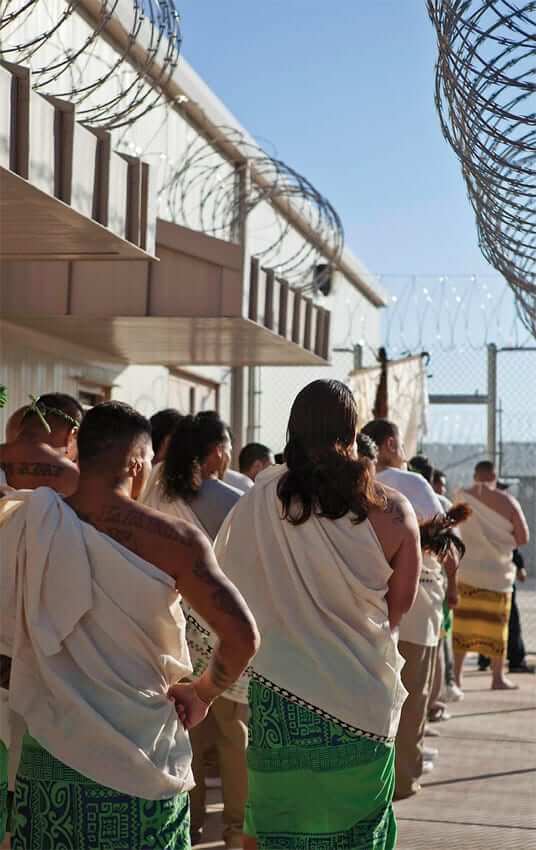
Paʻahao (inmates) at Saguaro Correctional Center in Arizona participate in Makahiki celebrations in October 2011. This month marks 30 years since the state has utilized private prisons on the continent to house Hawaiʻi inmates. – Photo: © Nick Oza – USA TODAY NETWORK via Imagn Images
By Sonny Ganaden
This month marks 30 years since the state has utilized private prisons on the continent to house inmates from Hawaiʻi
It is a well-established truth that the criminal justice system in Hawaiʻi disproportionately impacts Native Hawaiians.
While significant progress has been made in the last few decades to address Native Hawaiian equity in education, business, housing, and economic opportunity, the state criminal justice system remains deeply inequitable.
Despite generations of respected Hawaiians practicing law and serving in the judiciary; despite numerous studies and the termination of private prison use by other states; the utilization of private prisons has remained a significant tenet of Hawaiʻi’s justice system since December 1995.
The Rise of Private Prisons in America
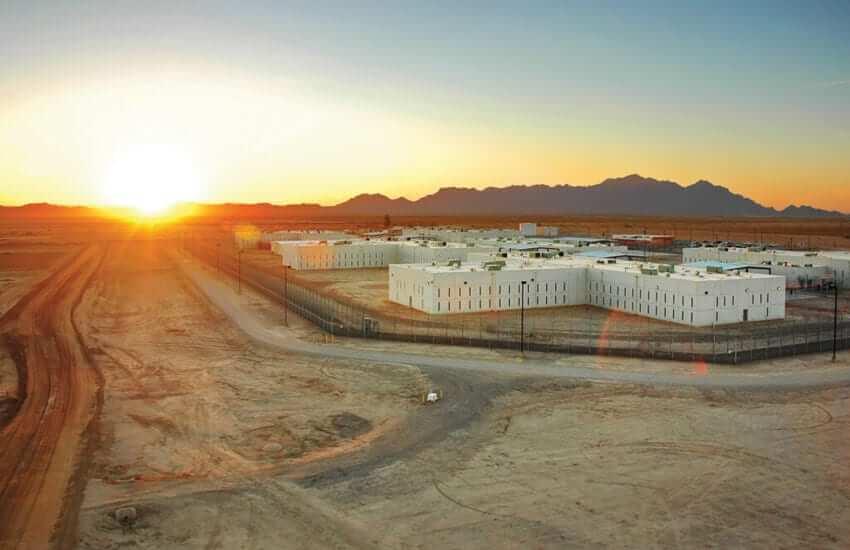
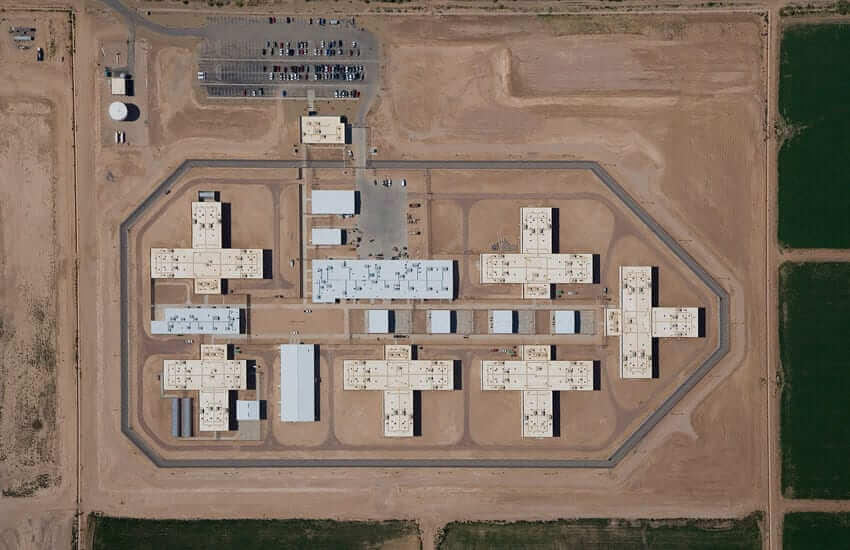
Saguaro Correctional Center is located in the Arizona desert 65 miles southeast of Phoenix near the town of Eloy. Nearly half the inmates at the 1,896-bed facility are from Hawaiʻi. Saguaro is a private prison operated by CoreCivic, a corrections management corporation. In 1995, the State of Hawaiʻi began sending inmates to private prisons on the continent due to overcrowding. Above are both a street view and aerial view of the facility. – Photos: Moss.com
America’s “war on drugs,” initiated by the Nixon administration and expanded in the 1980s under the Reagan administration included establishing mandatory federal sentences for all drug-related crimes. Today, most states have mandatory minimum sentencing laws, significantly increasing the rate of incarceration as judges are required to impose long, predetermined prison terms in drug cases without professional discretion.
As a result, since the 1980s, the federal prison population has increased by more than 500%. Today, the United States has the dubious distinction of having the highest incarceration rate of any country in the world, with nearly 2 million American citizens incarcerated in state and federal prisons, or in local jails – 70% of whom are people of color.
It did not take long for the increase in drug offense convictions to overwhelm state correctional facilities, which ultimately gave rise to a new industry: private prison management. In 1983, Corrections Corporation of America opened the world’s first for-profit prison in Tennessee.
Today, Corrections Corporation of America – rebranded as CoreCivic – is the largest prison management company in the U.S. Along with GEO Group (a publicly traded company), CoreCivic manages more than 170 prisons and detention centers across America, with annual revenues in the billions of dollars.
In the past year, incarceration has increased exponentially because of hardline immigration enforcement policies. When Donald Trump announced “the largest deportation operation in the history of our country” at his 2025 inauguration, investors began betting on private prison stock, with the promise of new government contracts and the stability of existing contracts with states like Hawaiʻi.
According to a September 2025 article published in Just Security, during the second quarter of this year (April to June) CoreCivic reported total revenue of $538 million – an almost 10% increase from the same period in 2024. Meanwhile, GEO Group, ICE’s largest contractor, reported second-quarter revenue of $636 million – representing a 5% increase.
A Perfect Storm
As America waged its “war on drugs,” economic disparity in Hawaiʻi steadily increased due, in part, to speculation by outside investors that drove up land prices, while the prevalence of low-paying service jobs in our tourism-dominated economy failed to provide many residents with living wages.
At the same time, the methamphetamine crisis was exploding in Hawaiʻi. With increasingly harsh mandatory sentencing, incarceration at Oʻahu Community Correctional Center (OCCC) and Hālawa Correctional Facility soon exceeded capacity.
This led to other problems including failing infrastructure, staffing and health concerns, and deaths. A 1993 lawsuit by the American Civil Liberties Union (ACLU) resulted in a consent decree with the State of Hawaiʻi mandating that the correctional system meet basic requirements – but allocated no new funds to support any reforms.
By then, methamphetamine use was disproportionately afflicting rural and Native Hawaiian communities. Sentences got harsher and longer as prosecutors routinely stacked drug charges to secure convictions with lengthy prison terms.
Drug addiction was seen as a personal failing, not a medical condition or a coping mechanism associated with poverty or trauma. And convictions were difficult to appeal, as overworked public defenders were swamped.
From the perspective of the private prison industry, Hawaiʻi was the perfect customer.
In late December 1995, just a few months after Hawaiʻi State prison officials traveled to the continent for a tour of privately run prisons, some 300 Hawaiʻi paʻahao (inmates) were quietly relocated to private prisons in Texas.
It was supposed to a temporary solution until a new prison was built, but that never happened. Indeed, the practice of sending paʻahao to the continent to address prison overcrowding has expanded under every Hawaiʻi governor since its inception.
Strangers in a Strange Land
In the Arizona desert, some 65 miles south of Phoenix, tumbleweeds collect along fences in an arid landscape that stretches to the horizon. This is Eloy, home of Saguaro Correctional Center, a for-profit prison managed by CoreCivic. Saguaro is named for the tree-like cactus species made famous by countless western films.
Eloy could not be more different from Hawaiʻi and yet there are currently close to 900 Hawaiʻi paʻahao housed at Saguaro Correctional Center.
When Hawaiʻi’s private prison contract was initially signed, CoreCivic was allowed to choose who it housed from the state’s male and female inmate populations, shuttling them across facilities in Alabama, Arizona, California, Colorado, Florida, Minnesota, Mississippi, Montana, New Jersey, and Texas.
But in 2008, female paʻahao sent to private prisons on the continent were brought home after several lawsuits alleging sexual assault by guards. Subsequently, most of the male paʻahao were consolidated at Saguaro.
Despite being incarcerated in the middle of a desert hundreds of miles from the ocean and nearly 3,000 miles away from home, some paʻahao say that conditions at Saguaro are better than in Hawaiʻi.
Local prison conditions have become so intractable that some have their own nicknames. For example, at the Hilo Community Correctional Facility, the shared communal space (without a bathroom) is known as “the fishbowl” while the same space at OCCC is called the “thunderdome.”
Current State of Affairs

Testifying before the Hawaiʻi State legislature in 2025, Department of Corrections (DCR) Director Tommy Johnson said, “DCR would have returned the inmates long ago, but for the lack of space in its correctional facilities. DCR has no choice but to send them to private out-of-state facilities. DCR has no control over when and/or how many persons are sentenced by the court to DCR’s custody and care.”
Johnson’s regretful official tone is a more recent development, as there are currently no elected officials in Hawaiʻi who support the practice. In fact, several audits and state task force reports have slammed the private prison arrangement.
In January 2013, the Native Hawaiian Justice Task Force, comprised of nine members from the criminal justice system, submitted its report to the legislature. Their unanimous recommendation was that “prisoners held out of state should be returned. The state should make the return of inmates a top priority . . . and inmates should be returned as soon as practicable, consistent with public safety.”
Like other state-sponsored, well-intentioned documents, it was ignored.
The idea that Hawaiʻi cannot bring its prisoners home until a new facility is built is the deeply held belief of some state officials. It rests on the assumption that the number of incarcerated individuals is static. It is not. Crime, primarily violent crime, has fallen significantly in recent years in Hawaiʻi.
Meanwhile, CoreCivic profits from bureaucracy and inaction by the State of Hawaiʻi. The state pays CoreCivic more than $30 million a year to house paʻahao – ironically less than it costs to keep them home – which may explain why the practice has continued despite its unpopularity.
More enlightened thinking on the issue in recent years has led to a gradual return of inmates by the DCR – the result of an informal policy wherein individuals with Class-C felonies (charges carrying sentences of five years or fewer) are not sent out of state. The Hawaiʻi Paroling Authority has also begun bringing home inmates who are eligible for parole.
A Broken System
It is widely understood that, for Indigenous peoples and other people of color in America, the criminal justice system is broken. Or maybe it was intended to be this way.
Incarceration has long been used as a tool of oppression. The overthrow of the Hawaiian Kingdom was followed by a restructuring of laws. Everything about being Hawaiian became illegal: access to the sea; communal land ownership; freedom to practice traditional forms of dance and sport; access to Hawaiian medium education.
Known for her research on Native Hawaiian criminalization, in 2010 Dr. RaeDeen Keahiolalo-Karasuda published A Genealogy of Punishment in Hawaiʻi: The Public Hanging of Chief Kamanawa II. Accused of murdering his wife, Kamanawa was hanged in 1840 shortly after the signing of Hawaiʻi’s first written Constitution. The execution, witnessed by over 800 Hawaiians, was a grim public-political spectacle that reflected the increasing foreign influence in Hawaiʻi.
According to Keahiolalo-Karasuda, “Reexamining Hawaiian experiences in the past and current justice system through this lens allows us to see the political ramifications of incarceration and other forms of punishment, and to know that the criminalization of Hawaiians is neither straightforward nor simple.”
Some of the most ardent advocates for prison reform are not Hawaiian. Kat Brady of the justice reform-focused Community Alliance on Prisons has long fought for better treatment of Indigenous prisoners. “The difference between Indigenous and Western justice is that with Indigenous justice, you always had a chance at redemption. You could be forgiven, get your slate wiped clean and start over. With Western justice you never, ever, get out,” said Brady.
Despite, or perhaps because of, this alienation from their ʻohana, culture and ʻāina, Hawaiian men in Saguaro have asserted their heritage – most notably by celebrating Makahiki each year.
Delbert Wakinekona and Makahiki


The history of Makahiki celebrations by paʻahao began in the early 2000s – due in large part to the efforts of Delbert Kaʻahanui Wakinekona.
In 1969, at the age of 25, Wakinekona was indicted for the murder and robbery of a Nuʻuanu store owner – although he was not the shooter. After a three-day trial, the jury found him guilty. He was sentenced to life in prison without the possibility of parole.
After several altercations, in 1976 the State of Hawaiʻi sent Wakinekona to serve his time at Folsom State Prison in California – notorious for its violence and harsh, dehumanizing conditions.
Wakinekona sued, claiming that his exile from Hawaiʻi violated his constitutional rights. His case made it all the way to the U.S. Supreme Court, where he lost in 1983. That decision paved the way for the banishment of future paʻahao to the continent.
Notably, in his dissent to the 1983 decision, acclaimed civil rights advocate and Supreme Court Justice Thurgood Marshall wrote, “Whether it is called banishment, exile, deportation, relegation or transportation, compelling a person to quit a city, place, or country, for a specified period of time, or for life, has long been considered a unique and severe deprivation, and was specifically outlawed.”
Of his experience at Folsom Wakinekona once said, “all they had there was the Mexican Mafia, the Black Guerrilla Family, and one stupid Hawaiian.” Far from home, he eventually created a new community in exile as a leader among a growing population of Native Hawaiian paʻahao serving their time on the continent.
With help from cultural practitioner Kaiana Haili and Hawaiian social justice advocate Lillian Harwood (whom he eventually married) Wakinekona organized Hawaiian language and culture classes at Saguaro after he was relocated there. They also established an annual Makahiki celebration, with the men learning hula, oli and worshiping together.
Prison officials viewed these initiatives with skepticism. It took more than a decade, but eventually issues with facilities, wardens, official (and unofficial) rules were overcome, allowing paʻahao at Saguaro to celebrate Makahiki – a tradition that continues to this day.
In 2011, after nearly 42 years in prison, Wakinekona was granted a “compassionate release” after a liver cancer diagnosis. He lived the last two years of his life at home in Hawaiʻi, reunited with his family. He got married and became an advocate for a modern puʻuhonua to replace the brutal system in which he spent most of his life.
An Inconvenient Truth
Even though white Americans comprise 60% of the U.S. population, they only represent 30% of incarcerated individuals – evidence of the systemic racism that plagues America’s justice system and disproportionately convicts and imprisons Indigenous and other people of color charged with crimes.
That tracks here in Hawaiʻi where 40% of paʻahao are Native Hawaiian despite comprising just 20% of the population. The Native Hawaiian Justice Task Force Report is filled with stories about the men and women exiled to corporate prisons thousands of miles from home, tantamount to an “out of sight, out of mind” solution to the state’s 40-year-old prison overcrowding issue.
Whether due to funding or apathy, efforts to fix Hawaiʻiʻs overcrowded prison problem have made little progress. This, despite numerous studies strongly indicating that not only does mass incarceration have only a marginal impact on reducing crime, but it can also hinder rehabilitation, resulting in higher recidivism rates.
Rather, current research suggests that what does work are collaborative, community-based restorative justice programs; evidence-based models for rehabilitation; addiction treatment; job training; the zealous preservation of due process rights; and traditional cultural practices which perpetuate and reinforce the sense of belonging to a community.
Moving Forward
The Department of Public Safety recently released a study titled “Breaking Cycles: Alternative Models for Rehabilitation and Restorative Justice on Oʻahu.” It notes the overwhelming public support for systemic reform.
Earlier this year, the House passed Concurrent Resolution 153 calling for the incremental reduction of paʻahao incarcerated in out-of-state prisons. It also requests that DCR submit annual progress reports to the legislature ahead of the 2027, 2028, 2029, and 2030 legislative sessions.
Testifying in support of the resolution, the ACLU noted that “from 1995 to 2019, the state relied upon [DCR] to provide oversight over itself. During this time, a tragic history of death, sickness, and harm unfolded at Saguaro with no concerted efforts to fix conditions or question Hawaiʻi’s relationship with CoreCivic.”
The practice of sending Kānaka Maoli men to prisons on the continent is the ultimate expression of American colonialism in the 21st century, reflecting centuries of systemic oppression, cultural erasure, and displacement from the ʻāina.
This type of forced separation exacerbates emotional distress, weakens family bonds, severs ties to the land, and hinders successful reintegration. Advocates correctly argue that poverty continues to be criminalized in Hawaiʻi, with draconian laws regarding bail, and state and county ordinances that punish the survival behavior of those with the fewest resources.
There is no doubt that bringing our paʻahao home to Hawaiʻi will be expensive. But this is more than a political or budget issue; it is a moral issue akin to asking what it will cost to preserve Hawaiʻi’s forests, protect our coral reefs, or educate our children.