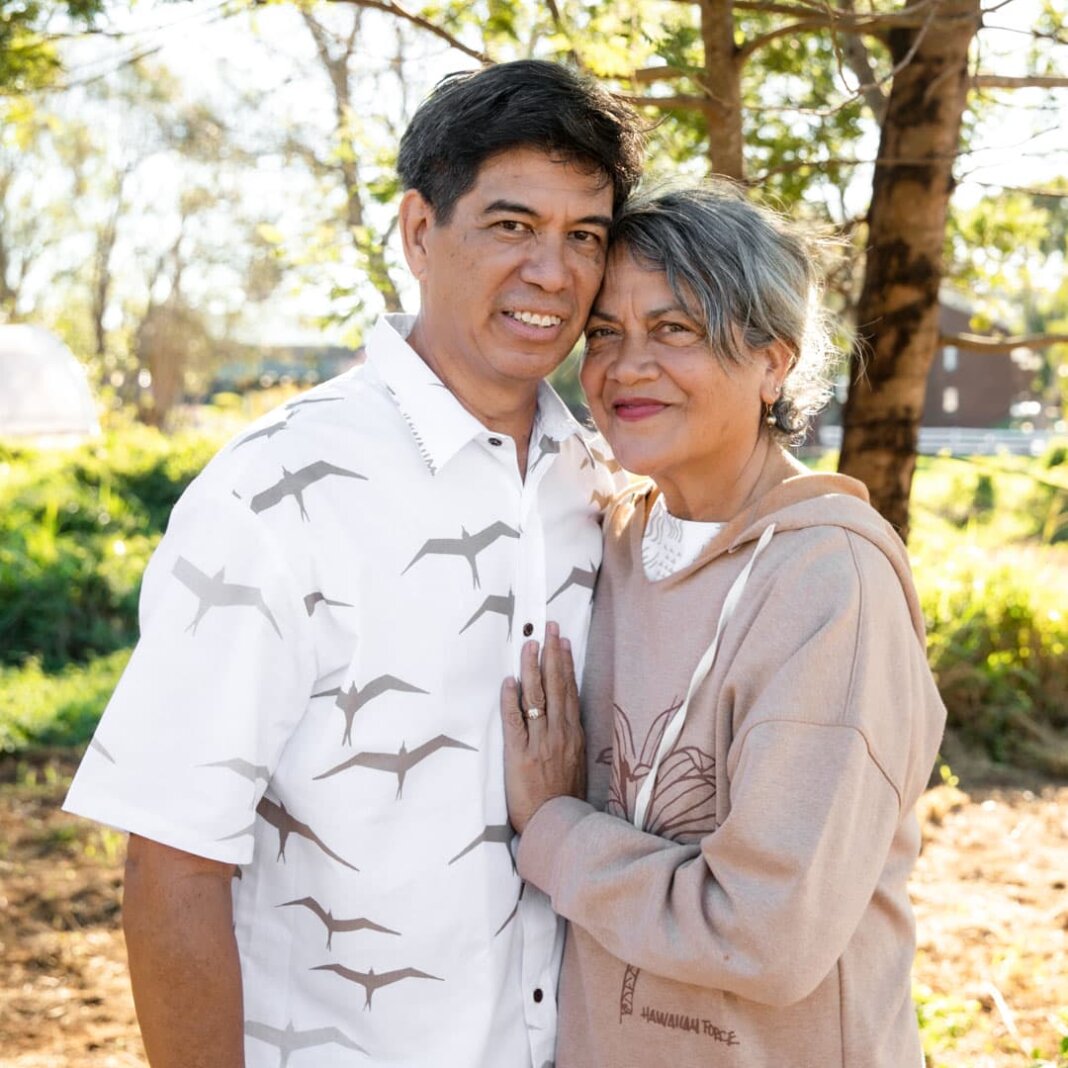
Craig and Luana Neff are the force behind Hawaiian Force, a Native Hawaiian small business that has been on the forefront of the apparel business – and the Aloha ʻĀina Movement – for more than 40 years.


“My mom always said you had to have the ʻeye’ – that ability to see and recognize beauty or balance,” artist and entrepreneur Craig Neff recalls.
Art came easily to Neff who grew up in a creative home. His mother also had the ʻeye,’ and his father enjoyed working with his hands. He started dabbling in t-shirt making in middle school, and when the 1977 Kalani High School graduate learned how to silkscreen in an art class, he and his brother, John, made t-shirts for their Makapuʻu body surfing club.
Neff came of age during the Hawaiian Renaissance – from the land struggles to Hōkūleʻa to the resurgence of Hawaiian pride – and that influenced both his art and his life.
After high school, Neff went on to UH Mānoa where he was one of just two ʻŌiwi art majors. In college he explored a range of artistic mediums from painting to sculpture to ceramics, but expressed his politics through his t-shirt designs, which soon became a side hustle.
“At the time there were hardly any Hawaiian clothing companies – and no one was making the kinds of designs I was looking for, so I started making my own designs,” Neff explained. “And then people would ask where I got my shirt and so I started making shirts for other people and then started to sell them on the side.”
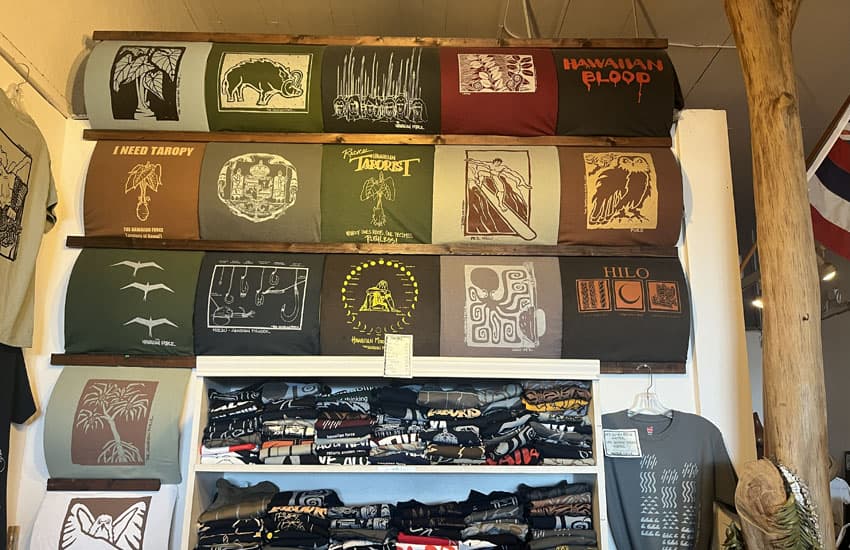
His first design influenced by the Aloha ʻĀina Movement featured the Hawaiian flag. His second was his now iconic “Hawaiian Blood” t-shirt which is still a huge seller more than 40 years later.
While in college, Neff made his first visit to the island of Kahoʻolawe – a huakaʻi that proved transformational. “Kahoʻolawe gave me a spiritual connection to ʻāina and deepened my connection to pono. It changed my life,” he said.
Neff quips that while he graduated from UH with a BFA degree, he graduated from the University of Kahoʻolawe with an AA (aloha ʻāina) degree, learning from revered kūpuna like Uncle Harry Mitchell and Uncle Les Kuloloio, and being mentored by Dr. Emmett Aluli.
Growing a business while growing the movement
By the time Neff graduated from UH in 1982, he was already producing t-shirts by the hundreds and selling them at craft fairs.
He also had a few early patrons who supported him, like Israel Kamakawiwoʻole. And while working at the Central YMCA, Neff met Palani Vaughan who encouraged his business pursuits – and backed it up by placing large orders of t-shirts for holiday gifts.
Neff’s designs were inspired by his growing political awakening, and his distinctive artwork and powerful aloha ʻāina messaging soon found a devoted following. At the time, Hawaiian Force t-shirts were wildly popular – there was nothing else like them and customers eagerly sought them out at craft fairs.
He admits that his early designs were “a little bit radical,” but usually offset with humor. His still-popular “Radical Hawaiian Tarorist” design was imagined while working in the loʻi kalo at Kānewai with some friends.
And when the phrase “Live Aloha” began being bandied about, Neff put his own spin on it. He produced a t-shirt design that said: “Live Aloha. Return Stolen Lands.” It was a satirical response to a shallow and overused phrase.
The name for his burgeoning t-shirt business – Hawaiian Force – was only slightly influenced by the Star Wars movies that came out around the same time. “I wanted it to represent Hawaiians as being a force,” Neff explained. “Like you wear the t-shirt, and you are part of that force and power. It wasn’t just a nice shirt; the name was intended to hui everyone together.”
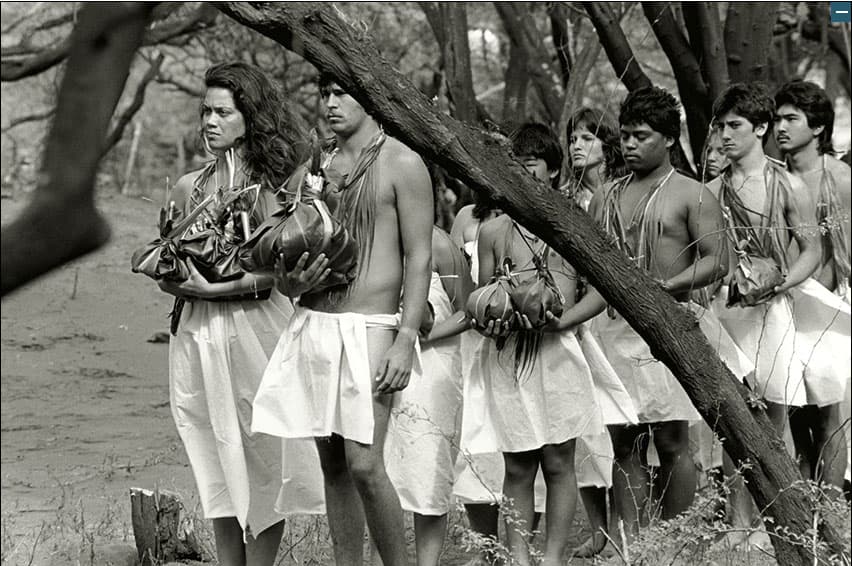
Neff became increasingly active with the Protect Kahoʻolawe ʻOhana (PKO) and was part of its first Makahiki celebration in 1982. It was also through his involvement in the Aloha ʻĀina Movement that he met his future wife, Luana Busby, at a protest in Waikīkī.
He was immediately smitten, but she already had a boyfriend. Undaunted, Neff bided his time. The two became friends, often working together as Kahoʻolawe access coordinators for Oʻahu. When Busby and her boyfriend split, her friendship with Neff grew into something more. By 1984, she was helping Neff with his t-shirt business, and they began to make a life together.
Hawaiian Force was established as a licensed business in 1984 – but for 15 years Neff’s shirts were sold primarily at craft fairs, although he took phone orders too. It was a lot of work – especially during the holiday season, “but you know, I was young, and I could hustle, and I had a lot of family and friends that always helped,” he said.
As Hawaiian political consciousness grew in the 1980s, people wanted t-shirts that made political statements – but the only available “Hawaiian” t-shirts were geared towards tourists. “The most local thing was ʻCrazy Shirts,’” Neff said. “There were no real Hawaiian t-shirts. It was a niche market, and we were able to ride it.”
Neff said that Hawaiian Force t-shirts make bold political statements, in part for their shock value, to spark dialogue and political conversations. “A lot of times at events when I was selling [my shirts], I would have discussions with people and try to educate them about what went down in Hawaiian history.”
In the mid-1980s, Neff began doing custom print jobs for Hawaiian organizations like Pūnana Leo. But a lot of effort goes into creating custom designs for clients and gradually he pulled back, preferring to focus on creating new designs for Hawaiian Force.
As his brand grew, buyers from stores like J.C. Penney’s and Sears approached Neff wanting to sell his shirts in their stores. But no matter how much money they offered, Neff declined preferring to retain full creative control.
“Craig has integrity. He’s unmatched when it comes to not selling out – to corporations or for the big bucks,” said his wife, Luana Busby-Neff.
By the late 1980s the couple had assumed leadership roles within PKO. Neff took the lead on building the hale halawai at PKO’s Hakioawa base camp and was training to become a moʻolono to help lead Makahiki ceremonies, while Busby-Neff was increasingly focused on the spiritual aspects of caring for ʻāina, studying under Pua Kanakaʻole and spending a lot of time in Hilo.
In many ways, their relationship was built around Makahiki and the healing ceremonies they were part of on-island. “We would always go together,” Busby-Neff recalled. “The Makahiki ceremonies held us, and the politics, together. Our pilina with the ʻāina was more real and more infused in the land. Makahiki was huge. It changed all our lives.”
In the early 1990s, the couple decided to move to Hawaiʻi Island. There, they continued to grow their business while working for the Aloha ʻĀina Movement, becoming active in efforts to protect Maunakea and to stop the bombing at Pōhakuloa while continuing their kuleana to Kahoʻolawe.
Shortly after moving, they opened their first storefront on Kīlauea Avenue in downtown Hilo. It was a small store, a little off the beaten path, but it was enough. When online shopping became a thing, they created a website and began selling their t-shirts online.
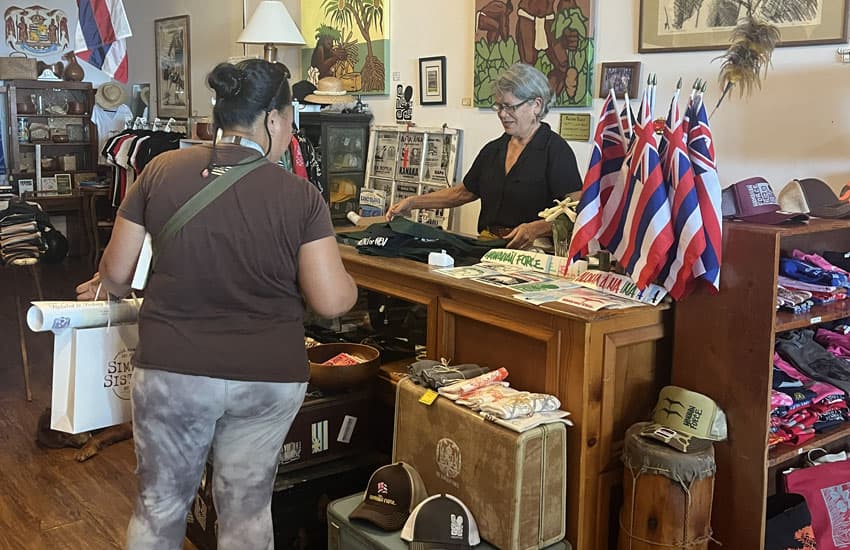
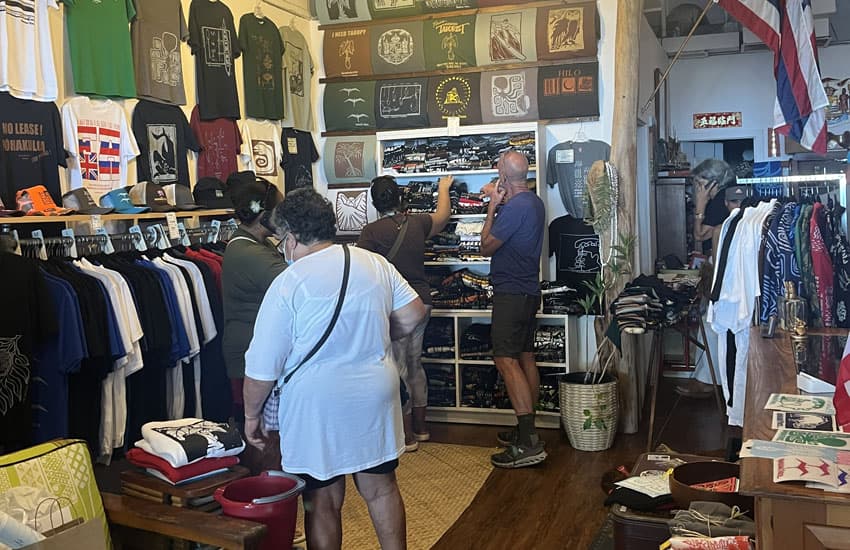
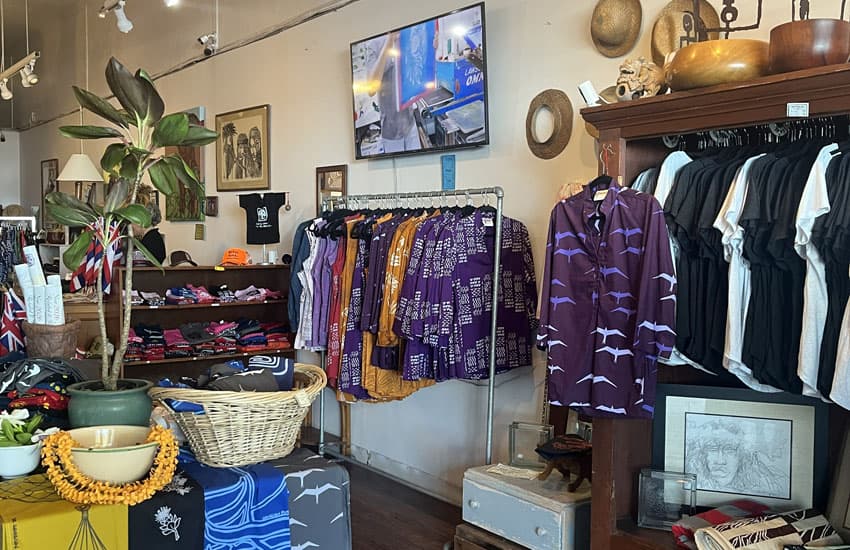
In 2012, after 17 years on Kīlauea Avenue, Hawaiian Force moved to a new, larger location on Kamehameha Avenue on the Hilo waterfront which gets a lot more foot traffic. The increased foot traffic plus the popularity of online shopping continued to grow the business, but Neff says that the addition of aloha wear took the Hawaiian Force to the next level. “T-shirts are still a big factor for us, but our aloha wear does really good.”
Their aim in adding aloha wear, Busby-Neff explained, “was to dress the nation in wearable art deeply inspired by what we value as Hawaiians – our ʻohana, our cultural traditions, our ʻāina, our kuleana.”
“A lot of people come into the store, especially tourists, and they want something that’s real that comes from Hawaiʻi. They want to support the economy of the Native people,” Neff reflected.
“That’s why [the sign] on the store says, ʻHawaiian Force – Native Hawaiian Artist.’ Hawaiian art is great, but art made by Native Hawaiians – that is Native Hawaiian art. That’s important to me, but it’s also important to the customer.”
“I ke aloha ʻāina ʻo ia hoʻi! May the force be with you … the Hawaiian Force!” Busby-Neff added laughing.
Most days, Busby-Neff minds the store. Her warmth and aloha create a welcoming space when customers stop by. This allows Neff to focus on creating new designs and hand-screening the t-shirts – which he still does in his workshop.
“Luana and I both have busy lives, so we balance out – you know, we take care of home and we take care of the business together,” Neff said.
Ea and authenticity
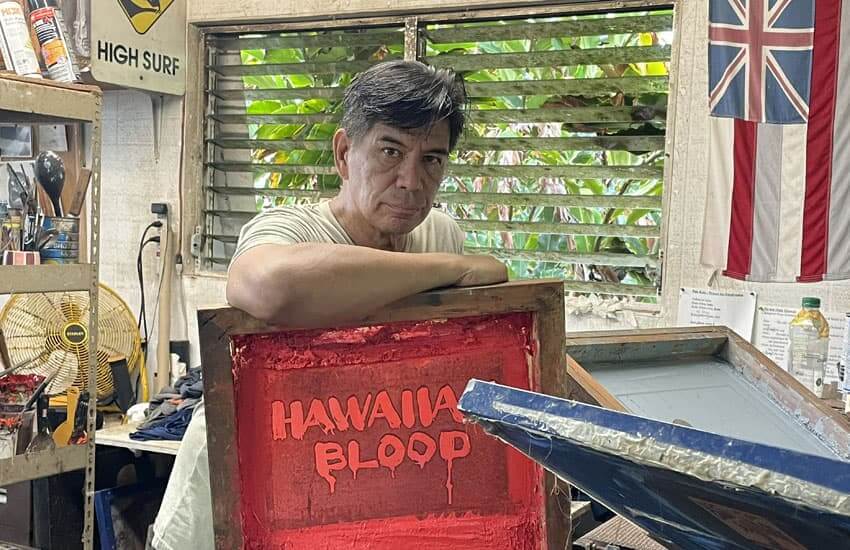
Unlike most modern designers, Neff still hand-draws all his designs.
“The sheer volume of work that he does, the mediums he uses – nobody I know does what Craig does,” said Busby-Neff. “Most people use computer generated designs. Craig doesn’t do any of that. It’s all hand-drawn, which I think is amazing. And even silkscreen – nobody does silkscreen anymore – it’s old school – but Craig does silkscreen.
“It’s real. It’s authentic. It’s powerful in its simplicity. I appreciate Craig Neff and I’m not saying that because he’s my husband. I appreciated that when I first met him. He is a man of integrity.”
Not only is the fabric for Neff’s aloha wear printed here in Hawaiʻi, but every piece of clothing is sewn here as well.
Today, most Hawaiian wear is made in Asia, but Neff is committed to his clothing being 100% made in Hawaiʻi. “Seamstresses are a dying breed,” he shrugged. “Labor here is more expensive and there’s a shortage. No young kids want to sew as a job now. It’s hard work.”
Despite their commitment to “Made in Hawaiʻi” product integrity, Hawaiian Force aloha wear is competitively priced.
In so many ways, Hawaiian Force is a model for ʻŌiwi entrepreneurship – a successful business with a higher purpose. “Hawaiian Force has supported our activism all these years. It has supported our work for aloha ʻāina because the Hawaiian Force is all about aloha and its expression and its reality in practice. It’s not just cerebral. It’s the act of doing and being present for the kuleana at hand,” Busby-Neff said.
“Kahoʻolawe and the movement were the inspiration for the Force, but the Force has supported me so I could do all of those things,” added Neff. “I’m not the richest guy in town, but I have the freedom to go where I need to go when I have to go.”
“When we talk about sovereignty and self-determination, the fact is that we’ve lived off of our own work,” noted Busby-Neff. “Hawaiian Force has paid our bills, paid for our house, and afforded us a comfortable lifestyle.”
A legacy of art
Although Neff is trained in multiple mediums, he wanted to make a living from his art, and knew it was “easier to sell a t-shirt than fine art.” However, he continues to paint and draw and work in other mediums, transforming some of those images to his shirt designs.
“Art is the way Craig expresses himself. He shares what he is passionate about – his Kanaka-ness, his Hawaiian-ness, through his artwork. That’s very important to him,” said Busby-Neff.
“We’ve always been part of the Hawaiian movement, always been advocates for aloha ʻāina, from the time it was unpopular. We helped make it popular because of the work we’ve done from the get-go. Seriously, I will claim that,” declared Busby-Neff. “We were a big part of the movement – and Craig depicted that movement through his art.”
In fact, Neff’s artwork and t-shirt designs have so uniquely depicted the history of the Native Hawaiian political movement, that they have been exhibited at Disney’s Epcot Center, at the Smithsonian Institution, and at Te Papa, the national museum of Aotearoa.
“His messaging was always pro-Hawaiian, and he addressed the issues in either a funny or serious way – the good, the bad, the ugly and the funny – he put it on a t-shirt when no one else was doing that,” said Busby-Neff.
Having stayed the course for more than 40 years, Neff is now contemplating the future.
“I’m living a good life; still living the dream. I recognize how lucky I am, with the skills and ability to have this business. But I’m 67 now. I can see the light at the end of the tunnel already and I’m open to options – but I’m also open to just closing the Force. Someone might want to buy it, but I’d rather close it than have it go off into the wrong direction.”
Neff pauses. “The Force is me. I am the Force. Maybe my lifetime is its lifetime.”
Visit the Hawaiian Force Website