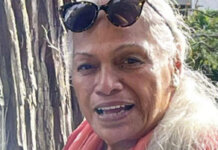

By Noelle M.K.Y. Kahanu
Ke Ao Lama – Enlightened World, an exhibition at the Capitol Modern, opened recently in response to the 13th Festival of Pacific Arts and Culture, and will remain up through most of this year. In the ground floor entry way, just to the left, is Rocky KaʻiouliokahihikoloʻEhu Jensen’s brilliant 8-foot-tall kiʻi, “Ke ʻEa ʻEkolu o Ke Kanaka.”
In his distinctive style, Rocky carved images that looked like us, with wide, flat noses and thick thighs and calves. Carved of milo in 1978, three images rise vertically. The bottom kiʻi appears burdened, its pearl eyes cast downward, its mouth a grimace, pained perhaps by the weight it bears. Upon its shoulders and hands stands the second image, its mouth puckered into a small circle, its face turned slightly upwards in a hopeful gaze. In its raised hands, it holds a large seed – our collective future.
Said Rocky, “When an ancestral image is produced today, it must follow closely the ancient guidelines set down by the very first depictor of the abstract form. Of course, the modern day artist has the freedom to use his own style, as was the case in the days of old. Yet the essence of that ancient image is still alive.” – State Foundation for Culture and the Arts (SFCA) catalogue entry, quoting Jensen from Ka ʻElele, Volume 10, Number 1 (January 1983).
Born in Honolulu, Hawaiʻi, on April 8, 1944, much of Rocky’s cultural foundation stemmed from time he spent with his grandparents in Lāʻie, Oʻahu, and Pūkoʻo, Molokaʻi.
In the 1960s, the Jensen family moved to Los Angeles, Calif., where Rocky finished high school and junior college. He returned to Hawaiʻi in 1968 and enrolled at Leeward Community College while also taking art classes at the Honolulu Academy of Arts.
Two years later, he illustrated 20 pre-contact kāne for the seminal book, Men of Ancient Hawaiʻi, but he is best known as a founder of the contemporary Native Hawaiian arts movement.
In 1975, he and his wife/scholar/writer/muse Lucia Tarallo Jensen established Hale Nauā III, the Society of Hawaiian Art – the first Native Hawaiian arts organization to support Hawaiian artists and protect the Hawaiian art form and its contemporary expressions.
Rocky especially saw it as a way to educate Hawaiians. “I have dedicated my life to help others of my blood to rediscover their lost heritage and to set the world straight on the obliviated truth.” Each year, Hale Nauā III broke new ground, mounting numerous exhibitions at Honolulu Hale, the AMFAC gallery, and at Bishop Museum with the very first contemporary Hawaiian art exhibition in its 90 years of existance.
Yet few works found their way into museum collections, and Rocky was a vocal critic of the SFCA and other institutions that systematically refused to purchase Kānaka Maoli art or support Kānaka Maoli artists. Despite the lack of local recognition, Rocky was among the first Hawaiian contemporary artists to show national and internationally, including at the Museum für Völkerkunde in Vienna, Austria, in 1978.
His prolific career continued, with major commissions for the U.S. Army Museum and ʻImiloa Astronomy Center, but by the early 2000s, his life had quieted and he was living on Hawaiʻi Island with his wife and his daughter, Natalie Mahina Jensen, who is also an artist.
While working at Bishop Museum, I tentatively reached out to this pillar of the community, thus beginning a collaboration that enabled a new generation of Hale Nauā III exhibitions at the museum.
In 2006, Rocky was among the first to receive the MAMo Award (the Maoli Arts Month Award), for a lifetime of achievement – a recognition of the path he had carved before us where none had existed. It was a testament to his delicate and meticulous illustrations, his “study pieces” that enabled him to embody the movements of ancestral kālai kiʻi, and his wondrous contemporary works that conveyed the evolving nature of our Indigenous artistic practices.
On Sept. 10, 2023, our Hawaiian world shuttered, heaved, and dimmed, as the black hawk soared into the arms of his ancestors.
Renowned master carver Rocky KaʻiouliokahihikoloʻEhu Jensen had passed away, suddenly and unexpectedly, marking nearly 50 years from the birth of Hale Nauā III to when he took his own life. Despite untold grief, the family chose to share their heartache, making palpable the struggles of mind and spirit that persist in so many of our beloveds.

Perhaps no other artist I know was so weighted by the burden of ancestral expectations and so disappointed by his contemporary brethren. He despaired, struggled with the lack of appreciation for, and comprehension of, his work – not so much by outsiders, but by his own people. It was as though he had become that which he carved – “Ke ʻEa ʻEkolu o Ke Kanaka” (the three souls of man) – the bottom figure upon whose shoulders all others rested.
Exhibitions are temporal, snapshots that capture who we are in that singular moment. The legacy left by Rocky is a multitude of these moments, charting who we once were, who we might have been, and who we can be again.
Next Spring, Hawaiʻi Triennial 25: Aloha Nō, the state’s largest thematic exhibition of contemporary art from Hawaiʻi, the Pacific, and beyond, will open in multiple venues across three islands.
Rocky will be prominently featured, posthumously, as we showcase his numerous works, including some that he left behind, unfinished. A long overdue remembrance, we cast our eyes upward as an act of defiant hope, our future held in his gently carved hands.
Noelle M.K.Y. Kahanu is an associate specialist in the American Studies Department of UH Mānoa, and a curator for Hawaiʻi Triennial 2025.