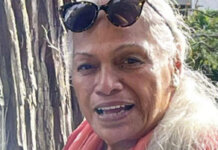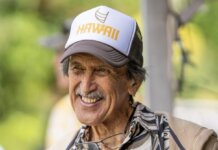
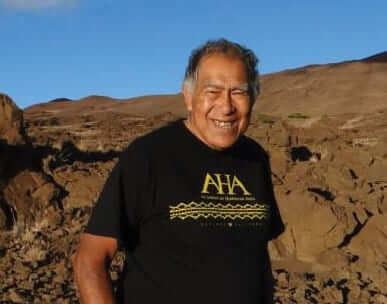
Clarence Fook Tam Kukauakahi “Ku” Ching
June 27, 1936 – Sept. 16, 2025
Lawyer, plaintiff, activist, teacher, businessman, father, grandfather, and friend, Clarence Ching was affectionately known as Uncle Ku. He was also sometimes known as “Goat.”
“The kids used to call him goat, not just because they thought he was the ‘greatest of all time,’ but because he was like a billy goat,” laughed Ching’s oldest daughter, Christi Maumau.
Born on June 27, 1936, in Pauoa, Oʻahu, Ching passed on Sept. 16, 2025, at the age of 89. He was a father of four, grandfather of seven, and great-grandfather of one.
In his later years, Ching spent most of his time walking Maunakea, tracing the traditional trails on the mauna and leading huakaʻi for his friends and family – earning him the nickname “goat” from his grandchildren.

He also acknowledged that he was referred to by some as “Ku: the old man of the mountain.”
“All the native trails are actually part of the highway system,” said Maumau, recalling the lessons her father taught her. “He felt that, as long as he could keep walking on those native trails, he could prove that people were still using them and that they couldn’t be taken away. He was trying to preserve the trails.”
Ching once wrote about his given name, Kukauakahi. “My DNA ascends through all islands, principally Liloa and ʻUmi on Hawaiʻi; Manokalanipō on Kauaʻi; and Kakuhihewa and Kualiʻi on Oʻahu. Also, Lonoikahaupu (one of Liliʻuokalani’s ancestors). I took the name of another of [my] ancestors, Kukauakahi.”
Prior to enrolling at Kamehameha Schools and graduating in 1954, Ching had attended Pauoa Elementary School. It was there that he first met Mary Maxine Kahaulelio.
“He was quite a guy, yeah. Very, very warm-hearted and yet kolohe,” said Kahaulelio of her friend of 75 years. “He was brilliant.”
After high school, Ching attended Brigham Young University in Utah, where he studied chemistry, and later earned his juris doctorate from the University of Idaho. Before becoming a private attorney in Honolulu from 1976 to 1992, he worked as a stockbroker, a radiochemist, a clerk, and a lifeguard.
His steadfast advocacy for the protection of the ʻāina and Native Hawaiian culture dates to the 1980s, eventually bringing him to serve as a trustee of the Office of Hawaiian Affairs (OHA) for one term, from 1986 to 1990.
Reflecting on his time at OHA, Ching wrote on his website: “Before I ran for OHA, I had already dedicated myself to the restoration of the Kingdom. When I was elected, I hoped to assist in the restoration of the Kingdom and continued revival of our culture and spirituality. As a trustee, I worked on the ʻOHA Blueprint’ to connect Hawaiian issues with global issues and helped negotiate with the state for back rent on ceded lands.”
Ching was involved in many cultural organizations over the years and was also part of the construction crew for the voyaging canoe Hawaiʻi Loa from 1990 to 1993.
He also served on the Cultural Advisory Committee for the Pōhakuloa Training Area from 2000 to 2013. In 2002, he led Huakaʻi i nā ʻĀina Mauna, which focused on learning about Maunakea landscapes by hiking from the Hāmākua Coast, starting at sea level, to Maunakea’s summit, then back down to swim in Luahinewai at Kīholo on the Kona coast.
Maumau recalled joining one of the huakaʻi and having difficulty with the altitude. “He came over, he goes, ʻcan you make it to the road?’ I said, ʻyeah, I think I can make it to the road.’ He goes, ‘okay, I’m going to go up and get the truck, and I’m going to meet you right there. Just go right there.’ He took off. He was so much older than me, but he was so much more fit than me.”
Ching hiked those trails well into his mid-80s, until his body could go no longer. “I feel that when he’s not checking on us, then he’s definitely there,” Maumau added.
Kahaulelio moved to Waimea in 1999 where she crossed paths again with her childhood friend and became active as a kiaʻi ʻāina alongside Ching.
“We were getting involved with a lot of struggles here, like Pōhakuloa, Maunakea, other things pertaining to real bad things happening in Waimea – let’s put it that way,” said Kahaulelio. “But 2014 is the time we went to court.”
In 2014, Ching and Kahaulelio filed a lawsuit against the State of Hawaiʻi and the Department of Land and Natural Resources over the state’s mismanagement of public trust lands at the Pōhakuloa Training Area. The land, part of the ceded lands trust, has been leased to the U.S. military for training purposes since 1964.
As trust beneficiaries and cultural practitioners, they argued that the state failed its constitutional duty as trustee by not adequately monitoring, inspecting, or enforcing lease conditions, instead relying on the military to self-report compliance.
The lawsuit, Ching v. Case, resulted in a 2019 Hawaiʻi Supreme Court decision affirming the state’s obligation to actively oversee third-party use of public trust lands.
“Malama ʻāina became codified as a legal argument and [that] set a kind of legal precedent,” said Candace Fujikane, of the landmark case.
Fujikane, a University of Hawaiʻi English professor and author of Mapping Abundance for a Planetary Future: Kanaka Maoli and Critical Settler Cartographies in Hawaiʻi first met Ching in 2012 and became a part of Huakaʻi i nā ʻĀina Mauna.
She reflected on the lessons learned along the way – from the beauty of the landscapes and their historical and scientific significance – to moments of stillness and kilo (observation) as Uncle Ku shared moʻolelo.
“He was my alakaʻi,” Fujikane said. “He was our fearless leader. He was the one who would plot out our course.”