
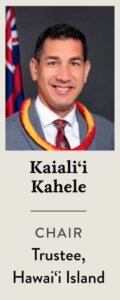
I grew up in a family where aloha ʻāina, sivila – civics and politics – and service were part of everyday life.
I was born in 1974, during an extraordinary period when a reawakening of Hawaiian consciousness was taking hold across our pae ʻāina. My father became a community organizer in Miloliʻi, working alongside kūpuna and families to protect sacred coastlines, preserve cultural practices, and address issues of land, housing and Native Hawaiian rights.
Some of my earliest memories are of sitting through late-night community meetings in the Kaupiko front yard in Miloliʻi, listening as our kūpuna discussed land rights, ocean rights, and the future of our people.
My father taught me Hawaiian history. He taught me about our aliʻi, the illegal overthrow of the Hawaiian Kingdom and the importance of knowing where we came from. But just as importantly, he taught me that knowledge creates responsibility.
That lesson has stayed with me; each of us has an obligation to do our part to move the lāhui forward. One of the simplest and most consequential ways we fulfill that obligation is by voting.
On November 3, Hawaiʻi voters will elect five members of the nine-member Office of Hawaiian Affairs (OHA) Board of Trustees. OHA elections are nonpartisan, and every registered voter in Hawaiʻi – Native Hawaiian and non-Hawaiian alike – may vote in every OHA contest.
These elections matter.
OHA trustees make decisions involving Native Hawaiian trust resources, lands, programs and policies. They determine priorities affecting housing, education, economic self-sufficiency, culture, natural resources and assets held for the betterment of Native Hawaiians. They are entrusted with stewardship of a trust exceeding $1 billion – resources intended to serve this generation and generations of Native Hawaiians to come.
Yet democracy cannot function simply because institutions exist. It requires participation.
Government derives its legitimacy from the consent of the governed. Voting is the most fundamental way citizens give – or withhold – that consent. When we participate, we strengthen our collective voice. When we disengage, we surrender that voice to others.
For Native Hawaiians, civic participation carries particular meaning. Our history reminds us what can happen when decisions affecting our people, our lands and our future are made without our meaningful participation.
We cannot change that history. But we can decide what we do with the responsibility handed to us today.
He aliʻi ka ʻāina; he kauwā ke kanaka. The land is chief; humanity is its servant.
That kuleana extends beyond caring for ʻāina. It means caring for the generations who will inherit the consequences of the decisions we make today.
So, learn about the candidates. Watch the forums. Ask questions. Talk story with your ʻohana. Understand what OHA does and what is at stake.
Then vote.
Your ballot is more than a piece of paper. It is your voice, your responsibility and your opportunity to help shape the future.
Our lāhui needs a diverse, informed and vigorous civic movement. That begins with each of us.
On November 3, exercise your voice. Fulfill your kuleana. Vote.
Important Dates – 2026 Election Dates
- Oct 16 – General election ballots will arrive in mailboxes
- Oct 20 – Voter service centers open statewide
- Nov 3 – General Election Day (All ballots need to be received by 7:00 p.m.)

