By Cynthia Engle, Executive Director of the Hawaiian Historical Society
“I felt it was important to identify and document these sites before they are lost forever.” – Nanette Napoleon
In 1986, Nanette Napoleon surveyed gravesites across 46 Oʻahu cemeteries, documenting the information recorded on tombstones and grave markers. These cemeteries were selected because they had no publicly accessible burial records at the time.

Nanette Napoleon. – Photo: Philip Deters
Napoleon’s dedicated research was ultimately published by the Hawaiian Historical Society – a nonprofit library and archive established in 1892.
In her publication, Napoleon explores how cemeteries are “outdoor museums” holding historical and cultural value. Cemeteries, in a sense, are like libraries and archives, and the headstones are like rare books that hold the stories of the individuals buried there.
These stories help others build their knowledge and strengthen their connection to the ʻāina and their ancestors. Repositories like the Hawaiian Historical Society preserve the past to support our lāhui in building historical narratives in the present. Our mission is to preserve, perpetuate, and encourage the study of the history of Hawaiʻi; e mālama, hoʻomau, a paipai i ke aʻo ʻana i ka moʻolelo o Hawaiʻi nei.
Preservation of this intrinsic value is crucial. However, accessibility to the information is just as important. Regarding the information included in Napoleon’s cemetery survey, access was limited to the repositories that held physical copies. Unless an individual visited archives like the Hawaiian Historical Society, or the actual cemetery, the threat of these sites being “lost forever” lingered.
In 2023, the Hawaiian Historical Society partnered with the Office of Hawaiian Affairs’ (OHA) Papakilo Database to digitize and transcribe into a searchable format Napoleon’s publication, expanding access to this information globally.
The Papakilo Database is a comprehensive digital repository that centralizes over a million historical records, land documents, and Hawaiian-language newspapers from multiple archives. It serves as a vital cultural resource that empowers researchers and the public to access, preserve, and explore Native Hawaiian genealogy and history from anywhere in the world.
OHA’s Papakilo Database empowers community archives to increase capacity through the digitization of historical material ensuring preservation while increasing accessibility to these collections.
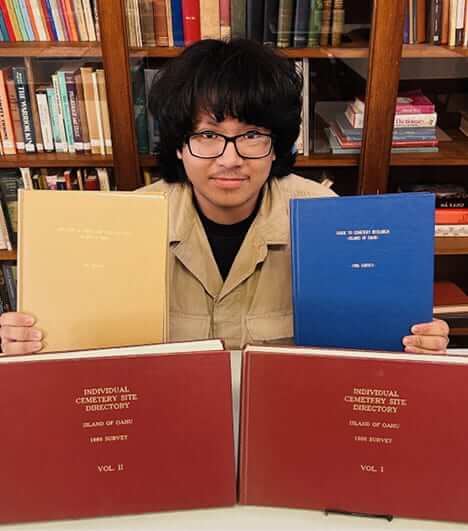
The digitization of the Oʻahu Cemetery Project was a three-year endeavor that took a dozen Hawaiian Historical Society staff, volunteers, and interns to complete. The work included scanning each page as well as transcribing each individual name. Papakilo then had to ensure the quality of each digital product and develop an infrastructure that is easily navigated by the general public.
To say the least, the work was tedious yet rewarding. For one intern, Daytona Aweau, this project unearthed genealogical ties. “Discovering family members from Kāneʻohe made me realize the importance of this project. The work I’m doing has the potential to help others find their family history too.”
For me, personally, the Oʻahu Cemetery Project data revealed details about my own family’s burials that I did not know before the project. I was astonished to discover my family had a burial plot at Oʻahu Cemetery. This revelation meant that my family had a suitable place to bury my grandparents’ urns. To the relief of my family here and on the continent, I could bring my Puna back home and lay her to rest. This moment was unreal for me.
Now that this information is widely available, there will, hopefully, be more of these surreal moments for others. It might even inspire a future Nanette Napoleon to continue her research.
Although the Oʻahu Cemetery Project collection comprises nearly 9,000 records of individual gravesites along with accompanying information inscribed on the grave markers, the data has grown since 1986. The beauty of research is that it is never done. There is always more to learn. The role of libraries and archives is to preserve what is documented, hopefully, in perpetuity.
October is Archives Month, a time to raise awareness about how primary sources tell our shared stories and support transparency. It is fitting, then, that we can celebrate Nanette Napoleon’s work and to make it widely available. Through shared work such as this, we collectively ensure that our past is neither lost nor forgotten.
The Oʻahu Cemetery Project is now available on the Papakilo Database. Visit papakilodatabase.com for access. This project is one part of a larger digitization partnership between the Hawaiian Historical Society and OHA’s Papakilo Database. Stay connected by visiting hawaiianhistory.org to schedule a reference appointment, become a member, or donate to help continue our mission of preserving Hawaiʻi’s history.