Wailehua a Miss America’s Teen Semi-finalist!

Six New Pwo Navigators Inducted
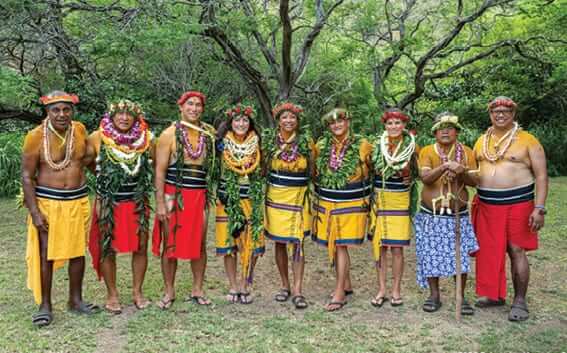
Six Hawaiʻi Polynesian Voyaging Society (PVS) captains and navigators were recently inducted as Pwo Navigators. Among the six, five are Native Hawaiian and four are wāhine – the first women in Hawaiʻi to earn this sacred title and responsibility.
A sacred induction ceremony was held in Hawaiʻi for the first time on July 30, 2026. It was conducted by Satawalese Pwo Navigators Isidore Metewalur, Robert Erailug, and Thomas Raffipiy who represent the family lineage of the late Master Navigator Mau Piailug and the Weriyaeng School of Navigation.
The newly conferred Pwo Navigators are firefighter Russell Amimoto, educator Pōmai Bertelmann, educator Shantell de Silva, waterman Archie Kalepa, PVS Voyaging Director Lehua Kamalu, and UH professor Kaʻiulani Murphy.
The Weriyaeng School of Navigation, located in the Caroline Islands, is the ancient Micronesian tradition and lineage of oceanic navigation in which Mau was trained and Pwo is among its highest honors. Those selected demonstrate decades of dedication to traditional navigation, voyaging, mentoring others, and serving their communities.
Mau was Hōkūleʻa’s first navigator in 1976, and he ensured that the ancient practice of wayfinding would survive by training navigators outside of Micronesia, first in Hawaiʻi, then throughout Polynesia. At the time, traditional navigation had been dormant in Polynesia for 600 years.
Mau personally initiated the first five Native Hawaiian navigators in Satawal on March 18, 2007. In 2008, he graduated six more Pwo: four Aotearoa Māori and two Cook Islands Māori. In 2018, Mau’s son, late Grand Master Navigator Sesario Sewralur, inducted ʻŌiwi Keahi Omai as a Pwo Navigator in Palau.
Uncertainty for Olelo Kanaka Niihau Kaiapuni School
Just weeks before the start of the new school year, Kula Aupuni Niihau a Kahelelani Aloha (KANAKA) New Century Charter School received a letter from the board of Kanaka Aupuni a Niihau (KAANA), which owns the land beneath the school, informing KANAKA that their 15-year lease would be terminated unless the school agreed to pay a monthly lease rent of $20,000.
That represented an increase of 245% over the $5,800 monthly rent the two organizations negotiated when the lease was first executed. Per the contract, the lease rent was open to negotiation every five years, however, KANAKA claims in a July lawsuit that the rent was increased without negotiation.
On July 23, a temporary restraining order was issued by Fifth Circuit Judge Stephanie Char preventing the termination of KANAKA’s lease until the legal dispute is resolved, which allowed KANAKA to open for school on August 3 as scheduled.
Outside of Niihau, KANAKA is the only Hawaiian immersion school that uses Olelo Kanaka Niihau as its medium of instruction. Fewer than 50 students are enrolled at KANAKA in grades K-12. Overall, an estimated 400-500 people speak the language, which is distinct from ʻōlelo Hawaiʻi.
KAANA is a nonprofit that promotes economic development for the people of Kauai and Niihau and supports KANAKA. Two KAANA board members, Katherine Tandal and Steven Sullivan, are named in the lawsuit. Sullivan is the widower of former KANAKA principal Hedy Sullivan and briefly served as interim principal of KANAKA following her passing in 2025.
Opunui Selected to Obama Leaders Program
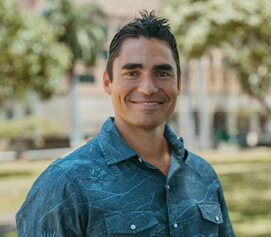
Dr. Landon Opunui was recently accepted to the 2026-2027 class of the Obama Foundation’s Leaders Program, joining more than 150 “changemakers” selected from around the world. He is one of 35 individuals selected for the Leaders Asia-Pacific program.
The Obama Foundation Leaders program is designed to empower, and connect emerging leaders from Africa, Asia-Pacific, Europe, and the U.S. to implement positive global change. Participants receive training in values-based leadership development to strengthen their skills and scale their work across public, private, and nonprofit sectors.
Launched in 2019, the Asia- Pacific program is creating a network of leaders to drive innovative change regionally and worldwide. This year’s cohort represents 19 countries, and its members work across a broad range of fields including: Indigenous language and cultural revitalization; ocean and climate resilience; rural health access; and independent media.
Opunui is the executive director, the medical director, and a naturopathic physician at Nā Puʻuwai Native Hawaiian Health Care System which serves the islands of Molokaʻi and Lānaʻi.
A graduate of Kamehameha Schools Kapālama, Loyola Marymount University, and Bastyr University, Opunui is the first naturopathic physician in Hawaiʻi to be credentialed as a primary care physician with HMSA.
Bode Will Lead HPD Admin Operations
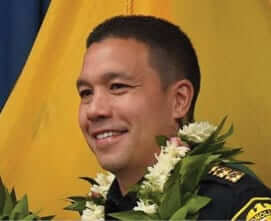
Honolulu Police Department (HPD) Maj. Parker Bode has been named as one of two deputy chiefs for HPD by new Police Chief David Lazar. Bode will lead HPD’s Administrative Operations while Maj. Brandon Nakasato will lead its Field Operations.
Bode, a graduate of Kamehameha Schools Kapālama, is a second-generation HPD officer; his father retired as an HPD major after 33 years of service. At just 39 years old, Bode is one of the youngest deputy chiefs in HPD history.
Bode has served at HPD for 16 years, much of which was in Human Resources focusing on personnel, workforce and organizational issues. He also served as captain of HPD’s Criminal Investigation Division. Most recently he served as Lazar’s interim chief of staff.
As part of his new kuleana as deputy chief for administrative operations, Bode will lead the department’s effort to gather input that will help shape HPD’s new strategic plan.
A former high school quarterback for Kamehameha Schools, Bode also serves in the community as a high school football coach and mentor.
Feds Push for Deep-Sea Mining in the Pacific
The Conservation Council for Hawaiʻi (CCH) and Faʻasao Amerika Samoa, represented by Earthjustice, filed a lawsuit in August challenging the Trump administration’s attempt to launch deep-sea mining off the coast of American Samoa.
The lawsuit targets the National Marine Fisheries Service’s conclusion that deep-sea mining “is not likely to adversely affect” any species protected by the Endangered Species Act.
The Marine Minerals Administration announced in July that it plans to hold a “lease sale” to mine the seabed of American Samoa’s Outer Continental Shelf on Nov. 19, 2026. This is the first lawsuit to challenge deep-sea mining – an industry that does not currently exist beyond a few small, exploratory projects – in U.S. controlled waters.
Deep-sea mining would extract metals from some of the most unexplored parts of the ocean using unproven technology. Scientists believe catastrophic biodiversity loss and habitat destruction will be unpreventable and irreversible.
As in Hawaiʻi, the people of American Samoa, rely on a healthy ocean ecosystem for sustenance, protection, and long-standing cultural practices.
“Our oceans are not an underutilized tool for profit,” said Jonee Kaina Peters, CCH executive director. “We cannot sacrifice our oceans to an inherently destructive infant industry.”
“The Trump administration is barreling ahead with plans that will sacrifice one of the most important and pristine ecosystems on the planet in the pursuit of a reckless deep-sea mining experiment. This carelessness is driven by dreams of corporate profits, rather than science,” said Earthjustice Senior Attorney Chris Eaton.
Hawaiʻi, too, is threatened by deep-sea mining. The Clarion- Clipperton Zone, 500 miles south of Hawaiʻi Island, is a key target for deep-sea mining by corporations and pro-mining governments.
OHA BOT Visits Molokaʻi
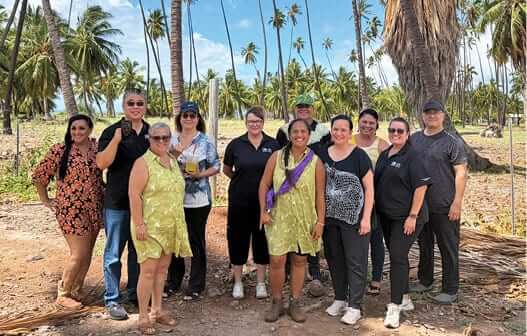
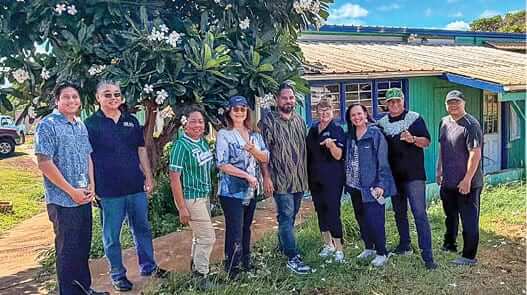
On September 17 and 18, the Office of Hawaiian Affairs (OHA) Board of Trustees (BOT) held their annual Molokaʻi Community and BOT meetings. Community presenters included: Leilani Chow of Hoʻāhu Energy Cooperative Molokaʻi; Melissa Lyman of Mokulele Airlines; Piʻilani Agustino of Molokaʻi Cares; Kanoelani Davis of Hoʻaka Mana, Lehua Kauka of the Kalamaʻula Homesteaders Association; and Sybil Lopez of Mokupuni Community Development Corporation. While on Molokaʻi, OHA also had the opportunity to visit the ancient coconut grove, Kapuaiwa, and met with staff at Sustʻāinable Molokaʻi. In the top photo Doreen Gaspar, E.D., with the Molokaʻi Occupational Center and Molokaʻi historian Mikiala Pescaia (both in green dresses) pause for a photo with OHA staff at Kapuaiwa Coconut Grove. In the bottom photo, Tehani Kaalekahi of Sustʻāinable Molokaʻi (third from left) is pictured with OHA staff (l-r) Kingston Seguancia, Nathan Takeuchi, Trustee Luana Alapa, Royce Campbell, Pamela Knapp, Interim Administrator Summer Sylva, Trustee Dan Ahuna, and Crayn Akina. – Top Photo: Nelson Gaspar; Bottom Photo: Lehua Itokazu
BLNR Transfers 300 Acres in Hilo to DHHL
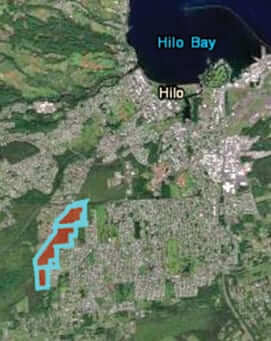
The Board of Land and Natural Resources (BLNR) has authorized the transfer of more than 300 acres of state-owned lands in the Waiākea area of Hilo on Hawaiʻi Island, from the Department of Land and Natural Resources (DLNR) to the Department of Hawaiian Homelands (DHHL).
The eight parcels identified for transfer consist of two commercial-zoned parcels appropriate for revenue-generating industrial/commercial development, as well as six parcels in the Hilo town core suited to connected residential and agricultural homestead development.
Next steps are for DHHL to conduct due diligence evaluations of the parcels to determine the extent to which they satisfy or otherwise meet the needs of the Hawaiian Home Lands Trust.
“[This] represents a significant milestone toward full satisfaction of the transfers required under Act 14, First Special Session Acts, passed in 1995,” said BLNR Chairperson Ryan Kanakaʻole. “The parcels approved for transfer will provide meaningful opportunities for both homesteading and revenue generation, supporting DHHL’s mission to provide for the economic self-sufficiency of Native Hawaiians.”
“The BLNR did Hawaiʻi proud,” said Gov. Josh Green. “We awarded more than 2,500 leases in 2025 and are on track to award approximately 3,000 this year. This transfer builds on that progress and brings us closer to helping even more beneficiaries turn their awards into homes, working farms and thriving communities.”
Act 14 was adopted to compensate DHHL for the state’s use of DHHL trust lands between Aug. 21, 1959 through July 1, 1988. Since its enactment, DLNR and DHHL have collaborated to fully implement the intent of Act 14.
UH to Help Advance Seafood Supply
The University of Hawaiʻi is set to play a pivotal role in a new effort to expand sustainable aquaculture as part of the Cooperative Institute Fostering Aquaculture Research and Markets (CIFARM) a consortium created by the National Oceanic and Atmospheric Administration.
Funded by an initial $13.5 million investment, this five-year cooperative institute seeks to unlock the potential of marine aquaculture in the U.S. The University of New Hampshire will serve as the host institution. UH will participate as one of five core consortium members.
UH’s research team is being led by Associate Professor Chatham Callan from UH Hilo’s Pacific Aquaculture and Coastal Resources Center. “Being selected is a testament to the decades of world-class aquaculture research happening right here in Hawaiʻi,” said Callan.
“Through our partnerships with Native Hawaiian communities, we draw on a tradition of ocean stewardship and fishpond engineering that stretches back centuries. By focusing on cutting-edge tech, environmental forecasting, and real-world marine demonstration projects, we are actively building the blueprint for a more resilient, self-sufficient seafood industry.”
Americans consume more than $24 billion in imported seafood annually. By advancing domestic aquaculture, CIFARM aims to bolster food security, create jobs and uplift coastal economies in complement to wild-capture fisheries.
Hawaiʻi is uniquely positioned for this work. Hawaiʻi is already home to Blue Ocean Mariculture in Kona, providing a vital real-world connection to the consortium’s demonstration and commercialization goals.
Community Planning for Kakaʻako Ma Kai