
The term “ʻike kūpuna” (ancestral knowledge) is frequently cited and referenced when we talk and write about our history and cultural practices; but how is ʻike kūpuna actually transmitted from one generation to the next in contemporary Hawaiʻi?
That is the question that “ʻAi Mama,” an exhibit at Gallery ʻIolani on the campus of Windward Community College explores through its examination of the lifework and lived experiences of two master cultural practitioners: ʻŌlohe ʻUmi Kai and Suluʻape Keone Nunes.
Kai is a distinguished artisan known for his production of traditional implements, from weapons to ordinary, utilitarian objects. He is also a revered ʻōlohe lua, a master of traditional Hawaiian martial arts. Nunes is renowned for his revival and mastery of traditional kākau uhi (tattooing). Trained by Suʻa Suluʻape Paulo, a master of traditional Samoan tattooing, Nunes carries the Samoan title, Suluʻape. His formal title in Hawaiian is Kahuna Kā Uhi.
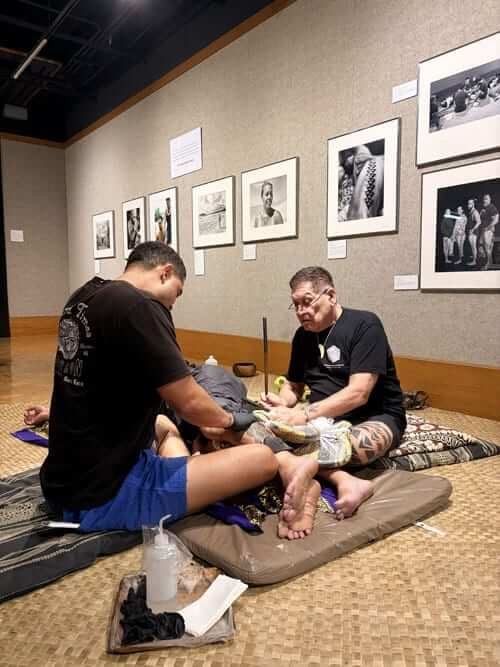
The exhibit title, “ʻAi Mama” refers to the process of chewing food and sharing it – as a parent or grandparent does with a very young child. In the context of the exhibition “this act becomes a metaphor for the transmission of knowledge: what is received is not simply retained but worked through, understood, embodied, and ultimately passed on to others. In this way, ʻAi Mama asks us to consider ʻike not as something static or contained, but as something living,” wrote exhibit co-curators Noelle Kahanu and Kapulani Landgraf.
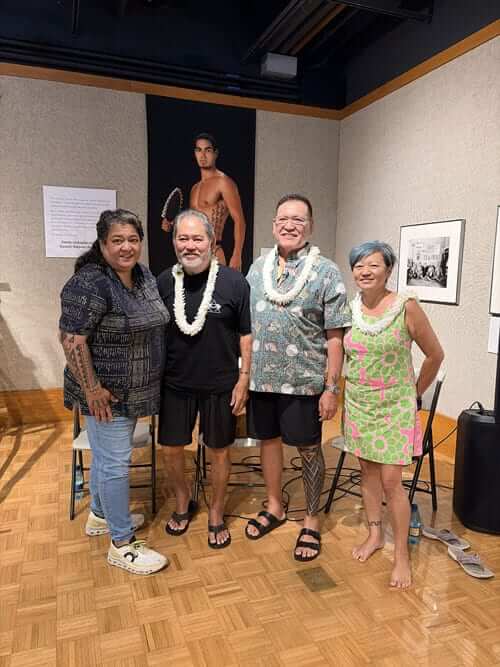
As part of the exhibit’s extensive programming, a panel discussion, “ʻAi Mama: The Ancestral Knowledge That is Carried,” featuring Kai and Nunes and moderated by Kahanu was presented on September 12. The discussion centered on what it means to carry ancestral knowledge – and how that ʻike is then transmitted from one generation to the next through practice, observation, mentorship and lived experience.
“When people think about receiving knowledge, everyone thinks about the head space – about being taught knowledge, about retaining what is taught to you in your mind,” Nunes reflected.
“For me, ʻai mama [means] to be able to give my students the knowledge that was given to me in a way that they can internalize it, so it becomes part of them – not just in the head, but in the body, in the understanding, in the spirit of what they’re learning. And, after a course of time, it becomes mana.”
Nunes notes that it’s important to understand that this passing of ʻike is “a continuum that was started by our ancestors millennia ago.”
Recalling his immersion in ʻike kūpuna as part of his upbringing in the 1950s Kai said, “When I was growing up, I didn’t know I was being taught. It was just a lifestyle – it didn’t feel like we were really forced except when we wanted to go surf or play. [It was like] when we dig the ʻimu you better watch – because you’re going to be digging the next one.”
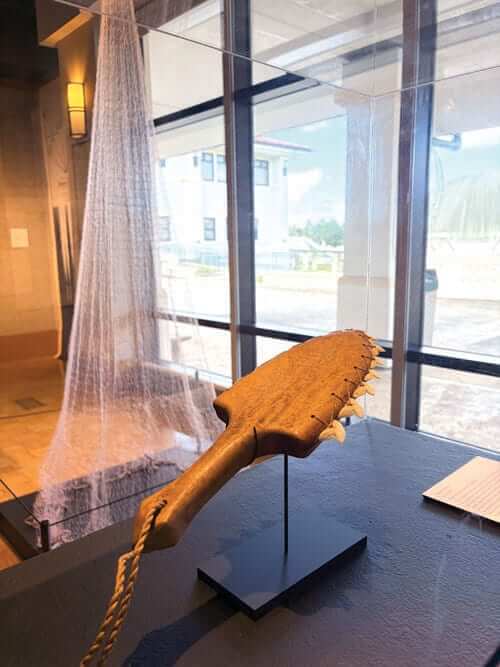
Kai compared that to how he teaches haumāna today, observing that not only is our modern lifestyle different, but so is the level of commitment of many learners. “They just want to make the leiomanō (shark-toothed war club) and forget about the niho ʻoki (shark-toothed carving knife). But the niho ʻoki sets the base for what you learn. You need to start at the bottom.”
Contrasting the western educational system with the way he is passing on ʻike to his haumāna Nunes said, “You go to school, you graduate. You go to college, you graduate. Then you take it from there, itʻs almost like, ʻI have enough knowledge.’ [But] I have students that have been with me for over 20 years and they are still in the process of learning.”
Nunes added that when he was young and his friends were going to nightclubs, he deliberately sought out kūpuna so he could sit and learn from them. Some of these were people born when Liliʻuokalani was still alive and carried specific knowledge and memories – the point being that while we can access the ʻike kūpuna that has been documented, young people today do not have access to the same kind of firsthand knowledge.
An additional challenge, Nunes said, is that some people still do not value Indigenous knowledge the way western knowledge is valued. “In my opinion we divide western education and Hawaiian education and say that western is better because you pay for the universities. You pay to be educated. We don’t [place] Indigenous knowledge on an equal level.”
In addition to the direct, hands-on instruction that Kai and Nunes received from their respective kumu and mentors, they have both spent a lot of time in museums.
“When I visit museums and all of the kūpuna that are there and the artifacts along with them, I’m looking for details. I’m looking for differences. The feeling I get is very somber, very respectful. I get a sense of the person that created the object. I get a sense of why they might have done something out of the ordinary,” Kai recounted.
Similarly, Nunes – who is also a carver – goes to museums to learn, to look at specific objects and understand, but never to simply replicate what he sees because we cannot know who the item was made by or for, or even be certain of an object’s function or purpose. “I tell my students don’t make a replica. Add to the culture. Add to the ʻumeke (calabash) of knowledge.”
Kai agreed, adding that his implements all include unique, personal modifications – although the item must still be functional and true to its purpose.
“When it comes to patterns and things [each object] was made for a specific person for a specific purpose. It has a history. You shouldn’t be duplicating that because it’s not yours. It’s like naming your child and somebody [else] using that name. Take the overall idea and create your own. Now you’re advancing your own ʻike, your own heritage.”
Regarding the designs he creates for kākau uhi – each of which is unique to the individual – Nunes notes that it’s important to know the foundational designs of any traditional art form in order to be able to create your own designs. “It’s almost like a picture within a frame. There’s so much variation you can do and still stay within that frame.”
Nunes said it’s problematic when people start creating designs that go way outside that “frame” or appropriating designs that come from another Polynesian culture and calling it Hawaiian. “Sometimes we think of ʻappropriation’ only for our culture, not realizing that we might be appropriating other people’s culture without even thinking,” he said.
Both men emphasize that being grounded culturally – particularly in ʻōlelo Hawaiʻi – helps to maintain our traditions and exercise creativity within the structures of our own culture. “If you want to do away with a culture, take away the language,” said Kai.
“Language is central to our culture,” added Nunes. “It’s very important. And so my students have honored me by learning as much Hawaiian as they can and incorporating Hawaiian within the practice.”
ʻAi Mama will be on view through December 11, 2026, at Gallery ʻIolani at Windward Community College in Kāneʻohe, Oʻahu. The exhibit and all related programming is free. Gallery hours are Tuesday – Saturday, from 12:30 – 4:30 p.m. For more information go to: gallery.windward.hawaii.edu


 is frequently cited and referenced when we talk and write about our history and cultural practices; but how is ʻike kūpuna actually transmitted from one generation to the next in contemporary Hawaiʻi?)