By Pelehonuamea Harman with contributions from Kimo Alama Keaulana
On Nov. 7, 2026, we will have a rare opportunity to see Mary Kawena Pukui and her daughters in motion, to hear the voices that accompanied their hula, and to learn from ʻike preserved nearly a century ago.
Bishop Museum, in partnership with the Mary Kawena Pukui Cultural Preservation Society, invites our community to Nānā i ke Kumu: He Hoʻoilina Ola ka Hula, from 5:30 to 8:00 p.m. on the museum’s Great Lawn.
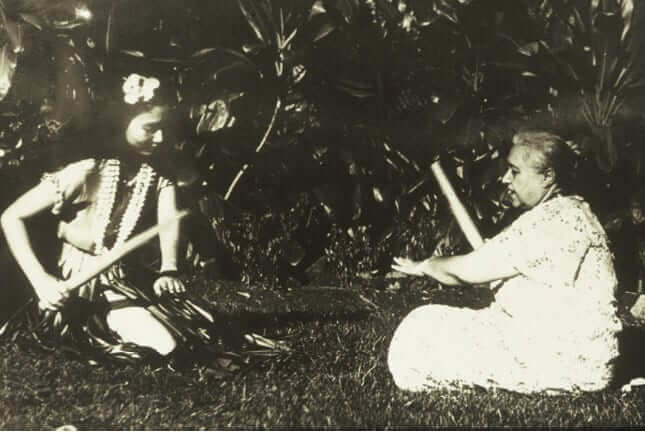
The evening celebrates traditional hula carried through the Pukui lineage, a living inheritance of movement, mele, language, and moʻolelo. Newly restored archival footage from the 1940s will premiere alongside archival audio, photographs, writings, narration, mele, and live hula.
Together, these materials invite us to “nānā i ke kumu,” to return to the source and look carefully at what those before us preserved.
Many know Kawena through her contributions to ʻōlelo Hawaiʻi and the written record of Hawaiian knowledge. She was also a dancer, hoʻopaʻa, kumu, and lifelong student of hula. She learned through relationships with her kupuna and kumu and shared that ʻike through teaching, documentation, and performance.
The films allow us to encounter this part of her legacy through the movements of her feet and hands, the cadence of mele, and the hula of her daughters, Patience Nāmaka Bacon and Pele Pukui Suganuma.
In 1943, World War II was in full swing. Hawaiʻi served as a place of rest and recreation for tens of thousands of United States military personnel in the Pacific. The United Service Organization, or USO, coordinated entertainment for these audiences.
Hula featured prominently in the shows, often as lively hapa haole performances tailored to malihini tastes. Those presentations differed from the traditional chants and dances that Kawena and her fellow practitioners sought to preserve.
Film and disc recording, the technology available at the time, offered a means of documenting those traditions. Sgt. George Bacon brought his camera and film production skills to record Kawena and her two daughters beside a stream in Nuʻuanu Valley.
Patience, then known as Patience Wiggin, was 23 years old. Her sister, Pele Pukui, was 11. Their movements, captured during a time of tremendous uncertainty, would become an inheritance for generations they could not yet know.
The dances carry the teachings of those who shared them. Many were taught to Kawena and Nāmaka by Kawena’s cousin, Joseph Kealiiakuikamoku Ilalaole, while others came to them from the hula greats of their time.
The program includes hula pahu, hula associated with Pele, and a rare papa hehi demonstration. Each carries its own history and lineage, reminding us that understanding hula requires attention to the mele, people, and circumstances through which it was transmitted.
Research by Kimo Alama Keaulana and I drew upon these films alongside Kawena’s program notes and writings. The evening takes inspiration from the hula and mele presentations she organized in Hawaiian Hall and throughout Hawaiʻi.
Her records help us understand the stories she shared, the sequence of dances, and what she wanted audiences to learn. They guide the presentation of traditional hula and mele rarely seen or practiced today.
The return of clear footage also carries a story of patient stewardship. More than 20 years ago, my hulu kupuna, Pat Nāmaka Bacon, encouraged me to view Hula Dancing Steps while I was working on my thesis. The deteriorated copy allowed me to follow her feet, but the only hand motion I could distinguish was for “flower.”
Years later, a visit to the Smithsonian Institution’s Hawaiian collections revealed a clear copy, making the details of her gestures visible again.
Dr. Adrienne Kaeppler arranged for a copy of the original footage during her work at the Smithsonian. That decision helped make this rediscovery possible. The Mary Kawena Pukui Cultural Preservation Society subsequently worked with Smithsonian staff and Bishop Museum Archives to secure permissions and arrange professional digitization. We receive these images today because people recognized their importance and cared for them.
In 2026, we are privileged to receive knowledge from those closer to these hula traditions than we are. With that privilege comes a collective kuleana shared by chanters, dancers, teachers, historians, filmmakers, sound recorders, producers, archivists, and all who cultivate and care for culture.
We ask everyone attending He Hoʻoilina Ola ka Hula to refrain from taking photographs, making video or audio recordings, or reproducing or sharing any film footage or archival audio. Please receive these materials with the intention and respect that guided their preservation.
He hoʻoilina ola ka hula. Hula is a living inheritance, sustained through practice, learning, and care. This evening honors Kawena, Nāmaka, Pele, George Bacon, and the many others whose commitment allows us to witness this ʻike today. We invite you to watch, listen, and learn with us, and to share the kuleana of carrying this legacy forward with integrity.
Mahalo for helping ensure that what was preserved for us may continue to nourish generations to come.
For more information visit bishopmuseum.org