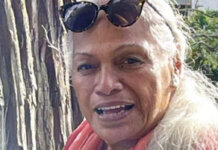
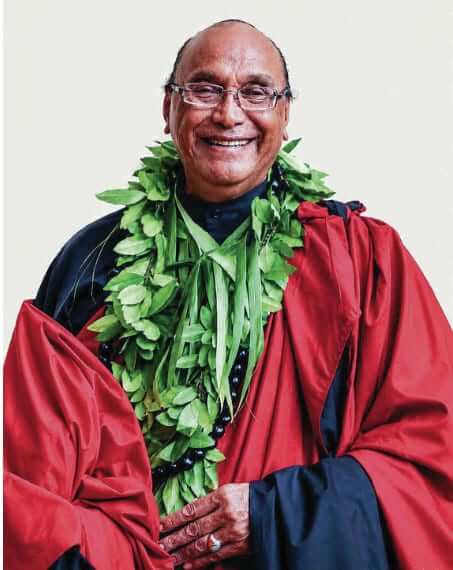
Thomas “Kamaki” Awa Kanahele III: Jan. 14, 1945 – July 27, 2026
“Many people have no use for these young Hawaiian radicals but I count my blessings for them. They’re telling everyone that they are Hawaiians, they love who they are, [they] are intelligent, talented, and will speak up, be heard, and finally be counted.” – Kamaki Kanahele, July 8, 1983
Thomas “Kamaki” Awa Kanahele III was many things: a cultural practitioner, a traditional healer and priest, a kumu hula, a teacher, a businessowner, an administrator, community leader, and a politician. He is remembered by the community, and especially by those who knew and loved him, as a beloved kupuna and visionary who dedicated his life to advocating for and serving our lāhui.
Kanahele was born to a large ʻohana and mostly raised in Nānākuli, Oʻahu, on a Hawaiian homestead. His mother was Agnes Kalanihoʻokaha Cope (Aunty Aggie Cope) who would, in time, become a revered kupuna and community leader on the Waiʻanae Coast. His father, Thomas Kahaku Awa Kanahele, passed away unexpectedly when Kanahele was just 5 years old.
After his father passed, Kanahele was sent to live for a time with his grandparents on Niʻihau. He was trained by his mother and grandmother in both hula and the healing arts including lāʻau lapaʻau, hoʻoponopono, lomilomi and more. He recalled, as a child, practicing his healing lessons on the family dogs saying “they were very good patients because we loved them.”
Kanehele graduated from Waiʻanae High School and went on to BYU Hawaiʻi (then known as Church College) and earned a bachelor’s degree in art and education. From there he went to BYU Provo where he completed a master’s degree in education. After graduating, he taught art history for five years at Olympus High School in Utah. As a teacher, he successfully helped to reduce racial conflicts between Ute and Hispanic teenagers, drawing upon his training as a traditional healer.
While living in Utah, Kanahele also started an import-export business, owned a couple of Hawaiian dance studios, and performed at a Hawaiian restaurant.
Around 1974, he accepted a job in Washington, D.C., as the administrator of education for the National Endowment for the Arts, coordinating and administering federal funding in support of arts education programs. It was an interesting time to be in Washington – although Richard Nixon was still president, it was at the height of the Watergate scandal and soon after Kanahele moved to Washington, Nixon resigned.
Many Washington administrators only last through one presidential term, but Kanahele held his position for 10 years serving under four administrations: Nixon, Ford, Carter and Reagan. In a 1986 Focus Hawaiʻi television interview, Kanahele recalled at the time that, “in the entire federal agency, I was not only the highest-ranking Native Hawaiian, but the highest-ranking Native American.”
It was an exciting job that afforded Kanahele the opportunity to meet famous artists and performers like Helen Hayes and Clint Eastwood. He also met world leaders, including the Shah of Iran, the Dalai Lama, and Mother Teresa.
However, the defunding of the Civil Rights Commission, federal reconsideration of affirmative action, and the appointment of four conservative justices to the Supreme Court during the Reagan administration gave him pause. He noted in the interview that the impact of these developments on him as a Polynesian – and the potential impact on the Hawaiian people – left him “a bit shaken as to what our role is in all of this.”
Kanahele left Washington and returned home to Hawaiʻi in 1985 after being selected as the new administrator for the Office of Hawaiian Affairs (OHA) in a special meeting of the OHA Board of Trustees to replace outgoing administrator T.C. Yim.
At a news conference following his appointment in November 1985, Kanahele said that his most important kuleana would be to ensure that Hawaiians were free to chart their own destiny exclaiming, “Give us an opportunity to decide our fate, not other people.”
Kanahele began his duties at OHA in January 1986 and served in this capacity for three years through February 1989. During his tenure as OHA administrator, Kanahele helped to set the direction for the 6-year-old organization and advance OHA’s work in education, health, economic opportunity, cultural preservation, and the pursuit of resources and revenues owed to Native Hawaiians.
“Kamaki Kanahele belonged to a generation of courageous Hawaiian leaders who helped establish OHA and define its responsibility to our beneficiaries,” said OHA Board Chair Kaialiʻi Kahele. “He understood that OHA could not merely speak about the needs of our people; it had to listen to our communities, protect their interests, and act with courage on their behalf.”
Around the same time, Kanahele became actively involved in the Hawaiian homestead movement. “When homestead leaders from across Hawaiʻi came together in 1987 to form what became the Sovereign Council of Hawaiian Homestead Associations (SCHHA), Kamaki became the first leader elected by homesteaders to serve as its chairman,” Maile Luʻuwai, current vice chair of SCHHA, was quoted as saying in an August 26 Star-Advertiser article.
Kanahele stepped down as OHA administrator in 1989 and the following year he ran for a seat on OHA’s Board of Trustees. He was elected as an at-large trustee and served in this capacity for four years, from 1990-1994.
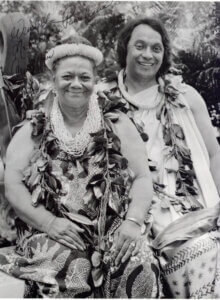
As an OHA trustee, Kanahele chaired the Committee on Education and Culture, bringing community concerns regarding traditional fishing practices and coastal development and access before the board. He also helped establish OHA’s Hawaiian Language Award that is presented at the Merrie Monarch Festival each year.
After leaving public office, Kanahele continued to provide leadership to the Hawaiian Homestead Association and dedicated himself to his Waiʻanae Coast community serving as a traditional healer and kahu. He eventually became chair of the Kūpuna Council of practitioners of Hawaiian healing traditions in West Oʻahu.
In 2009, Kanahele and his mother, Aunty Aggie Cope, established the Dr. Agnes Kalanihoʻokaha Cope Center for Traditional Native Hawaiian Healing where skilled practitioners not only treat patients, but pass their ʻike on to others. The Healing Center is overseen by the Kūpuna Council to ensure that cultural knowledge is practiced – and passed down – correctly.
Located on the grounds of the Waiʻanae Coast Comprehensive Health Center (WCCHC), the placement of the Healing Center is significant; Cope herself helped to found WCCHC in the early 1970s after realizing that many Hawaiians on the Waiʻanae Coast could not afford to visit a hospital when they became sick.
Upon the opening of the new Healing Center in 2009, Kanahele said: “This is the only place in all Hawaiʻi that will be a formal training center for the traditional healing arts. We’re trying to make this the premier reservoir of traditional healing practices by preserving, and healing, and actually implementing these practices.”
Reflecting on Kanahele’s profound contributions to our lāhui throughout his lifetime, Rep. Darius Kila who represents Kanahele’s beloved Nānākuli wrote in a Facebook post, “Uncle Kamaki dedicated his life to preserving Native Hawaiian culture, healing traditions, and advocating for our people. His legacy will continue to live on through the countless lives he touched and the generations he inspired.”
In an interview with Native Voices, Kanahele said that “death and dying is part of the structure in which all know of – and we prepare ourselves from childhood all the way up to the passing to understand that it is an important part of life.”
E moe mālie, e Kamaki Kanahele. Ua hala ʻoe, akā, e mau ana kāu mau hana aloha no ka lāhui.